Sharetribe Project Handover Checklist for Founders

A Sharetribe project is ready for handover when your business can verify the agreed functionality, access the relevant systems, and understand how the implementation will be operated. A working demonstration is useful, but it does not answer every question about deployment, maintenance, or future changes.
This Sharetribe project handover checklist helps founders review the evidence and documentation behind a delivery. It covers source code, account access, testing, integrations, and support arrangements. Use it alongside your agreed scope of work: the deliverables for a small configuration task will differ from those for a customised marketplace application.
1. Confirm What Has Actually Been Delivered

Start with the agreed scope, approved changes, and acceptance criteria. Review each requirement against the delivered implementation, recording whether it is complete, deferred, or still awaiting a decision. This gives both sides a shared record of what is being accepted.
Avoid signing off against broad descriptions such as “booking flow completed” or “CRM integration working.” Identify the actions involved, the conditions under which they should work, and the evidence used to confirm them. If a requirement changed during development, update the acceptance record so it reflects the final agreement.
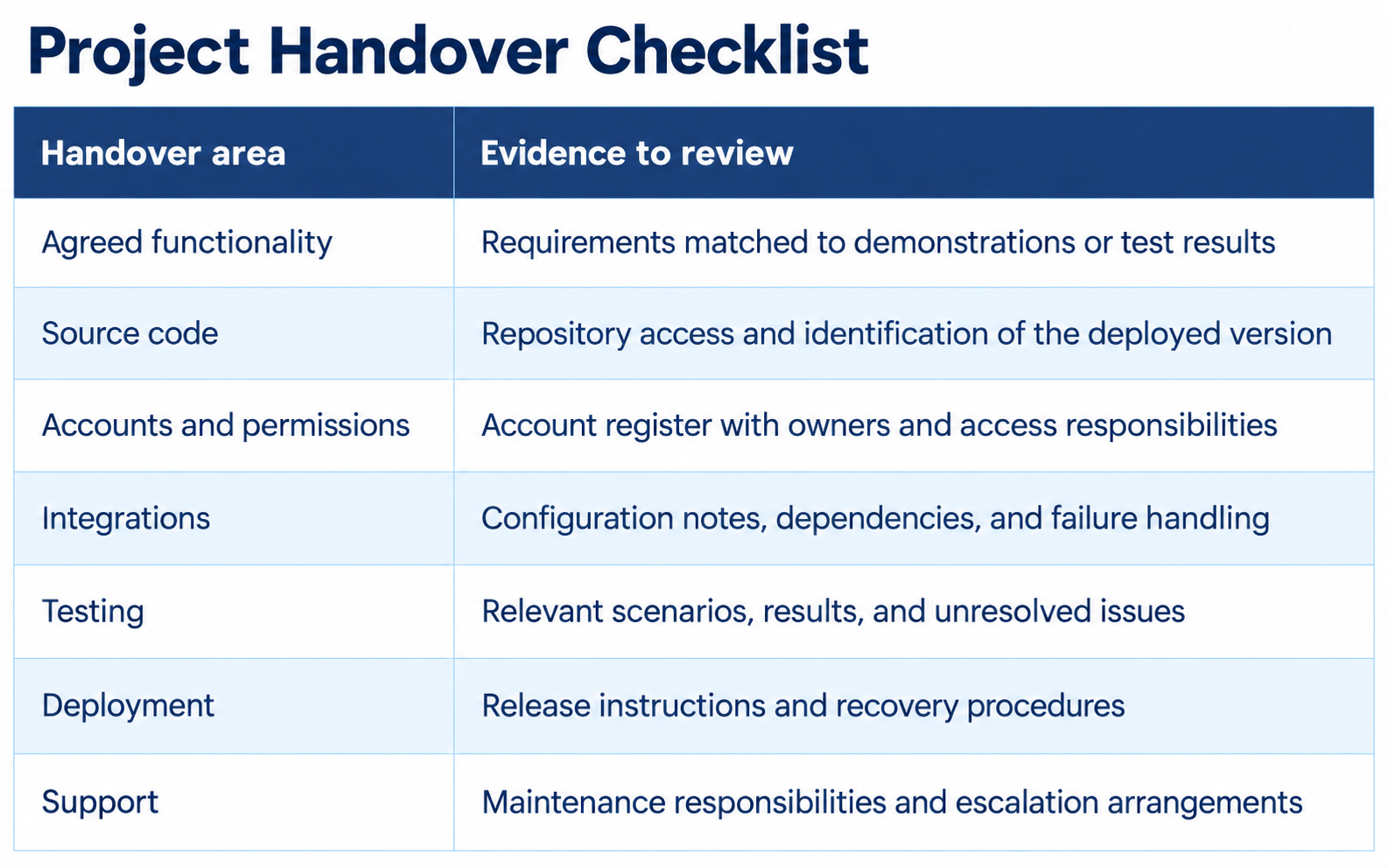
Some items may not apply to your project. A no-code configuration engagement, for example, may not produce a custom application repository. The checklist should describe the work delivered rather than create requirements unrelated to the engagement.
2. Review Source Code, Access, and Usage Rights
For a custom-coded application, confirm where the source code is stored and who can access it. The handover should identify the repository, the branch or release used for production, and the instructions needed to run the application in an appropriate development environment.
Access and ownership are separate questions. Repository access allows someone to inspect or work with code; the contract and applicable licences determine how that code can be used. Clarify the rights attached to custom work, commercial plugins, templates, and other dependencies. Do not assume every component can be transferred or reused under the same conditions.
Ask for a record of the main customisations and any dependencies that affect future work. Another qualified developer should be able to identify where important changes were made and understand the purpose of those changes without relying entirely on a verbal explanation.
If you need help assessing the technical knowledge required for an independent review, our guide to Sharetribe developer skills provides an overview.
3. Document Accounts, Environments, and Deployment

A marketplace can depend on several accounts beyond Sharetribe itself, including application hosting, domain management, payments, email delivery, and external integrations. Create an account register that records the business owner, billing responsibility, authorised users, and recovery arrangements for each relevant service.
Confirm that your business has the agreed level of control and continuity. Where a provider manages a service on your behalf, document how access, data, and configuration would be handled if that arrangement ended. Transfer credentials through an appropriate secure method rather than placing secrets in a shared handover document.
Know Which Environment You Are Reviewing
Sharetribe distinguishes between Test, Dev, and Live environments. Its official introduction to building a marketplace explains their different purposes.
The handover should identify which application connects to which environment and where acceptance testing took place. A demonstration on a development application does not establish that the production configuration has been verified. Confirm the relevant production settings through an agreed release check, without treating live customer transactions as a testing environment.
Understand the Deployment Responsibilities
For a custom-coded frontend, record where the application is hosted, how releases are deployed, and who is authorised to publish changes. Include the deployed version, configuration requirements, and recovery procedure if a release introduces a problem.
Sharetribe developers continue to operate its hosted backend, while a customised frontend introduces separate hosting and maintenance responsibilities. Its guide to custom coding explains this distinction. Your handover should make the responsibilities specific to your implementation clear.
4. Test Complete Journeys and Relevant Exceptions
Acceptance testing should follow the actions customers, providers, and administrators need to complete. Reviewing individual screens can miss problems that appear only when those screens form a complete journey.
Choose scenarios based on the agreed scope and business model. A rental marketplace might require checks around availability, booking, cancellation, and deposit handling. A service marketplace may need a different set of checks around requests, provider responses, and completion. Include exceptions that the implementation is expected to handle.
The following table illustrates how to make a test record assessable.

These are illustrative scenarios, not a universal specification. Ask the team to explain which checks apply, what results were observed, and which issues remain unresolved. A test report supports acceptance of the work reviewed; it does not guarantee that an application is free of defects.
Apply the Checklist to Real Marketplace Features
Journeyhorizon’s published Side By Side Share case study describes a rental marketplace with functionality including identity verification, deposits, location privacy, agreements, and messaging integrations.
That feature set illustrates why acceptance should follow a business journey. A verification screen appearing correctly is only one part of reviewing a verification requirement. A project team would also need to agree what happens when verification is incomplete or unsuccessful and how that outcome affects the user’s next action.
This is an example of applying acceptance criteria to documented functionality. It does not describe unpublished testing results or handover procedures from that project.
5. Check Integration Documentation and Operating Instructions
An integration handover should explain what is connected, what information moves between systems, and what triggers the exchange. Record which system holds the authoritative data, which permissions are required, and any known constraints.
Failure handling deserves its own explanation. If an update does not reach another system, your team needs to know how the issue becomes visible, whether an automatic retry occurs, and who is responsible for investigating it. Document any manual recovery steps that an operator is expected to perform.
Operating instructions should also cover the tasks your team will carry out regularly. Depending on the implementation, these may include reviewing submissions, handling transaction exceptions, updating content, or investigating reported problems. A short walkthrough supported by written instructions can make these responsibilities easier to transfer.
Where integrations and operational rules span several parts of the platform, Journeyhorizon’s custom marketplace development services provide context for discussing a broader implementation assessment.
6. Agree on Support and Record Known Issues
Before closing the project, separate unresolved defects from approved exclusions and future feature requests. Record each item with its impact, current status, and next action. This avoids leaving different interpretations of what remains included.
Confirm how support will work after acceptance. The agreement should identify the contact route, coverage, response expectations, and responsibility for hosting, application maintenance, and third-party services. Distinguish an initial defect-resolution period, if one is agreed, from ongoing maintenance and new development.
For a customised Sharetribe Web Template, clarify how relevant template updates will be reviewed and incorporated. Maintenance should also account for the dependencies and additional services used by your particular implementation.
If another team will take over, arrange a walkthrough of the application, repository, deployment process, and known issues. Our guide on how to hire a Sharetribe developer can help when evaluating a new development partner.
7. Frequently Asked Questions
What should a Sharetribe project handover include?
It should include the deliverables agreed for your engagement, supported by enough evidence and documentation to accept and operate the work. For a custom-coded application, this commonly involves source code access, account responsibilities, deployment instructions, test results, integration notes, and support arrangements.
Does every project need a source code repository?
No. A project limited to no-code configuration may not produce a custom application repository. Where custom code has been developed, confirm how it will be delivered and what access and usage rights apply.
How can a non-technical founder review a handover?
Review the agreed business journeys, account register, operating instructions, and outstanding issues with the delivery team. Ask for demonstrations tied to acceptance criteria. For code quality, security, or architectural questions beyond your expertise, consider an independent technical review.
Does receiving source code mean I own every component?
Not necessarily. Access to a repository does not determine ownership or licensing rights. Review the agreement for custom work and the terms attached to third-party templates, plugins, and dependencies.
Should all issues be resolved before acceptance?
Acceptance depends on the agreed criteria and the impact of any remaining issues. Record unresolved items explicitly and agree on their treatment. Issues that prevent an essential journey from working require a different decision from minor improvements that can be scheduled later.
What if I am changing development providers?
Confirm access to the relevant repositories, accounts, configuration, documentation, and outstanding work before the transition. Review contractual rights and arrange knowledge transfer so the incoming team can assess the implementation before making changes.
8. Conclusion
A Sharetribe project handover should give your business a clear record of what was delivered, how it was checked, and who will keep it running. Review the agreed functionality alongside the code, access arrangements, documentation, and support responsibilities.
Use acceptance criteria to guide the decision and record anything that remains open. You do not need to understand every technical detail, but you should know where the relevant information is held and who can act when something needs attention.
If you need support completing or taking over an implementation, explore Journeyhorizon’s Sharetribe development services. Bring the current scope, available documentation, and unresolved issues to discuss the next practical step.