When to Customize Sharetribe: No-Code vs Custom Code
You can launch and operate a Sharetribe marketplace without commissioning custom development. The decision to add code should follow a clear business requirement: something customers, providers, or your operations team need to do that the available setup cannot adequately support.
Knowing when to customize Sharetribe means distinguishing an important limitation from a feature that would simply be nice to have. A different booking journey, a business-critical integration, or a dedicated mobile application may justify development. An untested assumption about what users want usually needs more investigation first.
This guide provides a practical framework for assessing those requirements, prioritising development, and understanding the responsibilities that come with custom code. Platform capabilities change, so confirm the current configuration options and technical documentation before treating any requirement as a development project.
1. Start by Testing What Sharetribe Already Supports
Before commissioning development, configure the closest workable version of your marketplace and test its main journeys. Follow the provider experience from registration to publishing an offer, then follow the customer experience from finding a listing to completing a transaction. Include the administrative work required to keep those journeys running.
Document gaps as observable problems. “We need better onboarding” leaves too much room for interpretation. “Providers cannot complete registration without contacting our support team to submit additional information” identifies a specific obstacle that can be investigated.
For each gap, check the available Console settings, supported integrations, and operational alternatives. Sharetribe’s official guide to custom coding recommends taking the no-code setup as close as possible to your requirements before extending it with code. This gives your development team a clearer starting point.

Use this table as an assessment framework rather than a fixed list of platform limitations. The implementation depends on your exact requirements and the capabilities available at the time.
2. Recognise the Requirements That May Justify Custom Code
Custom development becomes worth assessing when an unmet requirement affects the marketplace’s core journey or creates a recurring operational problem. The following scenarios illustrate how to define that need; they are not claims that every marketplace requires these features.
A Customer or Provider Journey Needs Different Behaviour
A marketplace may need users to complete steps that the existing configuration cannot support. For example, a service marketplace might require a structured request, clarification from a provider, and customer approval before proceeding. The first task is to establish which parts of that journey already work and where a change is needed.
Map both the main journey and its exceptions. What happens if the provider does not respond, the customer changes the request, or the transaction is cancelled? A feature specification that covers only the successful path can leave significant work undiscovered until development or testing.
Manual Data Transfers Are Becoming an Operational Problem
Copying information between systems can be manageable at an early stage. An integration deserves assessment when repeated transfers introduce delays, errors, or a growing administrative workload.
Define the records involved, the system that holds the authoritative data, and the event that should trigger an update. Include permissions, duplicate handling, and recovery when synchronisation fails. “Connect our CRM” is a starting point for discussion; a clear description of what must happen gives a developer enough information to assess feasibility.
Users Have a Clear Need for a Dedicated Mobile Application
A mobile app should address a demonstrated user need. Investigate which tasks people repeat, where the browser experience creates friction, and what an application would improve. A marketplace that works well in a mobile browser may already provide an adequate experience.
A dedicated application also introduces release management, device testing, and ongoing support. Assess those commitments alongside the proposed benefits before choosing a template-based or fully custom approach.
These scenarios require different technical capabilities. Our guide to Sharetribe developer skills explains the knowledge relevant to evaluating and implementing changes on the platform.
3. Prioritise Customisations Using Evidence
The strongest reason to build a feature is a problem you can demonstrate. Support requests, user interviews, incomplete journeys, and repeated administrative tasks can all provide evidence. Review them together: an abandoned booking alone does not establish why someone left or prove that a proposed feature would have changed the outcome.
For each requirement, record who is affected, how often the issue occurs, and how it is handled today. Compare the proposed development with a simpler alternative, such as clearer instructions, a configuration change, or a temporary manual process. Then define an outcome that can be measured after implementation.
Consider a hypothetical marketplace where providers repeatedly submit incomplete information. Before commissioning a new dashboard, investigate whether the problem comes from unclear instructions, missing validation, or a genuinely unsupported workflow. Each cause suggests a different scope, cost, and maintenance commitment.
A prioritisation record should answer five questions:
- Problem: What task is difficult or impossible to complete?
- Evidence: What observations support the requirement?
- Alternative: Could a simpler change resolve it?
- Outcome: How will you evaluate the result?
- Ownership: Who will operate and maintain the solution?
Where requirements span several journeys or external systems, a custom marketplace development assessment can help clarify dependencies and separate the first release from later improvements.
4. Understand What You Will Need to Operate
The cost of custom code extends beyond its initial implementation. Before approving a build, establish who will host, test, deploy, and maintain the application.
Sharetribe developers continue to operate its hosted backend when you use a custom-coded frontend. The customised frontend requires external hosting and maintenance. Any additional services introduced by the implementation also need clearly assigned responsibilities. For a customised Sharetribe Web Template, relevant template releases must be reviewed and incorporated through a development process rather than assumed to appear automatically.
Agree on access to the repository, hosting accounts, deployment configuration, and credentials. Document the release approval process, monitoring responsibilities, and response to production issues. These arrangements should remain understandable to your business even if the development team changes.
Testing should cover the affected journey and its failure conditions. Depending on the feature, that may include interrupted payments, cancelled transactions, unavailable listings, or an external service failing to respond. Ask for acceptance criteria and test results relevant to your implementation rather than relying on a general assurance that the feature has been tested.
5. Prepare a Brief That Can Be Assessed
A useful feature brief explains the current behaviour, the required change, and the business reason behind it. Screenshots, recordings, or a simple process diagram can help show where the existing journey falls short.
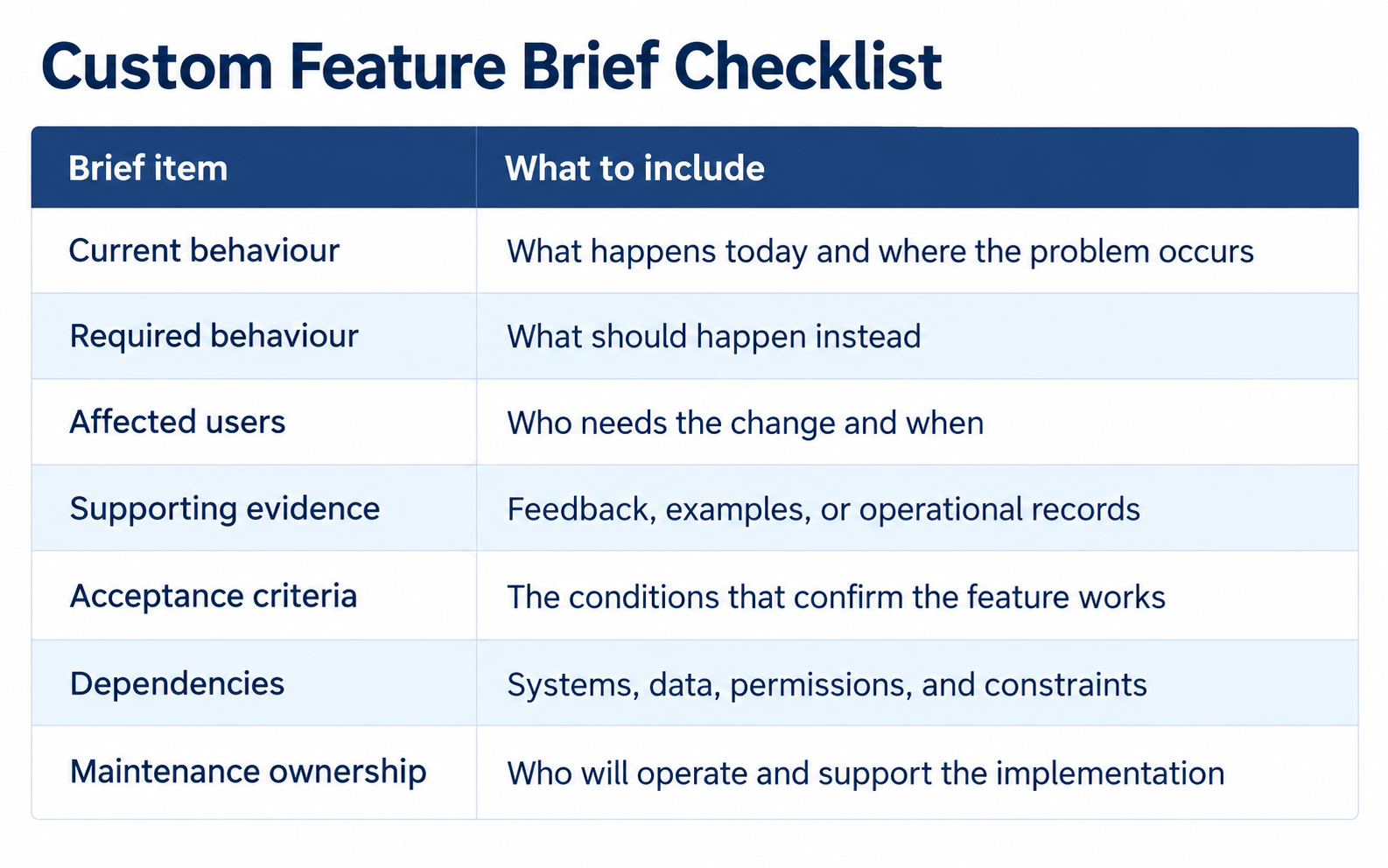
For an integration, for example, the brief could specify that approved provider records must be sent to an operations system, that the marketplace holds the authoritative approval status, and that failed updates must be visible to an administrator. The development team can then investigate API access, technical constraints, and implementation options.
Request a proposal that identifies assumptions, exclusions, dependencies, testing, and ongoing responsibilities. Where feasibility remains uncertain, a discovery task or limited proof of concept may be more appropriate than committing immediately to a full build. Our guide on how to hire a Sharetribe developer covers the next step of evaluating potential development partners.
6. Choose a Focused First Release
You are ready to consider custom code when the requirement is important, the existing options have been assessed, and someone can take responsibility for the resulting implementation. Uncertainty about user demand is a reason to test the idea further before expanding the scope.
Start with a change that can be delivered and evaluated independently where possible. Define acceptance criteria before development, record the relevant starting metrics, and review the outcome after release. Use those findings to decide whether further investment is justified.
Journeyhorizon’s Sharetribe development services support marketplace implementation and customisation. Bring your current setup, the problem you need to solve, and any supporting examples to discuss feasibility, scope, and the next practical step.

7. Frequently Asked Questions
Can I launch a Sharetribe marketplace without custom code?
Yes. You can launch using Sharetribe’s no-code tools if the available configuration supports your core marketplace journey. Test whether providers can publish offers, customers can complete transactions, and your team can manage operations before deciding what needs development.
How do I know when to customize Sharetribe?
Consider custom code when you have identified an important requirement that the current configuration cannot adequately support. Document the problem, check existing options, and assess whether a simpler operational workaround would be sufficient. Repeated customer difficulties or administrative errors provide a stronger basis for development than an untested feature idea.
Do I need to rebuild my marketplace to add custom code?
Not necessarily. Sharetribe’s no-code setup can serve as the starting point for a customised frontend connected to its hosted backend. The amount of development depends on the required changes, your existing implementation, and any external systems involved. A technical assessment should establish what can be retained before a rebuild is proposed.
Who maintains a custom-coded Sharetribe marketplace?
Sharetribe maintains its hosted backend, while your team or development partner maintains the customised frontend and any additional services introduced. Agree on responsibility for hosting, testing, deployments, dependency updates, and production support before development begins. Relevant Web Template updates also need to be reviewed and incorporated into your customised codebase.
How much does Sharetribe customisation cost?
There is no single price that applies to every project. Cost depends on the required behaviour, integration complexity, design changes, testing, and the condition of the existing codebase. Request an estimate that separates initial implementation from recurring hosting, maintenance, and third-party costs, with assumptions and exclusions clearly documented.
Should I build all planned custom features before launching?
Usually, it is more practical to launch with the features needed to complete the core transaction safely and reliably. Validate optional improvements through user feedback and operational evidence. Features essential to your business model may need to be included from the start, but each should have a clear purpose and acceptance criteria.
8. Conclusion
Deciding when to customize Sharetribe starts with understanding where your current marketplace falls short. Test the available configuration, identify the people affected, and establish whether the problem warrants development. A focused requirement supported by evidence is easier to scope, implement, and evaluate than a broad feature wishlist.
Before committing, account for the work that follows launch: hosting, testing, maintenance, and support. Define what success looks like, assign ownership, and use the results of the first release to guide further investment.
If you have a requirement ready for assessment, explore Journeyhorizon’s Sharetribe development services. Bring your current setup and the problem you need to solve to discuss feasibility, scope, and the next practical step.