What Is robots.txt in SEO? A Guide for Marketplace Founders

Every time a search engine crawls your site, it makes decisions about where to go and what to skip. A single plain-text file — the robots.txt file — sits at the root of your domain and quietly shapes every one of those decisions. If you have been asking what is robots.txt in SEO, the short answer is that it is a set of instructions telling crawlers which parts of your site they are allowed to access. For marketplace founders, the longer answer matters more: how you configure this file can directly determine whether your most valuable pages get crawled efficiently or whether Googlebot spends its time wandering through checkout flows and parameter-driven filter pages that should never be indexed.
At Journeyhorizon, we work with marketplace operators who have inherited platforms where robots.txt was set up hastily at launch and never revisited. The result is almost always the same — slow indexing of new listings, poor crawl coverage on high-value category pages, and organic growth that stalls without any obvious explanation. This file is small, but its downstream effects are anything but.
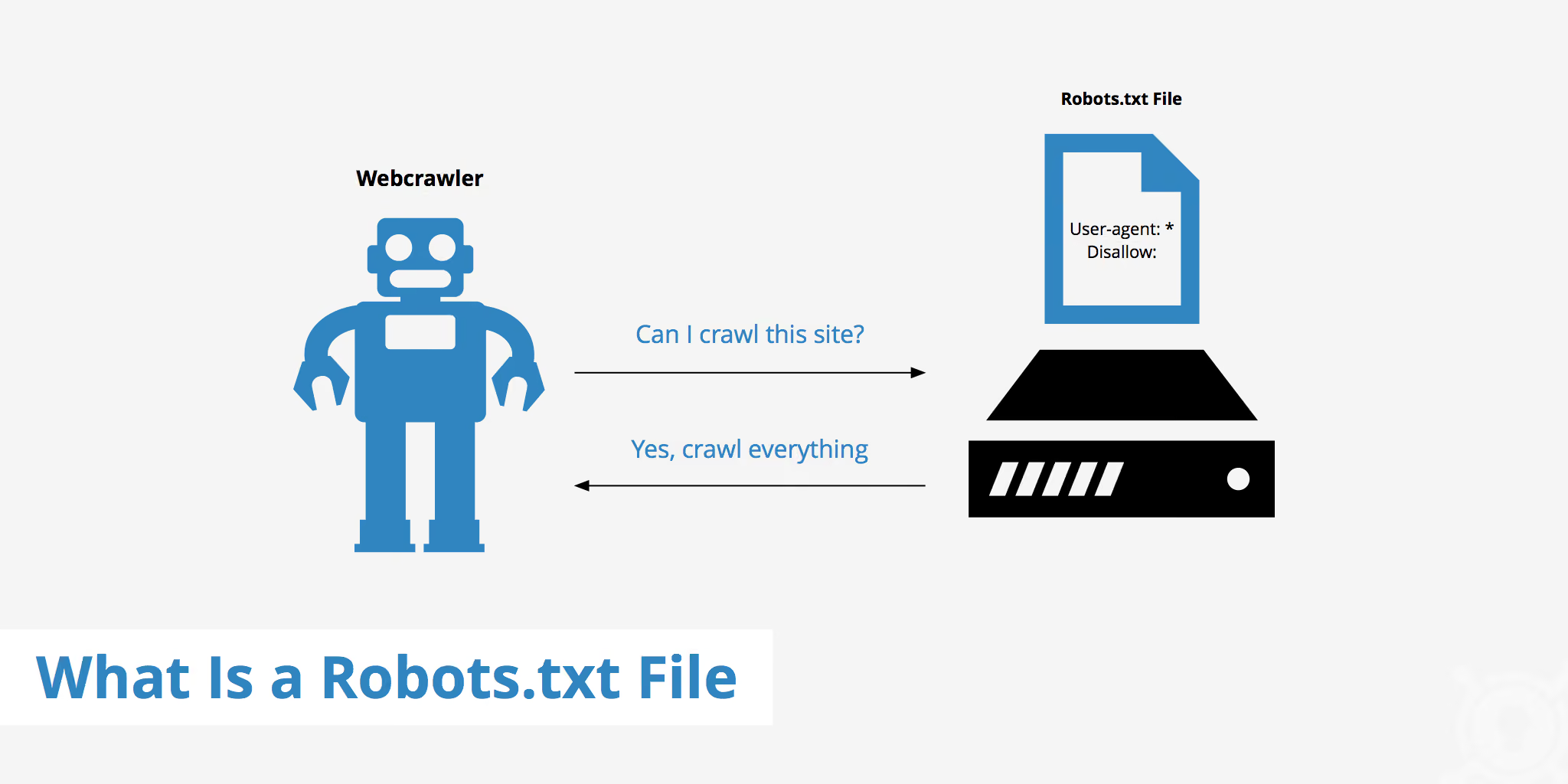
What Is robots.txt in SEO and Why It Matters More on Marketplaces
A robots.txt file is a plain text document placed in the root directory of your website, accessible at yourdomain.com/robots.txt. It uses a simple syntax of directives to tell search engine bots — Googlebot, Bingbot, and others — which pages or directories they should crawl and which they should skip.
One of the most common misconceptions is that disallowing a page in robots.txt removes it from Google's index. It does not. A blocked page can still appear in search results if Google discovers the URL through external links. The robots.txt file controls crawling, not indexing. If your goal is to fully exclude a page from search results, you need a noindex meta tag or server-level access restriction instead. The two tools serve different purposes and are often confused, even by experienced teams.
For marketplaces, the stakes around this distinction are significant. A marketplace generating 50,000 or more URLs — through product listings, seller profiles, filtered category pages, and search result combinations — cannot afford to leave robots.txt management to chance. Without clear rules in place, search engine crawlers will spend budget on URLs that add no indexing value while undercrawling the pages that actually drive revenue.
The Crawl Budget Problem Marketplace Founders Need to Understand

Crawl budget is the number of pages Googlebot will crawl on your site within a given window. Every site has an allocation based on its domain authority and server responsiveness. For large marketplaces, this budget is a real constraint — not a theoretical one.
When Googlebot encounters URLs like /listings?category=shoes&colour=blue&sort=price-low, it treats each variation as a separate page. On a marketplace with extensive filtering, this can produce tens of thousands of near-duplicate URLs. If robots.txt does not block these, the crawler consumes budget on content that will never rank, and your genuine category pages and individual listing pages get crawled less frequently. New listings take longer to appear in search results. Updated pricing or availability information lags. Organic momentum slows.
Technical SEO work for marketplace clients almost always starts with a robots.txt audit. The directories that consistently need attention include internal search result pages, cart and checkout paths, duplicate content created by URL parameter combinations, and any staging or admin sections that were not locked down properly. A well-structured robots.txt for a marketplace typically disallows patterns such as:
One rule that applies without exception: never block your CSS or JavaScript files. Google needs those resources to render your pages correctly. Blocking them causes Google to see a broken version of your site, which directly impacts how pages are evaluated and ranked.
How robots.txt Directives Actually Work
The syntax of a robots.txt file is straightforward. Each entry contains a User-agent line identifying which bot the rule applies to, followed by one or more Disallow or Allow lines.
A wildcard user-agent (*) targets all crawlers. Googlebot can be targeted specifically. The Google Search Central documentation covers the full specification in detail, but in practice the directives marketplace operators use most frequently are:
Including your sitemap URL in robots.txt is good practice even if you have already submitted it through Google Search Console. It means any crawler — not just Googlebot — can find your most important content efficiently from the moment they visit your site. For a marketplace, submitting separate sitemaps for listings, categories, and static pages gives you granular control over what gets prioritised.
robots.txt in the Age of AI Search
As AI-powered search tools become more prominent, a new category of crawler is visiting sites — not to serve traditional search results, but to collect training data for large language models. GPTBot (OpenAI), ClaudeBot (Anthropic), and similar crawlers operate on their own user-agent strings and are increasingly active across the web.
For marketplace founders, this raises a practical question: do you want your listings, pricing data, and seller content feeding into AI model training? The robots.txt file is currently the most accessible mechanism for managing this. You can selectively block or allow individual AI crawlers the same way you would any other bot. Well-behaved AI crawlers respect these directives, though the protocol remains voluntary rather than legally enforceable.
The trade-off is worth thinking through carefully. Allowing AI crawlers may increase your marketplace's visibility in AI-generated answers and recommendations. Blocking them gives you tighter control over proprietary content — particularly relevant if your marketplace has exclusive inventory data or unique review content that represents a competitive advantage. There is no universal right answer; it depends on your commercial model and how you think about content ownership.
Working with a Marketplace Developer who understands both the technical SEO layer and the commercial implications of these decisions helps you make the right call rather than defaulting to whatever template was installed at launch.
Getting robots.txt Right From the Start
If you are building a marketplace or about to migrate to a new platform, robots.txt is not a set-and-forget file. It should be reviewed whenever you add new URL structures, change your filtering logic, or launch on a new domain. A misconfigured robots.txt is one of the most common — and most avoidable — causes of sudden organic ranking drops following a site migration.
Teams that treat technical SEO as a core part of their development process build robots.txt review into every deployment cycle. The file itself is small. The downstream consequences of getting it wrong at scale are not.
What is robot txt in SEO, at its core, comes down to this: it is your ability to guide how search engines spend their crawl budget on your site. For a marketplace with thousands of dynamic URLs, that control is not optional — it is a foundational part of your organic growth strategy. Journeyhorizon helps marketplace founders build and audit the technical infrastructure that supports long-term search performance, including robots.txt configuration, crawl budget management, and the content architecture that allows large platforms to scale without losing organic visibility.
Frequently Asked Questions
What is robot txt in SEO and does every site need one?
A robots.txt file tells search engine crawlers which parts of your site they can access and which to skip. Not every site strictly needs one, but for marketplaces with large volumes of dynamic URLs — filtered pages, user accounts, parameter-driven search results — a well-configured robots.txt is essential for managing crawl efficiency and protecting your organic performance.
Does robots.txt prevent a page from appearing in Google search results?
No. Disallowing a page in robots.txt stops Googlebot from crawling it, but Google can still index and display the URL if it discovers the page through external links. To fully exclude a page from search results, you need a noindex directive or password protection instead.
How often should a marketplace review its robots.txt file?
Any time your site structure changes — new URL patterns, updated filtering logic, platform migrations, or new subdirectories — your robots.txt file should be reviewed. For active marketplaces, building this into regular development reviews rather than treating it as a one-time setup is the practical approach.
Can robots.txt block AI crawlers from accessing marketplace content?
Yes, to a point. Well-behaved AI crawlers respect robots.txt directives, and you can block specific bots by their user-agent strings. The protocol is voluntary, not enforced, so it is a deterrent rather than a guarantee for crawlers that choose to ignore it.