B2B content strategy for firms: A practical framework for sustainable growth

Many B2B firms invest in content as part of their broader B2B marketing efforts, yet struggle to see clear business results due to the lack of a structured B2B Content Strategy for Firms.
This article explains what a B2B content strategy means in a firm context, how it differs from traditional B2B Content Marketing, and how firms can build a practical framework that supports authority, demand capture, and long-term growth.
Journeyhorizon works with B2B firms to design content strategies that connect expertise, SEO, and sales. Our focus is on turning content into a strategic growth asset rather than a standalone marketing activity.
1. What is a B2B content strategy for firms?
A B2B Content Strategy for Firms is a long-term, structured approach that defines how a firm uses content to support business growth. It focuses on building authority, attracting qualified demand, guiding complex buying decisions, and contributing to sustainable revenue over time.
In this context, “firms” refers to consulting firms, professional services providers, B2B service businesses, and B2B marketplaces where trust, expertise, and multi-stakeholder decision-making are central to success. For these organizations, content plays a strategic role beyond marketing execution.
A B2B content strategy for firms clearly defines:
- The ideal clients the firm serves
- The core problems the firm is uniquely positioned to solve
- How content supports buyers throughout a long buying journey
- How content aligns with sales and business objectives
This is different from B2B Content Marketing, which focuses primarily on producing and distributing content. A content strategy explains why content exists, who it serves, and how it drives measurable business outcomes.
Explore how content and SEO drive long-term B2B growth in practice: B2B Marketing Strategies 2026: How to rank in AI overview & raise business conversion.

2. Why B2B content marketing alone is not enough for firms
B2B firms operate in an environment that basic content marketing cannot fully support. Sales cycles are long, buying decisions involve multiple stakeholders, and buyers conduct extensive research before engaging with sales. In this context, trust, credibility, and demonstrated expertise play a decisive role.
As a result, content must do more than attract attention. It needs to educate buyers, address risk and uncertainty, and guide decision-making over time. Content that focuses only on visibility or engagement rarely influences revenue.
Common reasons B2B content marketing fails to drive pipeline for firms include:
- Content topics that are too broad and not aligned with buyer intent
- Limited focus on decision-stage questions that influence purchasing
- A disconnect between marketing content and sales conversations
- SEO treated as a tactical add-on rather than a strategic growth input
- Success measured by traffic instead of pipeline and revenue impact
Without a clear B2B Content Strategy for Firms, content marketing efforts remain fragmented and rarely compound into sustainable business growth.
3. How a B2B content strategy drives firm-level growth
A well-executed B2B Content Strategy for Firms functions as a firm-level growth system by delivering impact across multiple dimensions:
- Builds authority and trust
Consistent, high-quality content demonstrates expertise, reduces perceived risk, and builds buyer confidence. Over time, this authority compounds and differentiates the firm in competitive markets. - Supports demand generation and demand capture
Educational and thought leadership content creates awareness and credibility, while SEO-driven content captures high-intent buyers actively searching for solutions. - Aligns marketing and sales efforts
Strategically designed content supports real sales conversations by addressing objections, explaining complex concepts, and reinforcing credibility throughout the buying process. - Strengthens long-term brand positioning
Rather than reacting to short-term trends, firms use content to shape how the market understands their value, expertise, and point of view.
4. Core components of an effective B2B content strategy for firms
4.1. Brand positioning and ideal client definition
Every effective B2B Content Strategy for Firms begins with clarity. Firms must clearly define who they serve and who they do not. Without this focus, content becomes generic and fails to resonate with decision-makers.
Strong market positioning ensures that content speaks directly to the challenges, priorities, and context of the ideal client, rather than trying to appeal to a broad audience.
4.2. Buyer-centric content mapping
A B2B Content Strategy for Firms must be buyer-centric. This means mapping content to real buyer problems and decision stages instead of organizing content around internal services or offerings.
Effective content reflects how buyers research, evaluate options, and make decisions throughout a long and complex buying journey.
Read more about B2B buyer journey mapping.
4.3. Content architecture and topic structure
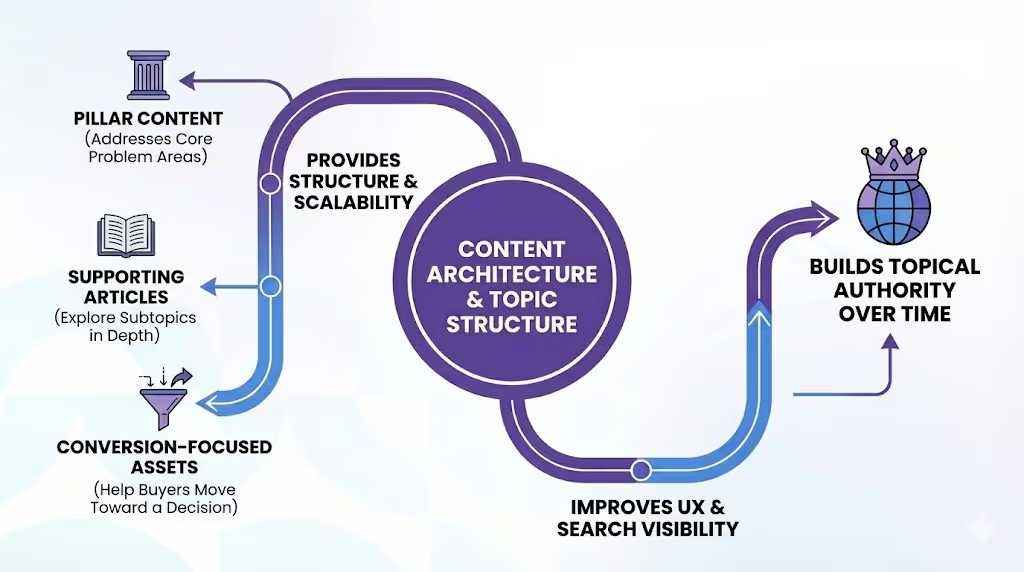
Content architecture provides structure and scalability. This typically includes pillar content that addresses core problem areas, supporting articles that explore subtopics in depth, and conversion-focused assets that help buyers move toward a decision.
A clear topic structure improves both user experience and search visibility, helping firms build topical authority over time.
4.4. SEO as a demand capture mechanism
SEO plays a central role in a B2B content strategy. For firms, SEO is not about chasing high-volume keywords. It is about capturing high-intent searches from buyers who are actively seeking solutions to specific problems.
Integrating SEO early in content planning ensures that content aligns with real demand and delivers long-term value.
4.5. Content and sales alignment
Content must support sales, not exist in isolation. Effective firms ensure that content can be used by sales teams to educate prospects, address objections, and reinforce trust throughout the buying process.
When content and sales are aligned, content becomes a practical tool for driving pipeline, not just a marketing asset.
5. B2B content strategy for firms template
While the core components define what makes an effective strategy, a practical B2B content strategy for firms template translates these principles into a usable structure. A practical B2B Content Strategy for Firms template should include the following core elements:
- Business and growth objectives
Clear goals that define how content contributes to pipeline growth, revenue impact, and long-term business outcomes. - Ideal client profiles
A precise definition of the target clients the firm is best positioned to serve, including their needs, constraints, and decision-making context. - Core buyer problem areas and topic focus
A focused set of problem areas and themes that reflect real buyer intent and guide content creation. - Content priorities and formats
Clear decisions on which content types to produce and how they map to different stages of the buyer journey. - SEO and keyword strategy
An integrated SEO approach that validates demand, structures topics, and supports long-term search visibility. - Distribution channels and ownership
Defined channels for content distribution, along with clear ownership and responsibilities across teams. - Success metrics tied to revenue
Performance indicators that measure pipeline influence, lead quality, and revenue impact rather than traffic alone.
6. How to create a B2B content strategy for firms step by step
- Step 1: Define firm-level growth and revenue objectives
Clarify what business outcomes the content strategy must support, such as pipeline growth, qualified inbound demand, improved conversion rates, or shorter sales cycles. - Step 2: Identify high-intent buyer problems and questions
Focus on the problems buyers actively research and the questions that influence purchasing decisions, especially in the consideration and decision stages. - Step 3: Build a strategic content roadmap
Prioritize topics based on business impact and buyer intent, not on publishing volume. Define what to publish first and why. - Step 4: Select content formats that match buying behavior
Align formats to the buyer journey, such as educational guides for early-stage research, comparison content for evaluation, and proof-driven assets for decision-stage confidence. - Step 5: Integrate SEO into content planning
Use SEO to validate demand, refine topic scope, and structure content for search visibility and topical authority. Do this before writing, not after publishing. - Step 6: Connect content distribution with sales efforts
Ensure content reaches the right buyers through the right channels, and equip sales teams to use content in real conversations to address objections and build trust. - Step 7: Establish performance metrics beyond traffic
Track impact indicators such as pipeline influence, lead quality, conversion rate by content type, and deal velocity, not just sessions or engagement.
By following these steps, firms can move from ad-hoc content creation to a structured B2B content strategy that builds authority, captures demand, and supports sales throughout the entire buying journey.
7. Content types that work best in a B2B content strategy
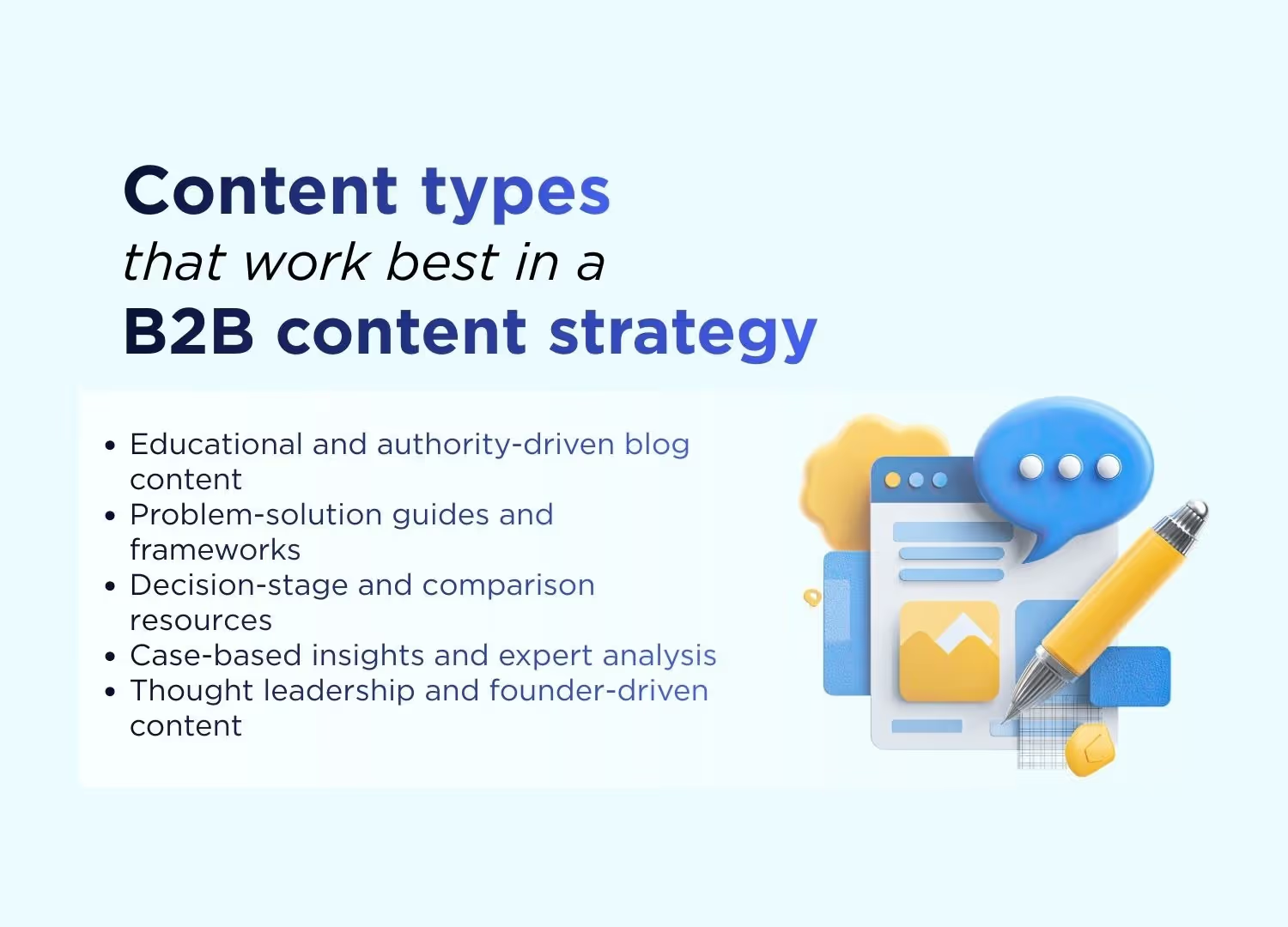
An effective B2B Content Strategy for Firms relies on a deliberate mix of content types, each designed to support a specific stage of the buyer journey and a specific business objective:
- Educational and authority-driven blog content
Helps buyers understand complex problems, builds topical authority, and establishes the firm as a credible expert early in the buying process. - Problem-solution guides and frameworks
Provides structured explanations that help buyers frame their challenges and evaluate potential approaches, increasing trust and engagement. - Decision-stage and comparison resources
Supports buyers during evaluation by addressing alternatives, trade-offs, and selection criteria that influence purchasing decisions. - Case-based insights and expert analysis
Demonstrates real-world experience and applied expertise, reducing perceived risk and reinforcing credibility. - Thought leadership and founder-driven content
Communicates the firm’s perspective, values, and market understanding, strengthening brand positioning and long-term differentiation.
Each content type plays a distinct role in guiding buyers from early awareness to confident decision-making, ensuring content contributes directly to firm-level growth.
8. Common mistakes firms make with B2B content strategy
Many firms struggle to see results from content because they approach strategy in ways that limit long-term impact. Common mistakes include:
- Prioritizing content volume over relevance
Publishing frequently without a clear focus on buyer intent often leads to content that attracts attention but fails to influence decisions. - Treating content as a short-term campaign
Content is managed as a series of isolated initiatives rather than a long-term growth asset that compounds over time. - Disconnecting content from sales and business goals
Content is created independently of sales conversations, reducing its ability to support pipeline development and revenue growth. - Copying SaaS content approaches without adaptation
Firm-based business models require different content priorities than SaaS. Applying the same playbooks often results in misaligned messaging and weak outcomes.
Avoiding these mistakes is essential for building a B2B Content Strategy for Firms that delivers sustainable growth and measurable business impact.
9. Journeyhorizon - A specialized partner for B2B content strategy for firms
Journeyhorizon is a strategic SEO and content growth partner for B2B firms, helping organizations build authority-driven content strategies that attract qualified demand and support long-term revenue growth.
We work with founders and leadership teams to design and execute B2B Content Strategy for Firms that aligns content, SEO, and sales across complex buying journeys.
Journeyhorizon provides the following services related to B2B content strategy:
- B2B content strategy and planning
Defining firm-level content frameworks aligned with business goals, buyer intent, and long-term positioning. - SEO-driven content architecture
Building pillar and cluster structures that support topical authority and high-intent demand capture. - Content creation and optimization
Developing educational, decision-stage, and authority-driven content designed for B2B buyers. - SEO audit and optimization for content performance
Ensuring content is discoverable, relevant, and aligned with real search demand. - Content and sales alignment support
Helping firms connect content strategy with sales conversations and pipeline outcomes.
Explore B2B Marketing services or our full range of Marketing services.
If you are looking to build a B2B Content Strategy for Firms that delivers measurable business impact rather than surface-level visibility, Journeyhorizon can help you design a strategy that supports sustainable growth.
Looking for specialized support? Discover how a B2B tech marketing agency drives growth for technology firms and how a B2B digital marketing agency can help you align content, SEO, and demand generation for measurable business impact.
10. Conclusion
Content creates real impact for B2B firms only when it is guided by a clear strategy. A strong B2B Content Strategy for Firms turns content from isolated activities into a growth system that builds authority, captures demand, and supports complex buying decisions.
Firms that align content with buyer intent, SEO, and sales objectives gain a long-term advantage over those treating content as a tactical channel.
If you are ready to make content a measurable growth asset, Journeyhorizon can help.
Contact us to build a B2B content strategy that drives qualified demand and sustainable growth.
11. FAQs
1. What is a B2B content strategy for firms?
A B2B Content Strategy for Firms is a long-term plan that defines how a firm uses content to build authority, attract qualified demand, support complex buying decisions, and drive sustainable revenue growth.
2. How is a B2B content strategy different from b2b content marketing?
B2B Content Marketing focuses on creating and distributing content, while a B2B content strategy for firms defines why the content exists, who it serves, and how it supports business and sales objectives.
3. How long does it take for a B2B content strategy to deliver results?
Most B2B firms begin to see meaningful impact within three to six months, with stronger authority, SEO visibility, and pipeline influence compounding over time.
4. What types of content work best for B2B firms?
Educational content, problem-solution guides, decision-stage resources, case-based insights, and thought leadership content are the most effective for supporting long B2B buying journeys.
5. Do B2B firms need SEO as part of their content strategy?
Yes. SEO is essential for capturing high-intent demand and ensuring content reaches buyers who are actively searching for solutions, making it a core component of any effective B2B content strategy for firms.

.avif)
