Custom App Developers: Build Software That Fits Your Business
.avif)
Most growing businesses reach a breaking point where the tools they depend on—Trello, Airtable, Notion, Google Sheets, assorted CRM platforms, payment systems, and analytics dashboards—no longer fit how the company actually operates. Each tool solves one problem but creates new ones. Data lives in silos. Processes require manual workarounds. Teams waste time moving information between disconnected systems. The subscription costs keep climbing. And despite having dozens of tools, something critical is always missing.
This is where Journeyhorizon and the broader category of custom app developers enter the picture. A custom app developer is not simply a coder who builds features. It's a technical partner who understands that software should adapt to how your business works, not force your business to adapt to rigid, one-size-fits-all software. This is particularly valuable for businesses with specific workflows, operational complexity, and teams large enough that tool sprawl becomes genuinely expensive.
US businesses comparing custom app development companies in the USA should look beyond technical skills and assess product experience, delivery speed, communication, integrations, and post-launch support.
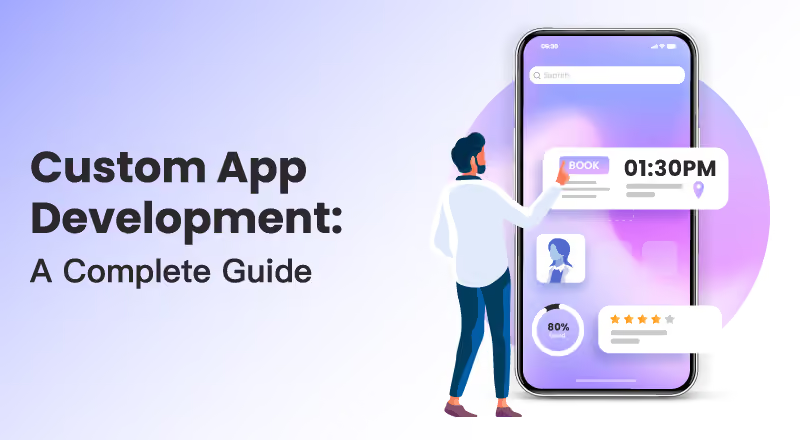
Why Businesses Turn to Custom App Developers
The appeal of off-the-shelf software is obvious. It works immediately. It's familiar. It's lower-risk than building something custom. But that appeal fades quickly as a business grows and its needs become more specific.
Many growing companies face the same frustration: their workflow is unique, but their tools are generic. A marketplace operator might need vendor management, booking workflows, and customer operations integrated into one system—but existing tools force them to stitch together disconnected pieces. An agency managing client projects across multiple departments might need approval workflows, resource allocation, and real-time reporting—features no single SaaS product offers. A team managing inventory, orders, and customer data might spend hours each week manually syncing information across three different platforms.
The cost dimension matters too. A team of fifteen people might pay $150 per month for software A, $200 for software B, $100 for software C, and then discover they need software D because none of the first three tools integrate properly. Annual spend climbs to $10,000 or more for tools that still don't fully address the business's actual needs. This is the moment when custom app development become strategically important—not because they're cheaper in the short term, but because they offer a path to sustainable operational control and long-term cost efficiency.
=>>> Read More: Outsourcing vs In-House App Development: Which Fits Your Marketplace
What Separates Custom App Developers from Generic Development
Not all developers are custom app developers in the strategic sense. The distinction lies in understanding business workflows, operational constraints, and how software becomes embedded in how teams actually work.
A true custom app developer asks different questions. Instead of "what technology should we use?" they ask "what problem does your team face every day?" Instead of building features in isolation, they design software around real workflows. Instead of assuming the client will adapt, they build software that adapts to the client.
This approach delivers real advantages. Custom software built around your actual business processes is faster to use because it matches how your team thinks. It's more secure because it's designed for your specific data and compliance requirements, not a global audience. It's more scalable because it grows with your business instead of hitting hard limits at arbitrary user counts or transaction volumes. And it's more cost-effective long-term because you avoid recurring licensing fees for features you don't use, overlapping functionality across tools, and the hidden productivity costs of manual workarounds.
For marketplace operators, this advantage is especially pronounced. A custom app developer who understands both software development and marketplace operations can build vendor dashboards, booking systems, payment workflows, and analytics that feel native to the business. The system knows about your commission structure, your vendor approval process, your customer churn patterns, and your seasonal demands. That level of integration is virtually impossible with off-the-shelf tools.
Common Scenarios Where Custom App Developers Create Measurable Value
Understanding whether a custom app is the right choice requires honesty about the specific business problem. Here are the scenarios where custom app development typically delivers clear ROI.
Replacing expensive SaaS tools with tailored software. A team managing customer onboarding, project workflows, and vendor coordination might use four different platforms at $150 to $300 per month each. The total cost is real, but the bigger problem is that none of the tools talk to each other. A custom internal tool that consolidates all three workflows can be built in weeks and eliminate tool sprawl entirely. The Chimedeck case study is instructive here: a custom task management system replaced Trello and saved over $10,000 annually while delivering workflows specific to the client's business model.
Building internal tools that automate repetitive work. Many growing teams rely on spreadsheets, manual data entry, and email-based approval processes because no SaaS tool quite fits. A custom internal dashboard might pull data from your CRM, aggregate it with customer behaviour from your analytics platform, and surface actionable insights in real time. An approval workflow system might automatically route requests based on spend levels, urgency, and department. These kinds of tools eliminate busywork and let teams focus on higher-value work.
Building operational systems for marketplaces and ecommerce businesses. A marketplace needs vendor dashboards, booking systems, commission tracking, analytics, and integration with payment processors. Building this piecemeal with off-the-shelf tools is expensive and fragile. A custom operational system designed specifically for marketplace dynamics—understanding vendor tiers, commission structures, booking rules, and customer workflows—becomes a competitive advantage. It also becomes easier to evolve as the marketplace grows.
Centralising data and improving visibility across departments. A growing company might have customer data in the CRM, transaction data in accounting software, support data in a ticketing system, and operational data in project management tools. No single view of the business exists. A custom data platform or dashboard that brings all this together dramatically improves decision-making and lets teams spot problems before they escalate. This is especially valuable for CEOs and operators who need to understand what's actually happening across the business.
=>>> Related Post: Custom Mobile App Development for Startups | Journeyhorizon
Building vs. Buying: When Custom Development Makes Financial Sense
The biggest objection to custom development is cost. Building something custom requires upfront investment, while buying a SaaS tool can feel cheaper and faster.
This objection is reasonable but incomplete. The calculation should be longer-term. A SaaS tool that costs $200 per month seems cheap until you multiply by the number of users, the number of similar tools you're paying for, and the recurring nature of the expense. Over five years, a $200/month tool costs $12,000. Add four more tools and you're at $60,000 in recurring software expenses, and you still haven't solved the integration problem or the workflows that don't quite fit.
Custom development usually requires higher upfront investment—weeks or months of development, testing, and refinement. But the ongoing cost is typically lower. After launch, the main costs are maintenance, monitoring, and occasional updates. This is why custom development often makes sense for businesses that will use the system for years, have complex or specific workflows, or are paying substantial amounts for multiple tools that don't integrate well.
The decision rule is practical: if your software needs are generic, standard tools are usually the faster and cheaper option. If your needs are specific, if your workflow is unusual, if you're paying for multiple overlapping tools, or if you need tight integration with your marketplace or operations, custom development becomes the more strategic choice.
TurtleCI is a good example of this trade-off. For teams with complex deployment pipelines, a custom CI/CD platform tailored to their specific workflow can be more efficient and cost-effective than trying to bend a generic tool to fit. The system understands the team's build process, their testing requirements, their deployment strategy, and their performance targets. The result is faster deployments, lower infrastructure costs, and better visibility into the build pipeline.
How to Work with Custom App Developers: The Realistic Process

Effective custom development requires a partnership approach. The developer isn't just a vendor executing specifications—they're a strategic partner who helps you think through the problem clearly before writing code.
Discovery and requirements. The process starts with listening. A good custom app developer will ask questions about your business model, your current pain points, your team structure, your growth plans, and the specific workflows that matter. They'll want to understand not just what you do, but why you do it that way. This discovery phase usually takes weeks and involves multiple stakeholders.
Design and planning. Based on discovery, the developer creates a plan that includes wireframes, architecture decisions, technology choices, timeline, and cost estimates. This is the moment to pressure-test the plan and make sure it actually solves your problem. The worst time to discover misalignment is after six months of development.
Development in phases. Good custom development happens in phases, not as one big-bang delivery. Early phases deliver core features and core workflows. Later phases add refinement, integration, and scaling. This phased approach lets you see progress, adjust course if needed, and validate that the solution actually works before investing in full completion.
Integration and scaling. Once the core system works, the focus shifts to integration with your existing tools (CRM, payment processors, analytics platforms, accounting software), scaling to handle real-world load, and hardening security. This is where the system becomes truly valuable—when it connects with everything else and becomes the central source of truth for your operations.
Ongoing support. Custom applications aren't "done" at launch. They require monitoring, occasional updates, security patches, and feature improvements as your business evolves. A good custom app developer provides long-term support and continues to improve the system based on real-world usage.
Building Software That Connects Your Entire Growth System
For many businesses, custom app development is only one part of a larger growth and operations system. A custom internal tool might need to connect with a marketplace platform, a customer-facing application, a CRM, payment infrastructure, and content-driven growth through SEO. This is where Journeyhorizon's broader experience across custom app development, marketplace development, integrations, workflow automation, and growth-focused SEO services becomes valuable. The goal is not to build software in isolation, but to create a system that supports how the business actually operates and grows. Journeyhorizon is not only a development team that builds features. It helps businesses design software systems around real workflows, cost constraints, long-term scalability, and measurable business value. This integrated approach means your custom app doesn't exist as a standalone system—it becomes the backbone of your operations, marketplace, and customer experience.
Making the Decision: Is Custom App Development Right for Your Business?
The choice to invest in custom development is a strategic decision, not just a technical one. It's a bet that the business has specific enough needs, will use the system long enough, and benefits enough from operational efficiency to justify the upfront investment.
Ask yourself these questions: Are you paying for multiple tools that don't integrate? Are your teams using manual workarounds because off-the-shelf software doesn't quite fit? Is your marketplace or ecommerce operation limited by generic platform constraints? Are subscription costs growing faster than your ability to manage them? Do you have data scattered across systems with no unified view? Are you building custom integrations because standard tools don't connect? If you answered yes to more than one of these, custom app development is probably worth exploring seriously.
The risk of custom development is real—poorly executed projects can be slow, expensive, and deliver systems that don't actually solve the problem. That's why partner selection matters enormously. The right custom app developer will listen more than they talk, ask hard questions about your actual needs, and build incrementally so you can course-correct along the way.
Frequently Asked Questions
How long does it take to build a custom app?
Timeline varies significantly based on complexity. A simple internal tool might take 4–8 weeks. A mid-complexity system with multiple integrations might take 3–6 months. Large-scale platforms with significant technical complexity might take 6 months to a year or more. The key is building in phases so you see progress and can validate the direction early.
Can custom development ever be cheaper than SaaS tools?
Yes, but not immediately. Custom development usually requires higher upfront cost. However, over a 3–5 year horizon, the total cost of ownership is often lower because you avoid recurring licensing fees, expensive add-ons, and productivity losses from tool sprawl. The math becomes compelling when you're paying for multiple tools or when the tool doesn't quite fit your workflows.
What if my business changes? Won't a custom app become outdated?
A well-built custom app is actually more flexible than off-the-shelf software because it's designed around your business, not around what the vendor thinks all businesses need. If your business changes, the app can evolve with you. The key is choosing a development partner who provides ongoing support and stays engaged with your business as it grows.
How do I know if a custom app developer is the right partner?
Look for a team that listens as much as they talk, understands your industry, has relevant experience, provides clear communication and transparency, can show a solid portfolio of work, and commits to ongoing support. Avoid partners who jump straight to technology discussions or make promises about delivery timelines before fully understanding your problem. The right partner will invest time in understanding your business first.