Flutter Developer Hourly Rate 2026: What Marketplace Founders Should Know
If you're planning a Flutter app, the Flutter developer hourly rate is usually one of the first numbers you'll compare. Rates can range from roughly $18 to $100+ per hour, but that number alone tells you very little about what kind of product you'll actually get.
A developer charging $30 per hour and one charging $75 per hour may both be capable of building a functional app, but their delivery speed, architecture decisions, problem-solving ability and experience with production applications can be very different. Understanding what drives the Flutter developer hourly rate helps you budget more accurately and avoid making a hiring decision based on price alone.
For businesses that would rather work with a full development team than hire individual developers, Flutter application development services can cover architecture, UI/UX, development, integrations, testing and deployment under one delivery model.
Why Flutter Matters for Marketplace Mobile Apps
Flutter has become the default choice for marketplace founders building cross-platform mobile experiences. A single codebase runs on iOS and Android, which means you get to market faster and spend less on maintenance than native development would cost. This efficiency is a major reason marketplace platforms — from service marketplaces to rental platforms to creator economies — have adopted Flutter over the past few years.
The catch is that efficiency on paper doesn't guarantee business results. A cheap Flutter developer who builds slowly or creates technical debt is actually more expensive than a more senior developer who ships features that work and scale. When you're evaluating the Flutter developer hourly rate you'll pay, you're also implicitly deciding whether you're prioritising speed, quality, or cost. Most marketplace founders would benefit from understanding which trade-off they're actually making.
Unlike web platforms that can be patched and updated on the fly, mobile apps require app store review cycles, user adoption delays, and careful management of breaking changes. This means mistakes are more costly. For marketplaces especially, where user experience directly affects supply and demand dynamics, a poorly designed mobile experience can kill growth regardless of how cheap it was to build.
Understanding the Flutter Developer Hourly Rate Breakdown
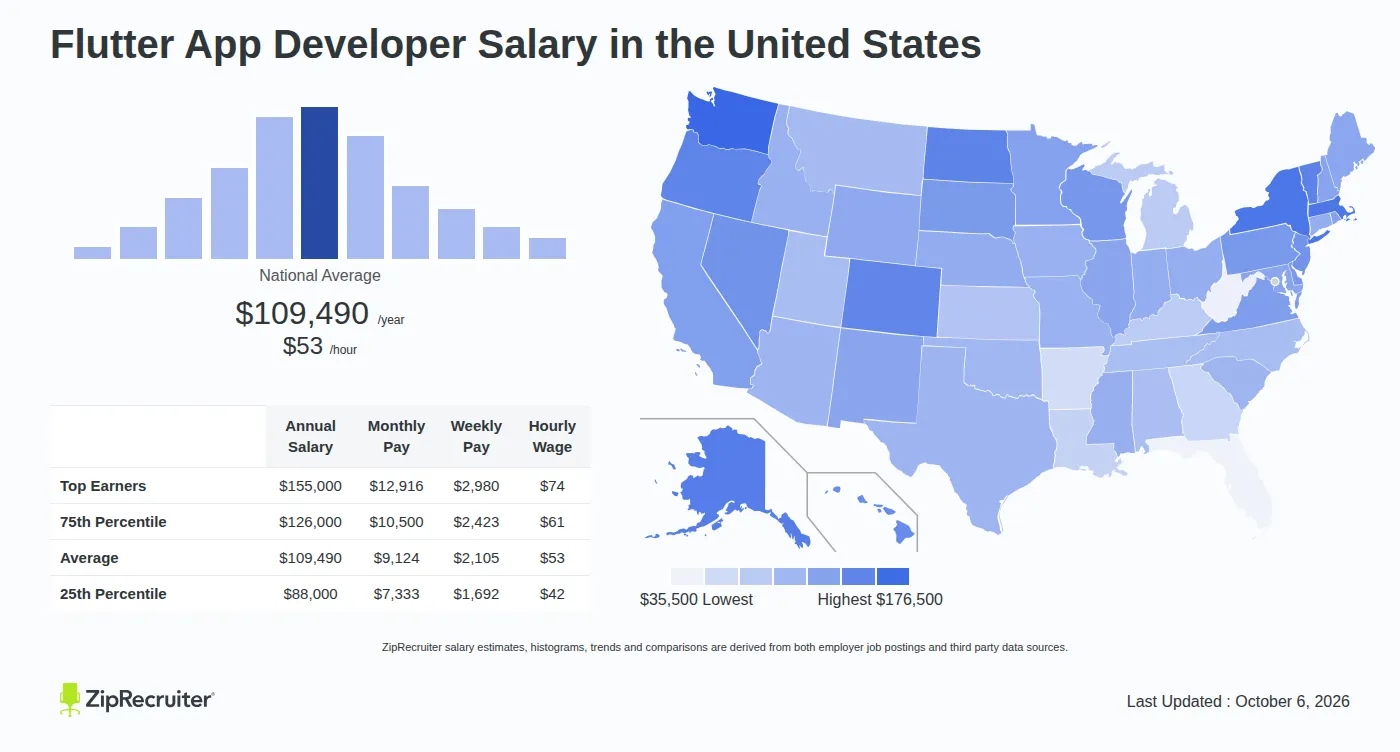
Global Flutter developer hourly rates range wildly — from roughly $18 in Southeast Asia to $100+ in the United States. The global median sits around $41–60 per hour for contracted work, but this aggregate number compresses vastly different markets together.
Location is the strongest single driver of hourly rates. A senior Flutter developer in the US averages around $58/hr, while an equivalently skilled developer in Eastern Europe averages $36–40/hr. This isn't because Eastern European developers are less skilled; it reflects cost-of-living differences, tax structures, and local market demand. When you're sourcing Flutter developers, geography becomes your first variable.
Seniority is the second driver. The gap between a mid-level and senior developer typically represents a 40–50% rate increase. A mid-level developer usually has 2–5 years of production experience and can build features, integrate APIs, and handle most day-to-day work. A senior developer has 5+ years, understands system architecture, anticipates scaling problems, and can reduce the total number of decisions you need to make as a founder.
For marketplace founders deciding on Flutter developer hourly rates, the critical insight is this: paying more per hour often reduces total project cost. A senior developer working 40 hours to ship a feature properly can cost less than a junior developer taking 100 hours and introducing bugs you'll need to fix later.
Seniority Matters More Than You Think
Let's put this concretely. If you're building a marketplace mobile app, you need features like real-time notifications, secure payment handling, user authentication with multiple providers, and smooth API integration. A mid-level developer can build all of these. A senior developer will ask questions first: How will this scale to 100,000 users? What happens when the payment provider changes their API? How should we structure the codebase so the next hire can extend it without rewriting half the app?
These questions cost nothing to answer upfront but save months of rework later. For marketplace platforms especially, where your mobile app is part of a larger ecosystem (backend APIs, web platform, payment systems, support systems), architectural decisions made early compound into either smooth scaling or painful rebuilds.
The Flutter developer hourly rate also reflects reliability. A strong senior developer is less likely to go silent, miss deadlines, or dump half-finished work on you. They've built the reputation and the financial stability to honour their commitments. For founders on tight timelines, reliability might be worth more than the hourly rate itself.
Location and Budget: Finding the Right Rate
Most marketplace founders face a trade-off between quality and budget. Hiring locally (in the US or Western Europe) is straightforward but expensive. Hiring remotely from lower-cost regions lets you stretch budget further but introduces timezone, communication, and quality-assurance challenges.
The middle ground that many founders pursue is sourcing senior developers from tier-2 regions like Ukraine, Poland, Brazil, or parts of Asia. You get experienced developers at $35–45/hr instead of $60+/hr, reducing total project costs by 30–40% while still getting someone capable of making good decisions.
However, sourcing itself has costs. Finding, vetting, interviewing, and onboarding a developer takes time. Many founders underestimate this friction and end up with a developer who doesn't fit the culture or can't deliver to spec. For marketplace platforms with complex requirements, getting the right person often matters more than getting the cheapest person.
Some marketplace founders bypass the hiring process entirely by working with agencies or development partners that specialise in marketplace platforms. A partner like Journeyhorizon combines marketplace expertise with Flutter development, which means less time spent explaining your vision and more time building the right product. The hourly rate model disappears, but you get dedicated teams that understand both the marketplace app development landscape and the technical execution side.
What You're Really Getting for the Hourly Cost
A Flutter developer working at $30/hr and one at $70/hr aren't just different on paper. The differences compound across every dimension of your project:
A junior or entry-level developer is typically learning on the job. They're building features correctly but slowly. They may not know how to debug complex problems. They need oversight and code review. They're valuable for well-scoped, straightforward work, but marketplace platforms rarely fall into that category.
A mid-level developer is the workhorse. They ship features predictably. They catch obvious architectural mistakes before they happen. They can integrate third-party systems without blowing up your timeline. For many marketplace projects, hiring a mid-level developer at $40–50/hr is the sweet spot between cost and reliability.
A senior developer reduces decision load. They ask the right questions before building. They anticipate edge cases. They make technology choices that scale. They can mentor junior team members or hand off projects clearly. For marketplace founders managing multiple priorities, having one strong senior developer can replace the need to hire two mid-level developers.
Beyond execution, you're also buying judgment. The Flutter developer hourly rate at the senior end reflects years of experience making choices between competing options. That judgment accelerates your product development more than raw coding speed ever could.
Building Marketplace Features with Flutter Developers
Marketplace platforms have specific technical needs: real-time messaging between buyers and sellers, location-based search, payment processing, ratings and reviews, and complex user authentication. These aren't trivial features to build well.
When you're hiring Flutter developers for marketplace work, you need people who understand these constraints. A generic mobile developer can ship a functional app. A marketplace-focused developer understands that poor search performance kills supply-side users, that confusing payment flows destroy conversion, and that latency in messaging breaks trust between transacting parties.
This is where development partners stand out. If you work with a custom marketplace development specialist, you're buying not just coding time but accumulated knowledge about what works and what doesn't in marketplace platforms. The hourly rate becomes secondary to the outcomes you'll actually achieve.
Choosing Between Full-Time, Contractor, and Agency Models
The hourly rate question is really about employment model. A contractor at $50/hr costs more than a full-time employee earning the equivalent of $35/hr (after accounting for overhead), but contractors are flexible, need no long-term commitment, and typically have sharper expertise in specific areas.
For marketplace founders, the choice often depends on your stage. Early stage, when requirements are still shifting, contracting makes sense. You pay more per hour but commit less capital. Later, when you know what you're building, hiring full-time developers becomes economical. You might find yourself needing both: full-time developers who maintain core platforms and contractors who bring specialised expertise for specific features.
A middle option is working with an agency that acts like your outsourced development team. Journeyhorizon operates this way — providing full-time dedicated teams for marketplace development without you needing to hire locally. You get the continuity of a committed team, the expertise of a marketplace specialist, and the flexibility of an outsourced model. This approach often costs less than hiring senior developers in-house, especially when you factor in recruiting, hiring, and management overhead.
Frequently Asked Questions
What hourly rate should I budget for a marketplace mobile app?
Budget for $40–70/hr if you're sourcing directly, or expect equivalent monthly costs of $8,000–15,000 for a dedicated mid-level developer. If you want a senior developer, budget higher. For a marketplace app with custom features, total cost is typically $30,000–100,000+ depending on scope and complexity.
Is a cheaper Flutter developer going to cost me more overall?
Often yes, but not always. A junior developer at $25/hr working on straightforward features can be cost-effective. The problem arises when you hire them for complex work. A poorly architected marketplace app costs far more to fix than it would have cost to build right the first time.
How long does it take to build a marketplace mobile app?
A simple marketplace mobile app (3–4 core features, single platform) takes 3–4 months with a developer at moderate seniority. A complex marketplace with real-time features, advanced search, and custom integrations takes 5–8 months or longer. Experienced developers compress timelines; inexperienced ones extend them.
Should I hire locally or remotely?
Remote hiring gives you access to a far larger talent pool at lower cost. The trade-off is timezone management and the need for more structured communication. For marketplace development, both models work; the decision depends on your cash position and timeline.


