How Many Internal Links Per Page for SEO: A Practical Guide

Ask any SEO professional how many internal links per page for SEO is ideal, and you will get a different answer every time. Some say five. Some say ten. Others reference a rule of one link per 200 words. The honest reality is that none of these figures matter much in isolation. What matters is whether your internal linking structure gives search engines a clear map of your site and whether it distributes authority toward the pages that need it most.
At Journeyhorizon, we work with marketplace founders building and scaling platforms across a range of industries. Internal linking is consistently one of the highest-leverage, lowest-effort improvements available to these teams, yet it is almost always treated as an afterthought rather than a foundational part of content strategy.
The Real Answer to How Many Internal Links Per Page for SEO
There is no universally correct number. The ideal count depends on the page's purpose, its length, and where it sits within your site architecture. A short category page behaves very differently from a 2,500-word pillar article targeting a competitive keyword cluster.
As a working benchmark, most experienced SEOs recommend somewhere between three and five contextual links per 1,000 words. For long-form content above 2,000 words, ten or more links is reasonable, provided each one is genuinely relevant to what the reader is exploring. The phrase "genuinely relevant" carries most of the weight here. A link embedded because it helps a reader continue a thought is worth more than three links inserted to hit a number.
Google's own stance on this has shifted over time. For years, the informal consensus was to keep total links under 100 per page, drawing from an old Googlebot crawl limit. Moz's internal linking guide notes that Google can now crawl hundreds of links per page, and the Search Essentials documentation no longer specifies a hard limit. The current guidance is simply to keep linking reasonable and to make sure links are crawlable. In practice, this means prioritising quality over volume.

Why Link Count Is Only Part of the Picture
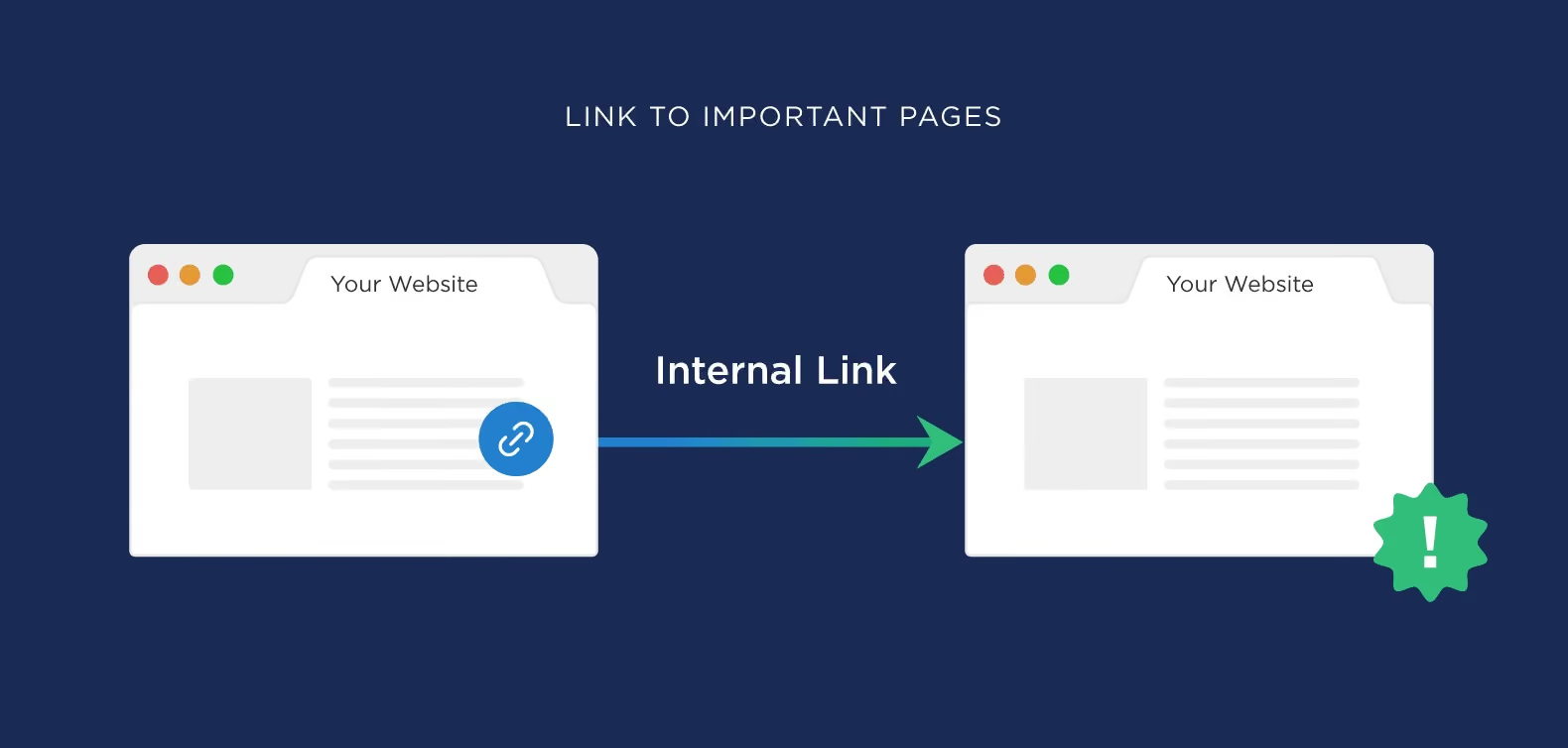
The number of internal links on a page is far less important than the logic behind each one. When you place a contextual internal link, you are doing two things at once: helping a reader navigate to something useful, and signalling to search engines which pages are related and which deserve ranking authority.
This is how link equity flows. Every page on your site carries a certain amount of ranking power, and internal links distribute that power to connected pages. When you link to a page frequently and contextually, you are telling Google it matters. When you never link to it, that page risks becoming what is known as an orphan, a page that exists in your CMS but cannot be reached through any navigational path. Orphan pages struggle to rank regardless of how well-written they are.
Understanding how Google indexing works for marketplace founders makes this clearer. Google's crawler needs to follow links to discover and re-index pages. If your internal linking structure has gaps, entire sections of your site may go unnoticed or be deprioritised in the crawl queue. This is especially common on marketplaces where new category pages or blog content gets published without being wired into the existing structure.
How Internal Linking Works Differently on a Marketplace
Most internal linking advice is written with a blog or a standard business site in mind. A marketplace has a more layered structure: homepage, category pages, subcategory pages, individual listing pages, and a content layer on top. Each of these layers needs its own linking logic, and the priority hierarchy matters.
Category pages are typically your most strategically important pages. They aggregate listing content and usually target the highest-volume search terms your platform competes for. These pages should receive internal links from both your blog content and from relevant subcategory or listing pages below them. Meanwhile, blog articles should link upward to the category pages they naturally support, funnelling topical authority where it counts.
The shallow site structure principle applies directly here. Any important page should be reachable within three clicks of the homepage. If a crawler or a visitor has to navigate through five levels to find a key category, that page will underperform regardless of how much content sits on it. Reviewing your technical SEO fundamentals as part of a site audit helps surface these click-depth problems early.
Building an Internal Linking Strategy That Scales
A scalable internal linking strategy is not about obsessing over link counts. It is about thinking in topic clusters. A topic cluster groups related pages so that they link to each other in a way that signals a coherent theme to search engines. You have a pillar page that covers a broad topic in depth, and a set of supporting articles that go deeper on specific subtopics. Each supporting article links back to the pillar, and the pillar links out to its supporting pages.
For a marketplace founder, this might look like a pillar page on how service marketplaces work, supported by articles on vetting providers, setting pricing, building trust signals, and handling disputes. Each supporting article targets its own long-tail queries while reinforcing the pillar's authority on the broader topic.
Anchor text quality matters at every step. Generic phrases like "click here" or "read more" waste the opportunity to signal relevance. Descriptive anchors such as "marketplace onboarding strategy" or "how category pages rank" help Google understand what the linked page is about. You do not need exact-match keywords in every anchor, but you do need specificity. Broad, vague anchor text is as much of a missed opportunity as no link at all.
The Mistakes That Quietly Damage Marketplace SEO
Under-linking is more common than over-linking. Many marketplace blogs publish content consistently without ever linking that content to their service or category pages. The articles exist, accumulate traffic, and then contribute nothing to the pages that actually drive conversions.
Relying entirely on navigational links in headers and footers is another common problem. If every link to your most important category page comes from global navigation, that page receives no topical signal from your content layer. Contextual links placed within relevant paragraphs carry stronger relevance signals because they show Google the link was made for editorial reasons, not just for navigation.
Broken internal links are a quieter drain. Every internal 404 error wastes crawl budget and cuts off a path for link equity to flow. Running a regular technical SEO audit to catch and fix broken links is basic maintenance for any growing platform. For teams looking to build this into an ongoing content and SEO service workflow, having this embedded in how content is published prevents the issue from compounding over time.
Teams that handle both the marketplace development and the ongoing SEO work are naturally better positioned to keep internal linking consistent as a platform scales. When the people building the site understand how linking affects rankings, structural decisions are made with SEO in mind from the start rather than retrofitted months later. If you are building or growing a marketplace and want to think through your linking architecture more systematically, Journeyhorizon supports integrated growth that spans both the technical and content dimensions of this work.
Frequently Asked Questions
How many internal links per page is ideal for SEO?
There is no universally correct number. A practical benchmark is three to five contextual links per 1,000 words, and ten or more for long-form content above 2,000 words. How many internal links per page for SEO ultimately depends on the page's purpose, length, and role within the broader site structure. Relevance matters far more than hitting a specific count.
Can you have too many internal links on a page?
Yes. Too many links dilute the link equity passed to each destination and create a cluttered reading experience. If every paragraph contains multiple links, readers cannot tell which pages are most important, and the topical signal to search engines becomes scattered. Prioritise links that genuinely guide the reader to something useful.
Does internal linking matter more on a marketplace than on a regular site?
In most cases, yes. Marketplaces have larger, more layered site architectures with category, subcategory, and listing pages. A strong internal linking structure ensures link equity flows to priority pages, crawlers reach every section efficiently, and blog content actively supports the category pages competing for high-volume terms.
What is the best anchor text approach for internal links?
Use descriptive anchor text that reflects what the linked page is about. Avoid generic phrases like "learn more." Specific anchors like "how marketplace category pages rank" give both users and search engines a clear signal. Varying your anchor text across links is also good practice, as repetitive exact-match anchors can appear unnatural.