How Much Does an LLM Cost? Pricing Guide for 2026

Understanding how much does an LLM cost is essential if you're building a marketplace, SaaS product, or any application that relies on artificial intelligence. The answer isn't straightforward because there are multiple cost models at play, each with different pricing structures. Whether you're considering integrating an LLM into your product or building custom AI features, knowing the actual expenses involved will help you make better decisions about which models to use and how to structure your application's architecture.
There's often confusion between two very different cost scenarios. On one hand, you have the enormous expense of training a frontier language model from scratch. On the other, you have the much more accessible cost of calling an existing model via API. For most marketplace founders and product teams, the latter is what matters. Journeyhorizon works with marketplace operators who are increasingly adding AI features to their platforms, and understanding these costs becomes critical to product planning.
The two worlds of LLM costs
When people ask how much does an LLM cost, they're usually thinking about one of two things. Training a new frontier model is extraordinarily expensive. Building something like GPT-4 or Claude requires hundreds of millions of dollars in compute infrastructure, specialised hardware like NVIDIA H100 GPUs (which cost around $25,000 each), and teams of researchers and engineers. The compute cost alone for frontier models ranges from $78 million to over $192 million just for the hardware and processing time. Add in the cost of high-quality training data, reinforcement learning from human feedback, and ongoing infrastructure, and you're looking at billions in cumulative investment.
But this isn't your cost. Building your own LLM from scratch makes sense only if you're a well-funded AI company with specific competitive needs. For everyone else—marketplace founders, SaaS teams, and enterprises—the relevant cost is API pricing. You're paying per token generated, which is far more manageable and scales with your actual usage.
Current LLM API pricing landscape
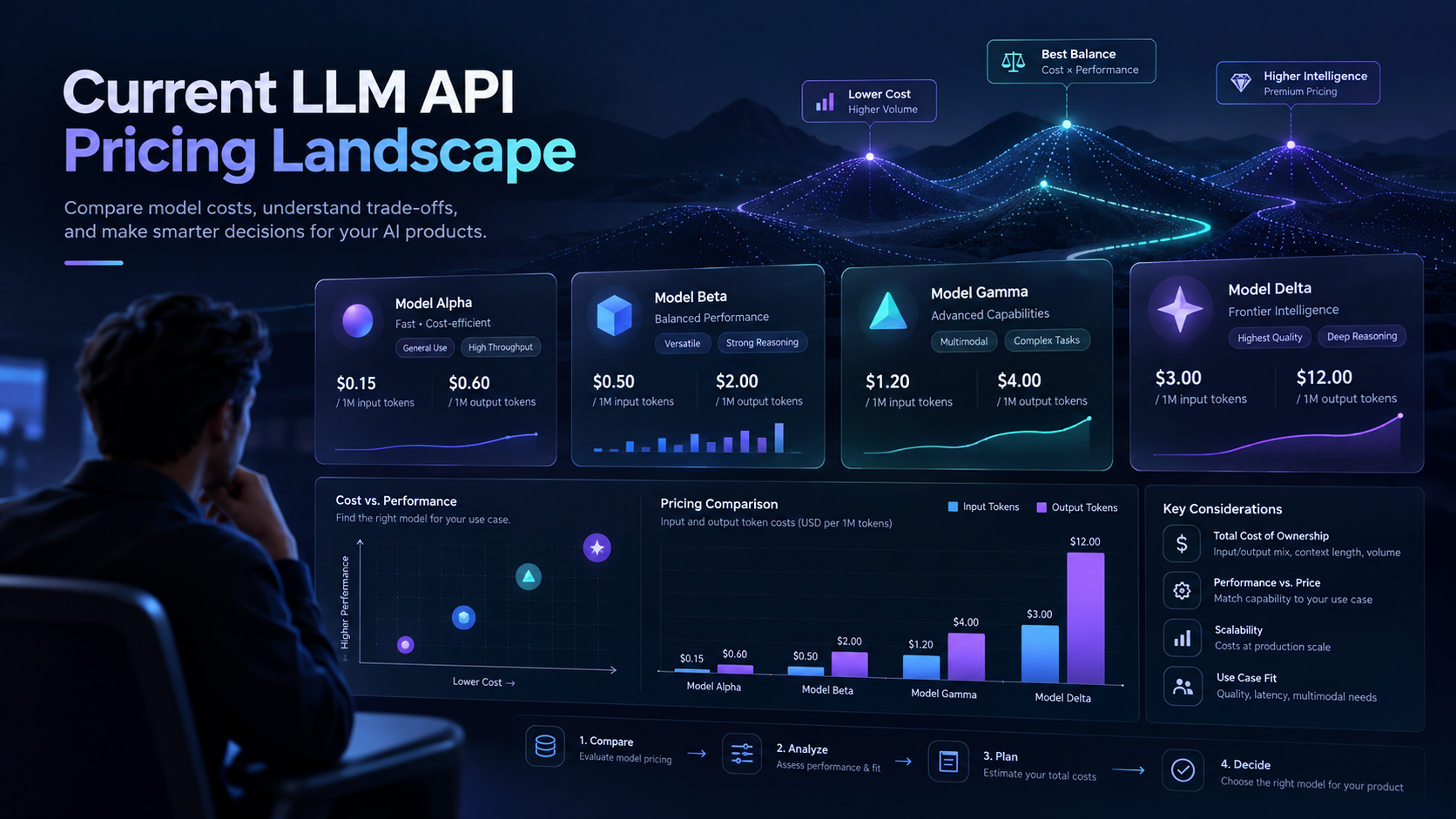
The cost to use an LLM via API has become remarkably competitive. Budget-friendly models like Amazon Nova Micro cost just $0.035 per million input tokens and $0.14 per million output tokens. If you need something more capable but still cost-effective, DeepSeek-V3.2 charges $0.28 per million input tokens and $0.42 for outputs. On the mid-range, Claude Haiku 4.5 costs $1 per million input tokens and $5 for outputs, while GPT-4o Mini runs $0.15 input and $0.60 output per million tokens.
At the higher end of capability, Claude Sonnet 5.5 and Claude Opus 5.5 cost $2 and $4 per million input tokens respectively, with outputs running $10 and $20. GPT-5 and similar frontier models push into the $1.25 to $2.50 range for inputs. The most powerful reasoning models—like o1 Pro—cost $150 per million input tokens and $600 for outputs, but these are designed for specific high-value use cases where the cost is justified by the complexity of the problem.
What matters is that the price-to-capability ratio has improved dramatically. A year ago, capable models cost significantly more. Now you can build a feature-rich application with sophisticated AI without breaking your infrastructure budget. Many marketplace platforms are now offering AI-powered features like smart search, automated categorisation, content moderation, and personalised recommendations using these reasonably priced models.
How LLM pricing actually breaks down
API pricing is almost always based on tokens, not requests or time. A token is roughly a word or part of a word (punctuation, digits, etc. count differently). Most models charge separately for input tokens (the prompt you send) and output tokens (the response the model generates). Output tokens typically cost 2 to 5 times more than input tokens because generating text is computationally more expensive than processing it.
Context window size matters too. Some models offer cheaper rates for smaller context windows (the amount of prior conversation or text the model can reference). A model with a 128K token context window might charge the standard rate, whilst the same model with a 1M token window costs more per token because it requires more processing. Caching—where you store frequently-used context to avoid reprocessing it—is becoming standard and can dramatically reduce costs if your application sends similar prompts repeatedly.
To calculate actual costs, you need to know your usage pattern. A marketplace recommendation engine that processes hundreds of items per second will have different cost dynamics than a content moderation system that runs on specific triggers. If you're building something like smart search for your marketplace, you might generate output only once per search query. If you're building a chat interface for customer support, you're generating continuous outputs. The token count adds up differently in each scenario.
Real-world cost estimation for marketplace features
Let's work through a practical example. Suppose you're building a smart categorisation feature for your marketplace that automatically tags listings. You process 10,000 listings per day, and each categorisation prompt costs about 100 input tokens and gets back 50 output tokens in response. Using Claude Haiku 4.5, that's 1 million input tokens and 500,000 output tokens daily, costing roughly $1.50 per day or $45 per month for that feature alone. Scale to a million items per month, and you're looking at $1,500 in monthly costs for a genuinely useful feature.
Now consider a different scenario. You build a natural language search interface where customers ask questions in plain English and the system searches your listings. Each search generates maybe 200 input tokens and 100 output tokens. If your marketplace handles 100,000 searches per month, that's 20 million input tokens and 10 million output tokens monthly, costing around $30 at Claude Haiku prices. The same feature on a more capable model like Claude Sonnet would cost $200 per month for the same volume.
These aren't trivial costs, but they're predictable and scale linearly with usage. The key is understanding your specific use case and choosing the right model for the job. You don't need Claude Opus or GPT-5 for basic categorisation or search. You don't need a reasoning model for routing customer support requests. Matching model capability to task complexity is how you optimise spending.
Strategies for managing LLM costs
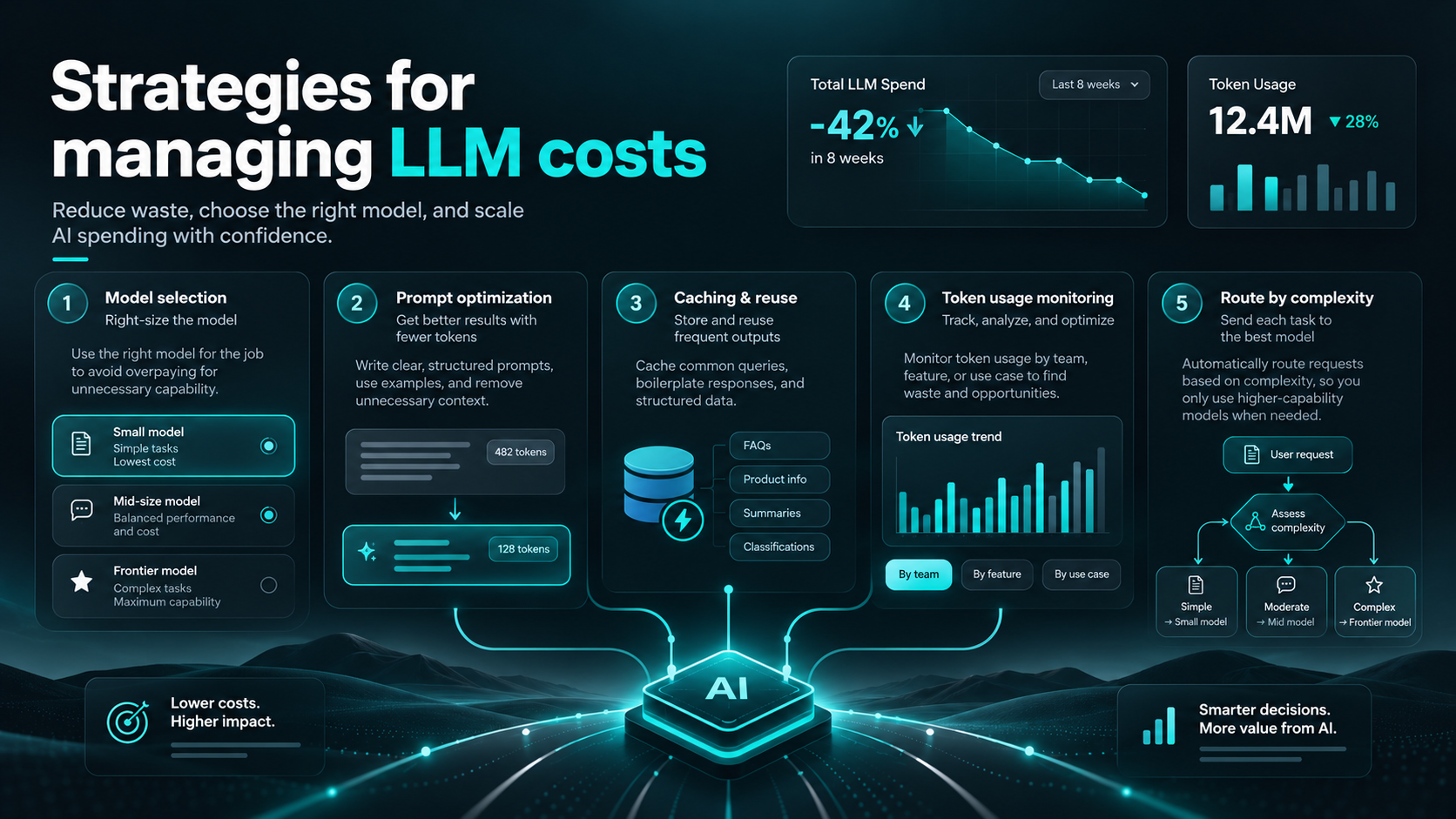
The first optimisation is choosing the right model for your specific task. An application that benefits from sophisticated reasoning might justify Claude Sonnet's higher cost, whilst basic classification or routing works fine on Haiku or similar models. Benchmarking your task against different models helps identify the sweet spot.
Prompt engineering reduces token usage. Shorter, more focused prompts consume fewer tokens than verbose ones. Providing clear instructions and examples in your system prompt actually saves tokens by reducing back-and-forth clarification requests. Tools like prompt caching let you store expensive context (like your product catalogue or style guide) so it's only processed once and reused across requests.
Batching requests, when your workflow allows it, is another approach. Instead of making individual API calls for each item, you can process items in groups, amortising overhead. Rate limiting—deliberately throttling requests during peak times—might feel counterintuitive, but it can be economical if it lets you shift work to lower-cost times or reduces redundant requests. Some marketplace features don't need real-time results, so batch processing overnight is viable.
Hybrid approaches work too. Use a smaller, cheaper model for initial screening, then escalate only uncertain cases to a more capable (and expensive) model for refinement. Classify most listings automatically, but route unusual or ambiguous ones to human review. This often gives better results than trying to solve every case with a single model.
The implications for marketplace builders
For marketplace founders thinking about integrating LLMs, the cost landscape is permissive if you're thoughtful. You can afford to add AI features without massive infrastructure spending. A listing description generator, seller support chatbot, or intelligent search interface are all within reach for a bootstrapped marketplace or a funded team on a reasonable budget.
The real question isn't whether you can afford LLMs—you probably can. It's whether the feature justifies the cost through improved conversion, retention, or operational efficiency. A marketplace that helps sellers write better descriptions might see better search performance and higher sales. Smart moderation reduces the cost of human review. Intelligent routing in support reduces response time. These features have business value beyond the novelty of "we have AI."
If you're scaling a marketplace and considering custom AI features or integrations, especially ones that need to work seamlessly with your platform architecture, working with a partner who understands both LLM costs and marketplace dynamics is valuable. Journeyhorizon has developed AI cost optimisation strategies specifically for marketplace and SaaS businesses, helping teams choose the right models, architect efficient integrations, and manage spending as they scale AI features. Whether you're adding a recommendation engine, automating moderation, or building custom workflows, understanding both the technical and financial dimensions helps you ship something users love without overspending.
Frequently Asked Questions
What are input and output tokens, and why do they cost differently?
Input tokens are the words and characters in your prompt or question sent to the LLM. Output tokens are the words the LLM generates in response. Output tokens typically cost more (often 3 to 5 times as much) because generating text requires more computational work than processing an incoming prompt. When evaluating how much does an LLM cost, always factor in both input and output rates.
Can I use free LLM models to avoid costs?
Yes, open-source models like Llama and Mistral can be self-hosted, which avoids per-token API charges. However, self-hosting requires infrastructure investment, ongoing maintenance, and engineering time. For many teams, paying for API access to a well-maintained model is cheaper and simpler than managing your own deployment. If your volume is very high or your use case is particularly sensitive about data privacy, self-hosting might make sense.
How do I estimate LLM costs for my specific use case?
Start by identifying the average number of input and output tokens per request. Run a few test prompts through your API of choice and count the tokens (most API dashboards show this). Multiply by your expected monthly request volume. For example, 100,000 requests per month with 200 input tokens and 100 output tokens each, using Claude Haiku, would cost approximately $30 per month in LLM costs alone.
Is the price of LLMs going down?
Yes. In the past 12 to 24 months, prices for most LLMs have dropped significantly. Newer models often launch cheaper than predecessors because competition between API providers has intensified. Budget models like Amazon Nova and DeepSeek have pushed prices down further. However, frontier models (the most capable ones) remain expensive, and this is unlikely to change dramatically in the near term.