How to Market SaaS: A Step-by-Step Framework for Sustainable Growth (2026)

Many capable SaaS teams (Software-as-a-Service) fail, not because of technology alone, but because they struggle with distribution and go-to-market execution. In the crowded SaaS landscape of 2026, sustainable growth requires more than strong features; it requires a strategy that aligns product, sales, and retention.
This article presents a practical, data-informed framework on how to market SaaS, designed for founders and marketing leaders who prioritize long-term growth over short-term tactics.
The insights shared are informed by Journeyhorizon’s experience supporting the development and launch of scalable SaaS platforms.
1. What is SaaS marketing?
SaaS marketing refers to the strategies and processes used to attract, convert, retain, and expand customers for subscription-based software products. Unlike traditional product marketing, SaaS marketing is optimized for long-term customer value, not one-time transactions.
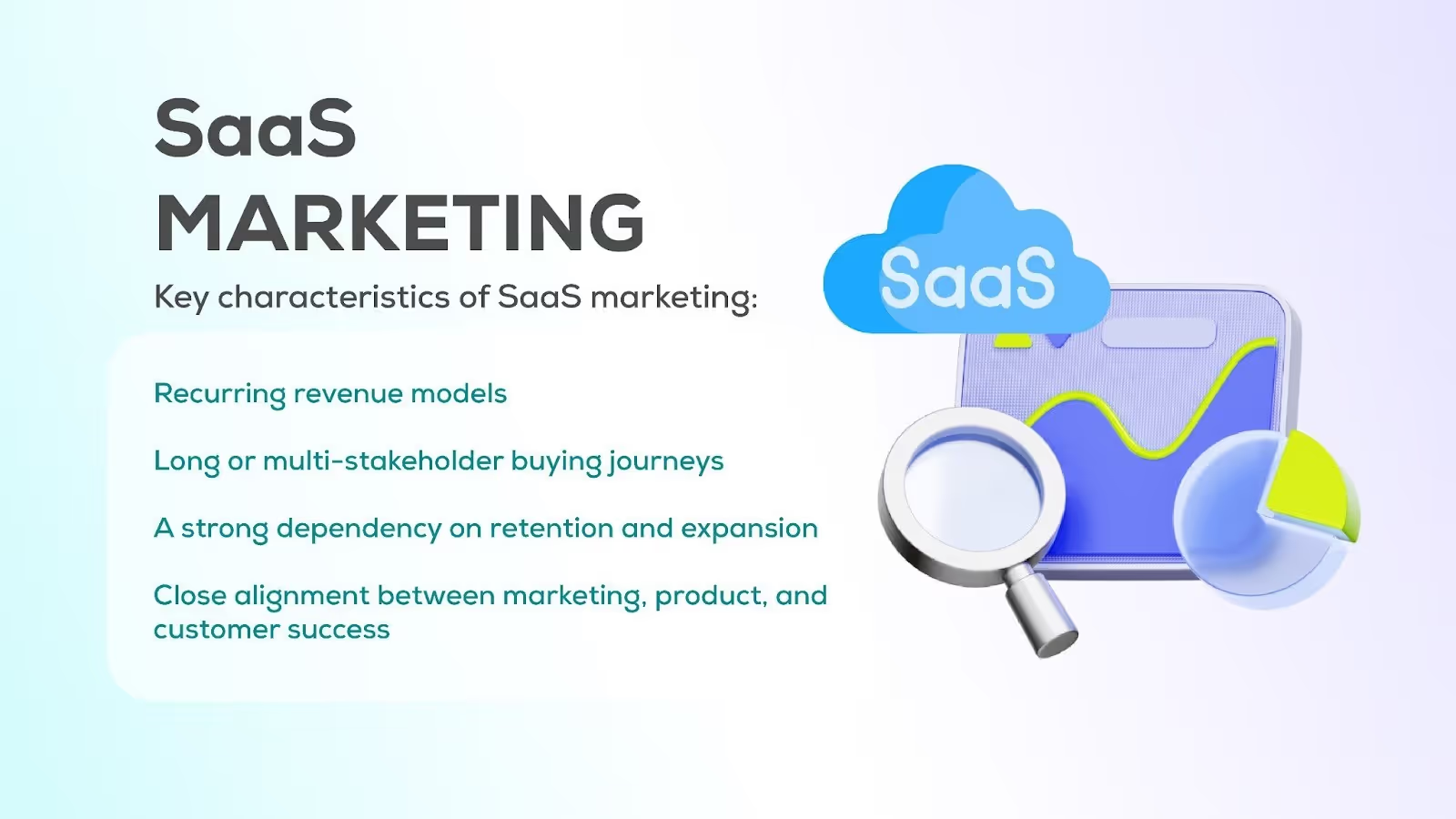
Key characteristics of SaaS marketing include:
- Recurring revenue models
- Long or multi-stakeholder buying journeys
- A strong dependency on retention and expansion
- Close alignment between marketing, product, and customer success
Understanding these fundamentals is essential before deciding how to market a SaaS product effectively.
2. Product-led vs Sales-led growth: Choosing the right SaaS marketing strategy
Before selecting channels or tactics, SaaS teams must clarify their primary go-to-market motion which is aligned to business goals. Most SaaS companies operate on a spectrum between two models.
- Product-led growth (PLG) relies on free trials or freemium access, allowing users to experience value before committing. Marketing supports education, onboarding, and activation.
- Sales-led growth relies on demos, outbound outreach, and longer sales cycles. Marketing focuses on demand generation, qualification, and trust building.
In practice, many mature SaaS companies adopt hybrid models, combining product-led acquisition with sales-assisted expansion.
There is no universally correct approach. The effectiveness of any SaaS marketing strategy depends on product complexity, deal size, and target customer profile. Problems typically arise when marketing execution does not align with the chosen model.
3. How to market SaaS step by step: the 4-stage go-to-market framework
Instead of treating marketing channels in isolation, effective SaaS growth follows a progression of stages. Each stage requires different priorities, metrics, and expectations.
While these stages often overlap in practice, they provide a useful framework for aligning marketing priorities with company maturity.
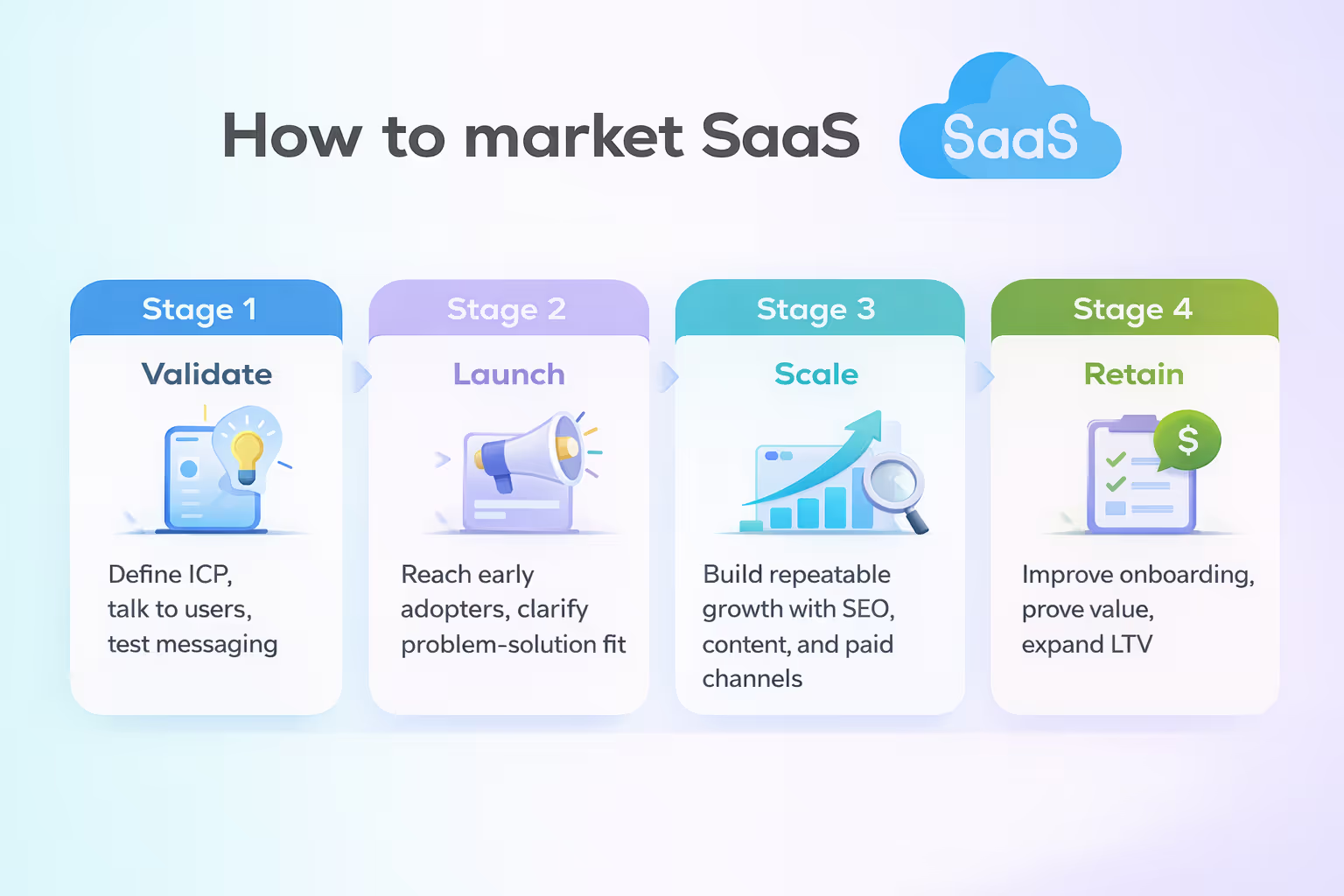
Stage 1: Pre-product market fit - validating your SaaS marketing strategy
The objective at this stage is learning, not scale. Marketing activities should focus on understanding the problem, the customer, and early signals of value.
Key actions include:
- Defining a narrow Ideal Customer Profile (ICP)
- Conducting direct conversations with early users
- Founder-led outreach and manual onboarding
- Testing messaging through small-scale experiments
This stage often involves “doing things that don’t scale,” which remains one of the most reliable ways to gather meaningful insight.
Stage 2: Launch and early go-to-market for SaaS products
Once early validation exists, marketing can expand cautiously to reach a broader audience.
Typical activities include:
- Launching within relevant communities or early adopter networks
- Listing on SaaS directories and review platforms
- Publishing foundational content that clearly explains the problem and solution
For many teams, this is where questions around how to market SaaS first become operational rather than theoretical.
Stage 3: Scaling SaaS marketing with SEO, content, and paid channels
With proof of value and early retention data, SaaS companies can begin building repeatable acquisition systems.
SEO and content marketing play a long-term role by capturing demand from buyers actively researching solutions. Over time, high-quality content compounds and reduces dependency on paid acquisition.
This stage is also where teams must answer how to measure SaaS content marketing accurately. Useful metrics include:
- Pipeline or revenue influenced by content
- Conversion rates by content type
- Engagement signals tied to activation or retention
Paid acquisition can be effective when conversion paths are proven and unit economics are predictable. Scaling too early, however, often leads to inefficient spend.
To explore how SEO supports sustainable SaaS growth, view more about SaaS SEO services.
Stage 4: Retention and expansion in SaaS marketing (Lifetime Value-focused growth)
At scale, retention becomes one of the most important levers in SaaS marketing performance. Improving onboarding, education, and ongoing engagement directly impacts lifetime value.
This is also where understanding how to use customer success stories in SaaS marketing becomes important. Well-structured case studies provide credible, specific proof that supports both acquisition and expansion - without overstating results.
4. SaaS marketing mistakes that consistently kill growth
Through our analysis of struggling SaaS ventures, we see four consistent patterns that derail growth:
- Scaling paid acquisition before retention is proven
- Treating churn as a customer success problem only
- Positioning features instead of outcomes
- Measuring activity instead of business impact
These mistakes appear frequently across SaaS companies at different stages and often contribute to stalled or inefficient growth.
5. How to measure SaaS marketing performance
Effective SaaS marketing decisions rely on a small set of business-critical metrics rather than surface-level activity data.These metrics form the foundation for evaluating SaaS marketing strategies and determining when to scale or adjust investment.
Together, these metrics help SaaS teams evaluate marketing performance, assess unit economics, and determine when it is appropriate to scale or adjust investment.
6. A practical 90-day SaaS marketing plan
This 90-day plan is designed to establish a solid marketing foundation and generate early traction - not to fully scale acquisition. Its primary goal is to help SaaS teams align positioning, validate channels, and build repeatable processes before increasing investment.
6.1. Month 1: Foundation - ICP, positioning, and tracking setup
The first month focuses on clarity and measurement. Without a clear understanding of the target customer and reliable data, marketing execution becomes guesswork.
Key priorities include:
- Clarifying the Ideal Customer Profile (ICP) and value proposition
- Ensuring core analytics and attribution are in place to track meaningful outcomes
- Auditing onboarding flows and messaging to ensure consistency between promise and experience
6.2. Month 2: Experimentation - content, outbound, and early channels
With a foundation in place, the second month emphasizes controlled experimentation. The objective is to identify early signals of channel effectiveness, not to maximize volume.
Key activities include:
- Launching a focused content initiative aligned with buyer intent
- Testing one outbound, partnership, or distribution channel at a time
- Collecting both qualitative feedback (from conversations) and quantitative data (from performance metrics)
6.3. Month 3: Optimization - reinforcing what works in SaaS marketing
The final month shifts attention to optimization and early reinforcement. Rather than expanding broadly, teams should double down on what shows clear potential.
Key actions include:
- Reinforcing channels that demonstrate clear, directional return on investment
- Refining messaging and positioning based on observed performance data
- Documenting repeatable processes to support future scaling
This approach emphasizes sustainability over speed, helping SaaS teams avoid premature scaling while building a reliable foundation for long-term growth.
7. Journeyhorizon - A strategic partner for SaaS marketing and growth
Journeyhorizon is a strategic SaaS marketing partner specializing in scalable growth systems. We help SaaS teams define go-to-market direction, prioritize high-impact channels, and turn marketing into a long-term revenue driver across the entire subscription lifecycle.
Journeyhorizon’s work in SaaS marketing typically focuses on the following areas:
- SaaS go-to-market and positioning
Supporting SaaS teams in defining Ideal Customer Profiles (ICP), value propositions, and go-to-market motions that match product complexity and sales cycles. - SEO and content marketing for SaaS
Designing intent-driven content and SEO strategies that help SaaS companies capture demand from buyers actively researching solutions, while supporting pipeline and long-term organic growth. - Lifecycle and retention-focused marketing
Helping teams improve onboarding, activation, and ongoing engagement through clearer messaging and lifecycle communication aligned with product usage. - Marketing measurement and decision support
Assisting SaaS teams in identifying meaningful metrics, connecting marketing activity to business outcomes, and making informed decisions about optimization and scaling.
Discover our full range of marketing services.
Journeyhorizon operates as a strategic partner rather than a tactical vendor, working with SaaS teams that prioritize clarity, sustainability, and long-term growth over rapid but unstable scale.
We also provide marketing services for B2B SaaS companies; teams considering external support may find this guide on how to choose a marketing agency for B2B SaaS helpful for further reference.
8. Conclusion: How to build a sustainable SaaS marketing engine
SaaS marketing is not a bag of tricks; it is an engineering problem. In competitive SaaS markets, teams that align product value, onboarding, and retention tend to build more resilient growth than those relying primarily on short-term acquisition.
By treating growth as a staged process - not a race - teams reduce the risk of premature scaling and create a revenue engine designed to last.
For SaaS companies looking to move from experimentation to structure, Journeyhorizon supports teams in building marketing systems focused on long-term performance rather than short-term noise.
Contact us to scale your SaaS today.
9. FAQs
1. How is SaaS marketing different from traditional product marketing?
SaaS marketing focuses on retention and long-term customer value rather than one-time sales, due to subscription-based revenue models.
2. How should early-stage SaaS companies start marketing?
Early-stage SaaS companies should focus on customer discovery, clear positioning, and small-scale experiments before scaling acquisition.
3. What are the most effective SaaS marketing channels?
Effective channels depend on the stage of the business but often include SEO and content for demand capture, product-led onboarding, and targeted outbound.
4. How do you measure SaaS marketing performance?
SaaS marketing performance is measured using CAC, LTV, MRR, and churn rate rather than surface-level activity metrics.
5. When should a SaaS company work with a marketing agency?
SaaS companies typically work with a marketing agency when they need structured support to build scalable marketing systems aligned with their go-to-market strategy.