How to Measure SaaS Content Marketing: The "Revenue-First" Framework (2026 Guide)

Many SaaS companies invest in content marketing but struggle to understand how to measure SaaS content marketing beyond traffic and engagement. While visibility increases, it often remains unclear which content actually drives pipeline or revenue.
This creates a gap where effort is visible, but business impact is not. The problem is not missing data, it is relying on metrics that fail to explain ROI or customer value.
This article introduces a revenue-first framework to measure SaaS content marketing by connecting content directly to pipeline, lifetime value, and ROI. Drawing on Journeyhorizon’s experience supporting SaaS companies and other scalable businesses in building measurable content systems, the focus is not better reporting, but turning content into a predictable revenue engine.
1. The strategic shift: From traffic to pipeline
1.1. Metrics vs. KPIs
Before going deeper, it is important to distinguish between metrics and KPIs.
- Metrics are raw data points such as pageviews, sessions, or keyword rankings. They describe activity, but not business impact.
- KPIs are performance indicators directly tied to outcomes such as pipeline influence, customer acquisition cost reduction, lifetime value growth, or revenue contribution from content.
For SaaS companies, traffic alone does not define success. The real question is how content contributes to pipeline creation and long-term revenue efficiency.
1.2. The SaaS growth loop
Effective SaaS marketing strategies treat content as part of a continuous growth loop rather than a one-time acquisition channel.
- Content attracts high-intent users who are actively researching solutions.
- Those users convert into leads, trials, or product sign-ups over time.
- Better-informed leads convert more efficiently, reducing acquisition costs.
- Educated customers adopt products faster, retain longer, and generate higher lifetime value.
This is why modern SaaS teams focus less on content volume and more on how to measure content marketing ROI for SaaS across the entire customer lifecycle.
Measuring SaaS content marketing involves tracking performance beyond traffic, focusing on pipeline influence, lead quality (MQLs/SQLs), and revenue attribution (ARR) to determine true ROI across the customer lifecycle.
2. The four-stage measurement framework
To accurately measure SaaS content marketing, metrics must be structured around the buyer journey rather than isolated channels. The following four-stage framework provides clarity on how content creates value at each phase of growth.
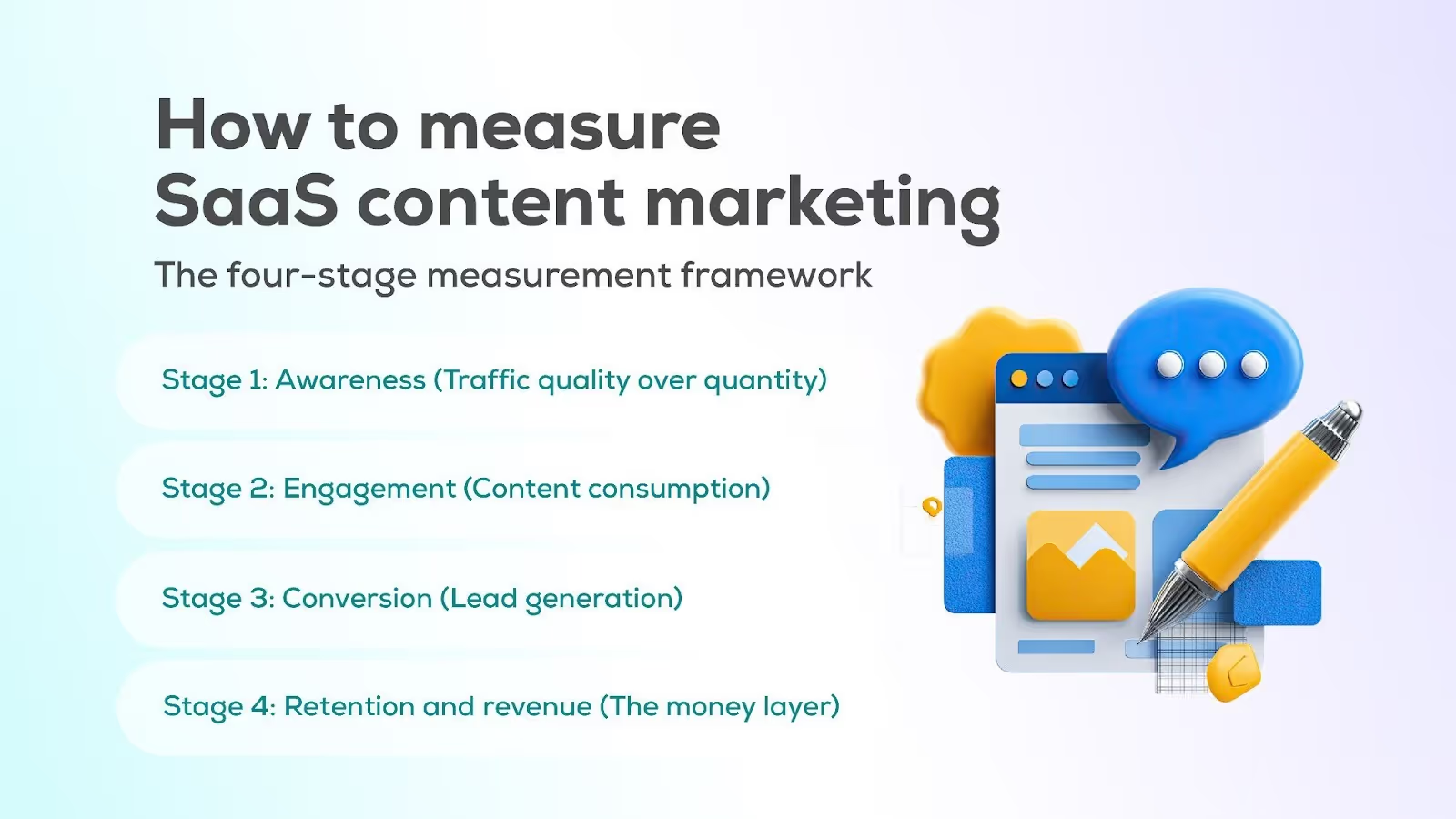
Stage 1: Awareness (Traffic quality over quantity)
Objective: Attract the right audience, not the largest audience.
At this stage, total traffic volume is less important than user intent. Ranking for keywords that signal evaluation or purchasing behavior is far more valuable than generic informational queries, because these users are closer to making a decision and more likely to enter the pipeline.
Key SaaS content marketing metrics:
- High-intent keyword rankings, such as “best software for” or “X alternatives”
- Brand search volume, which indicates growing market awareness and demand
This approach is especially important when learning how to market a SaaS in competitive or crowded categories.
Stage 2: Engagement (Content consumption)
Objective: Educate and qualify potential buyers.
Engagement metrics help determine whether readers are actually consuming and understanding your content. For teams earlier in their marketing maturity, these metrics answer a practical question: are users finding enough value to stay and explore further?
Key metrics:
- Scroll depth, which shows how much of the content users read
- Time on page, which indicates reading intent
- Micro-conversions such as PDF, ebook, or checklist downloads
It is important to note that engagement does not equal buying intent. These SaaS content marketing metrics signal trust and interest, not revenue readiness.
Stage 3: Conversion (Lead generation)
Objective: Turn content readers into qualified sales opportunities.
In SaaS, conversions rarely happen immediately. A user may read a blog post, leave the site, and request a demo or trial days or weeks later. This delay makes attribution more complex, but also more critical.
Key KPIs:
- Marketing qualified leads generated from content
- Demo or trial requests originating from blog sessions
- Content-assisted conversions, where content influenced the decision but was not the final touchpoint
Tracking this stage is essential to understanding how to measure SaaS content marketing beyond surface-level engagement.
Stage 4: Retention and revenue (The money layer)
Objective: Maximize revenue efficiency and customer lifetime value.
Content continues to create value after acquisition. Product education, onboarding materials, and knowledge base articles help users adopt features faster, reduce churn, and support expansion over time.
Key KPIs:
- Pipeline value influenced by content
- Content ROI, calculated as revenue influenced relative to content investment
- Churn reduction rate associated with educational and support content
At this stage, content becomes a measurable revenue lever rather than a standalone marketing expense, even though its impact is often indirect rather than immediately transactional.
3. SaaS content marketing metrics and KPIs mapped to revenue
The table below illustrates how SaaS content marketing metrics and KPIs support revenue outcomes across the funnel. While not all indicators directly generate revenue, each plays a measurable role in pipeline creation, conversion efficiency, and long-term profitability.
This mapping helps teams focus on metrics that contribute to revenue decisions, rather than surface-level indicators that look impressive but fail to drive business outcomes.
4. How to build your content dashboard
Measurement only works when insights are accessible and actionable. A well-structured content dashboard should serve different stakeholders, each with distinct decision-making needs.
4.1. The CEO view
This view focuses on business and financial outcomes influenced by content performance:
- Customer acquisition cost trends influenced by content
- Customer lifetime value by acquisition source
- Pipeline value influenced by content
- Overall content ROI
This dashboard answers a single, strategic question: is content helping the business grow more efficiently over time?
4.2. The manager view
Marketing and growth teams need operational clarity to improve execution and prioritization. This view focuses on leading indicators:
- Organic traffic trends and keyword rankings
- Leads and MQLs generated from content
- Conversion rates by topic, format, or article type
These metrics help teams understand what is working, what needs optimization, and where to focus next.
4.3. Technical implementation: A simple 3-step tracking setup
Knowing what to measure is only half the job. To measure revenue impact, you need tracking that connects content activity to lead and customer outcomes, not just pageviews.
Step 1: Use consistent campaign tracking (UTMs) Apply a clear naming convention for UTM parameters across email, social, partnerships, and paid distribution. This ensures you can reliably identify exactly where visitors and leads came from in your analytics reports.
Step 2: Define intent-based events in GA4 Track meaningful actions such as newsletter signups and resource downloads, plus high-intent actions such as demo requests and trial starts. Use Google Tag Manager when needed to ensure conversion events fire accurately on successful form submissions.
Step 3: Connect website data to your CRM Ensure key acquisition details (for example, first-touch and last-touch source) are captured in your CRM via hidden fields. This closes the loop, allowing you to measure exactly how specific content pieces influence pipeline and revenue outcomes (ARR) over time.
Minimal stack: GA4 for event data, Google Search Console for organic visibility, and a CRM such as HubSpot or Salesforce for revenue attribution. This setup covers most SaaS companies without adding unnecessary complexity.
5. Common mistakes to avoid
Even with the right framework and metrics, many SaaS companies still struggle to measure content marketing effectively. In most cases, the problem is not the lack of data, but how content performance is evaluated and interpreted.
Measuring too early
SaaS content marketing compounds over time. Evaluating performance too early often leads teams to abandon strategies that would have delivered strong returns with patience.
Prioritizing virality over problem-solving
High-traffic content that does not address real buying problems rarely converts. Sustainable growth comes from solving costly, specific challenges for qualified buyers.
Treating content as a standalone channel
Content rarely drives revenue in isolation. When content is disconnected from sales, onboarding, and product education, its real impact becomes difficult to measure and optimize.
Measuring volume instead of efficiency
Focusing on the number of articles or total traffic can obscure performance. Measuring cost per content-influenced lead and pipeline value per content cluster provides a clearer picture of efficiency.
Ignoring retention and post-sale impact
Content continues to create value after acquisition. Failing to measure how onboarding and educational content reduce churn and increase lifetime value leads teams to underestimate content ROI.
Taken together, these mistakes explain why many content programs appear unsuccessful on paper, despite quietly contributing to growth. Avoiding them is often the difference between content that looks busy and content that measurably drives revenue.
6. Journeyhorizon: A growth-focused partner for measurable SaaS content marketing
Journeyhorizon helps SaaS companies and other growth-focused digital businesses understand how to measure SaaS content marketing in a way that aligns content efforts with real business outcomes. Instead of treating content as a standalone activity, Journeyhorizon integrates SaaS SEO, content creation, and performance tracking into a unified growth approach that supports visibility, lead generation, and long-term efficiency.
In today's competitive landscape, a marketing team for hire is essential for businesses looking to accelerate growth without the time and cost associated with recruiting, training, and managing an in-house team. It provides immediate access to experienced strategists, content creators, SEO specialists, and digital marketers who can drive measurable results while allowing business leaders to focus on operations and revenue generation.
To support this approach, Journeyhorizon provides marketing and content services directly related to improving content performance and measurement:
- SEO and organic growth strategy focused on high-intent search demand
- Content creation and optimization aligned with discovery, evaluation, and conversion
- Marketing performance tracking and reporting to understand how content supports growth over time
- Marketing strategy and research support to guide content and SEO decisions
- Ongoing optimization based on data, user behavior, and evolving priorities
Discover our full range of marketing services.
And for B2B SaaS teams looking for the right partner to measure and grow content performance, read our guide on B2B SaaS marketing agency and how to choose a marketing agency for B2B SaaS to find the best fit for your business goals.
7. Conclusion
The most effective way to measure SaaS content marketing is to start with business objectives and work backward. When metrics and KPIs are tied to pipeline, retention, and ROI, content becomes a predictable growth asset rather than a reporting exercise.
If setting up content tracking and performance measurement feels overwhelming, Journeyhorizon helps companies align content, SEO, and performance tracking into a more transparent and measurable growth approach. When content is measured correctly, it stops being a cost center and becomes a strategic driver of long-term growth.
Ready to make your content measurable? Contact us to align your content strategy with real growth metrics and long-term ROI.
8. FAQs
1. How do you measure SaaS content marketing?
By connecting content performance to pipeline, retention, and ROI, rather than relying on traffic or engagement metrics alone. Effective measurement maps content impact across the entire customer journey.
2. What are the most important SaaS content marketing KPIs?
Key SaaS content marketing KPIs include content-influenced pipeline, marketing-qualified leads from content, customer acquisition cost trends, and overall content ROI. These indicators show whether content contributes to real business growth.
3. How long does it take for SaaS content marketing to show ROI?
Most SaaS companies see meaningful ROI from content marketing within six to nine months. This timeline reflects the compounding nature of content and longer buying cycles.
4. Why does SaaS content marketing often appear ineffective in reports?
Content marketing often looks ineffective because last-touch attribution undervalues early-stage content that influences decisions over time. In reality, content impact is usually indirect and cumulative.
5. How is measuring SaaS content marketing different from other industries?
SaaS content marketing measurement differs due to longer buying cycles and recurring revenue models. This makes it essential to track retention, lifetime value, and pipeline influence, not just conversions.