SEO For Ecommerce Site | What Is The Best SEO Component Should Focus?
.avif)
Most ecommerce businesses are not failing at SEO because they aren’t doing enough. They’re failing because they’re focusing on the wrong parts of their site.
Blog articles get published. Backlinks are built. DR is tracked. Technical audits are performed. Reports look active.
But rankings plateau. Revenue stagnates.
So let’s address the core question directly: What is the most important SEO focus for an Ecommerce site?
The answer is clear:
Category pages are the single most important SEO asset in any ecommerce SEO strategy. Product pages come second. Everything else supports those two.
This conclusion isn’t theoretical. It’s reinforced repeatedly in real-world discussions — including this Reddit thread on “Best SEO Focus for Ecommerce Site?” where experienced SEOs consistently point to category and product architecture over vanity metrics. E-commerce sites should consider hire technical SEO services, given the rapidly changing landscape of SEO.
At Journeyhorizon, when we implement structured SEO for Ecommerce, the breakthrough almost always begins with category optimization - not blogging, not DR chasing.
Let’s go deeper.
1. Why Category Pages Are the Core of SEO for Ecommerce
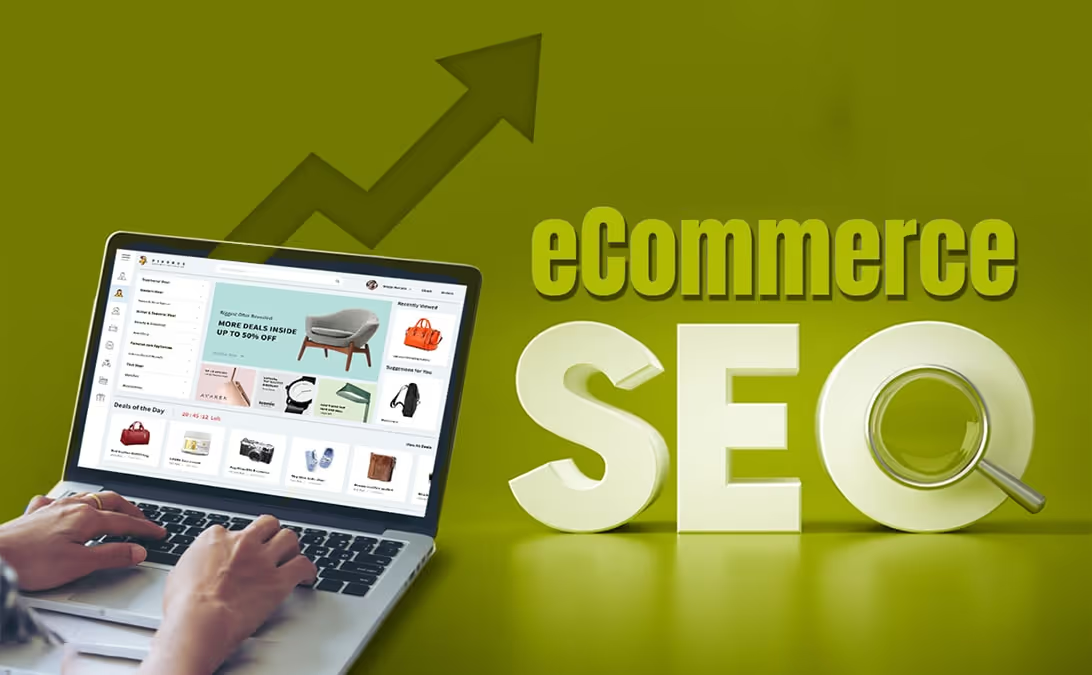
In any serious SEO for ecommerce site, category pages sit at the intersection of:
- Commercial search intent
- Scalable keyword targeting
- Internal authority flow
- Revenue impact
When users search for:
- “custom engraved metal signs”
- “industrial barcode labels supplier”
- “commercial stainless steel tools”
- “buy aluminum nameplates online”
Google typically ranks category or collection pages.
Why?
Because those queries signal buying intent. Users want product options — not informational blog content.
If your ecommerce SEO strategy prioritizes blog traffic before strengthening category architecture, you're optimizing secondary layers before fixing the foundation.
2. Category Pages Are Authority Hubs — Not Just Product Grids
Many ecommerce stores treat category pages as simple product listings with minimal text. That’s a structural mistake.
A properly optimized category page functions as:
- A commercial landing page
- A topical authority hub
- An internal linking distribution center
- A long-term ranking asset
Unlike product pages, which may rotate inventory, category pages persist. They accumulate authority over time.
In our structured ecommerce SEO strategy at Journeyhorizon, category pages are engineered — not filled.
3. What Proper Category Optimization Looks Like?
3.1 Intent-Based Keyword Architecture
Each category must map to a defined keyword cluster.
Before optimizing:
- Analyze the SERP.
- Identify whether Google favors category pages.
- Check if marketplaces (Amazon, Etsy) dominate.
- Evaluate the presence of Shopping Ads and AI Overviews.
Avoid:
- Keyword cannibalization between categories
- Thin subcategories without search demand
- Faceted filters generating uncontrolled indexable URLs
Structured targeting is critical in sustainable SEO for ecommerce.
3.2 Structured Decision-Support Content
Instead of adding filler text, build modular content blocks:
- Clear introductory overview
- Use cases
- Comparison guidance
- FAQ block
- Internal links to subcategories and best-sellers
- Trust signals (certifications, guarantees, case studies)
This improves:
- Search engine clarity
- Conversion performance
Strong category pages drive rankings and revenue simultaneously — which is the actual objective of SEO for ecommerce site growth.
4. Product Pages: The Conversion Engine
Once category pages are strong, product pages become the second priority.
A product page must:
- Remove hesitation
- Clarify specifications
- Build trust
- Reduce friction
Especially for custom or niche manufacturing ecommerce businesses, product pages should clearly outline:
- Customization options
- Production timelines
- Technical specs
- Real-world applications
- Shipping clarity
- Warranty and return policies
- Reviews
If customers need to email for basic clarification, the page lacks depth.
In many audits, we find that improving product clarity produces faster ROI than adding more backlinks.
=>>> Hire Technical SEO Services for Companies That Need Fixes, Not Just Audits
5. Technical SEO: Eliminate Structural Friction

Before scaling authority, fix structural inefficiencies.
Common ecommerce issues include:
- Faceted navigation creating thousands of low-value URLs
- Duplicate content from product variations
- Incorrect canonical tags
- “Crawled – currently not indexed” priority products
- Weak internal linking toward money pages
- Poor mobile performance
Google rewards crawl efficiency and clarity.
If your architecture leaks authority, link building won’t compensate.
Technical stability is foundational to any serious SEO for ecommerce implementation.
6. Backlinks: Build Context, Not Just DR
A recurring theme in the Reddit discussion on ecommerce SEO is the misconception around DR.
DR is a third-party metric. It is not Google’s ranking factor.
Instead of asking “How do I increase DR?”, ask:
- Where can my brand earn contextual authority?
- Which industry organizations can reference us?
- What partnerships can produce legitimate mentions?
Strong backlink sources include:
- Industry associations
- Trade publications
- Supplier or distributor pages
- Chamber of commerce listings
- Sponsorship pages
- Podcast interviews
- Case studies
In a mature ecommerce SEO strategy, backlinks amplify strong structure — they do not replace it.
7. Content Marketing: Support Commercial Pages
Blog content still matters — but only strategically.
Before publishing any article, ask:
Which category or product page does this support?
Effective content should:
- Address pre-purchase questions
- Compare product types
- Remove objections
- Internally link to commercial pages
Blogging without commercial alignment often results in traffic without transactions.
Strategic content strengthens topical clusters and reinforces category rankings in long-term SEO for ecommerce site performance.
What the Reddit Discussion Reinforces
In the Reddit thread discussing Best SEO Focus for Ecommerce Site, several experienced voices emphasized:
- Focus on category and product pages first
- Don’t obsess over DR
- Analyze SERPs before optimizing
- Ensure product pages are indexed and technically sound
This aligns directly with what we implement at Journeyhorizon when building scalable SEO for ecommerce frameworks.
The consensus is clear: structure before scale.
About Journeyhorizon
Journeyhorizon positions SEO not as a checklist of technical tasks, but as a revenue architecture strategy for Ecommerce and Marketplace businesses.
With hands-on experience implementing SEO for ecommerce site growth across niche manufacturing brands and competitive product-based businesses, our focus is clear: build strong commercial foundations first — especially category pages — then scale authority and content strategically. E-commerce sites should consider hire technical SEO expert, given the rapidly changing landscape of SEO today.
We do not prioritize vanity metrics or fragmented tactics. Instead, our strength lies in aligning SEO with business outcomes: improving category performance, strengthening product positioning, and ensuring that organic traffic translates into measurable revenue.
For Ecommerce brands that want structured, sustainable growth — not just traffic — SEO remains one of Journeyhorizon’s core competitive advantages.
FAQ: Best SEO Focus for Ecommerce Site
1. What is the most important SEO focus for an ecommerce site?
The most important SEO focus for an ecommerce site is category pages.
Category pages target high-intent commercial keywords, rank for broader transactional queries, and distribute authority to product pages. If your category structure is weak, blogging and link building will rarely produce sustainable growth in SEO for ecommerce.
2. How should a category page be properly set up?
A well-optimized category page should target a clear commercial keyword cluster and align the H1, meta title, and URL with that intent. It should include concise but strategic introductory content that helps users understand use cases and product differences, while also supporting internal linking to subcategories and key products.
From a technical perspective, filter-generated URLs must be controlled to avoid duplication, and relevant schema markup such as ItemList (and FAQ where appropriate) should be implemented. A category page should function as a commercial landing page — not just a product grid.
3. Should I focus on improving Domain Rating (DR)?
No. DR is a third-party metric and not a direct ranking factor.
Instead of chasing a score, focus on earning relevant backlinks from industry publications, partners, associations, and PR opportunities. Authority built through relevance and brand signals supports long-term ecommerce SEO performance far more effectively than artificial link volume.
4. Why does my ecommerce site get traffic but no sales?
This typically happens when informational content ranks but commercial pages are under-optimized. Category and product pages may lack strong keyword targeting, clear differentiation, trust signals, or structured internal linking toward conversion paths.
SEO for ecommerce must align with buying intent. Traffic alone does not generate revenue — commercial relevance does.
5. What is the right order to execute ecommerce SEO?
Start with category optimization, then strengthen product pages. Once those foundations are solid, address technical indexing issues and internal linking. Only after structural improvements should you scale backlinks and supporting content.
This order ensures that every SEO effort contributes directly to revenue growth rather than vanity metrics.