Sharetribe Marketplace Payment: The Complete Guide in 2026

Building a marketplace is an exciting challenge, but managing payments is often where real complexity begins.
In a typical store, money flows in a straight line. But in a traditional or a digital marketplace, you are playing traffic cop with other people's money - managing a messy triangle of buyers, sellers, and commissions.
At Journeyhorizon, we specialize in untangling these complexities of payments with top-tier security for Sharetribe founders, turning technical hurdles into smooth growth.
Ready to make sense of the chaos? Let’s dive into exactly how the Sharetribe Marketplace Payment system works and how to set it up for success.
1. What is Sharetribe marketplace payment?
At its simplest level, Sharetribe Marketplace Payment refers to the infrastructure that handles the movement of funds within a Sharetribe-powered platform. It covers the entire transaction lifecycle from the moment a buyer clicks "Book" to the moment funds reach the seller's bank account, regardless of the currency.
But here is the kicker: A marketplace payment system is fundamentally different from a regular checkout. It has to handle three critical layers seamlessly:
- Securing the funds from the buyer.
- Verifying the seller to prevent money laundering.
- Splitting the payment automatically, sending the commission to you and the earnings to the seller.
If you try to do this manually (collecting all money to your bank account and wiring it to sellers later), you are walking into a legal and operational minefield. Sharetribe automates this flow by integrating with compliant payment providers like Stripe, helping marketplaces manage payments efficiently while avoiding common legal and operational risks.
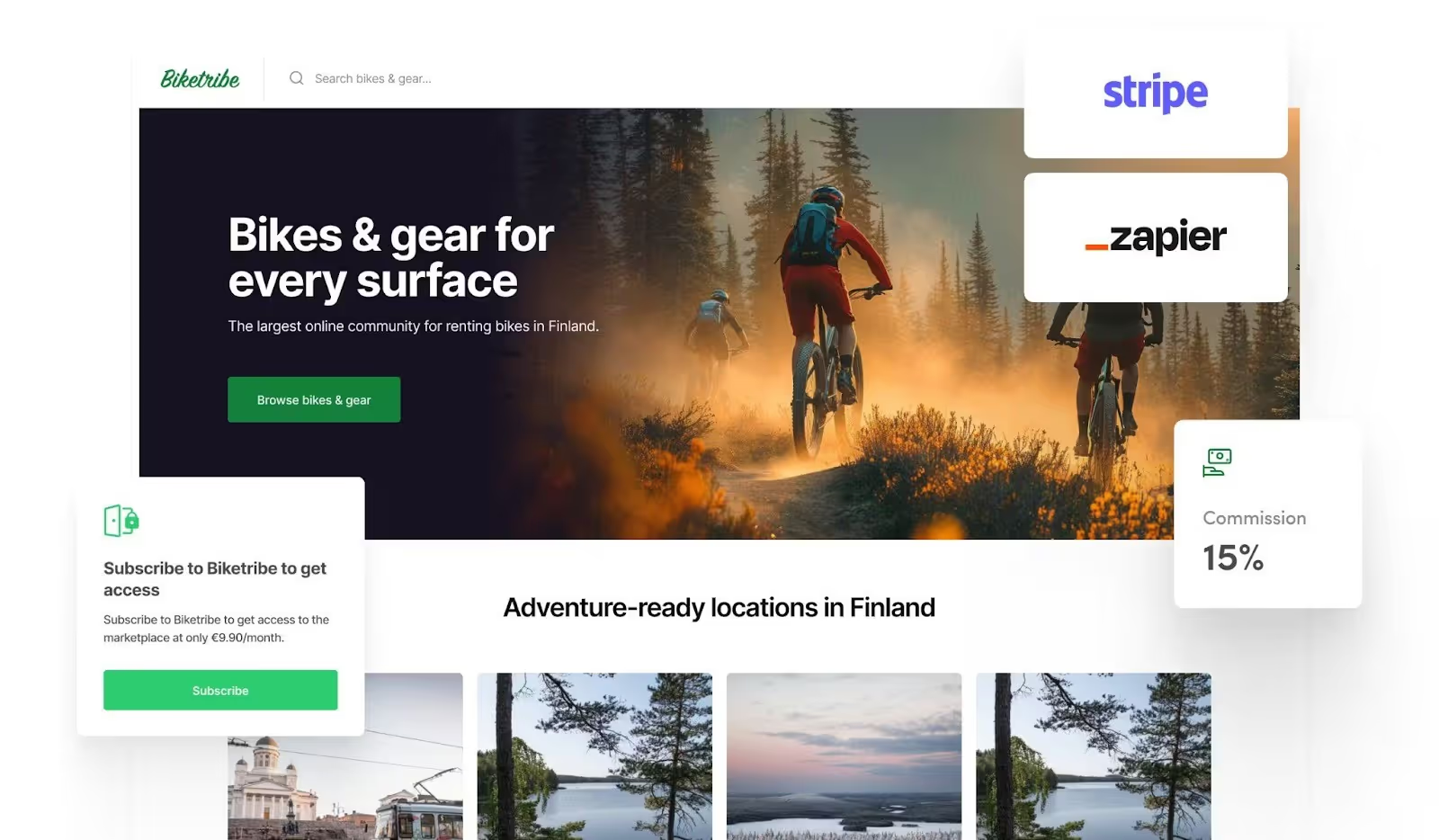
2. The 3-party problem: Why context matters
To understand the marketplace payment flow, you have to understand the players. In every transaction, there are three parties:
- The Buyer: Wants a smooth, secure way to pay.
- The Seller: Wants to get paid fast and transparently.
- The Platform (You): Needs to take a commission without directly holding seller funds, since doing so can trigger complex financial regulations such as money transmission laws.
Sharetribe’s architecture is built specifically to balance these three needs using a method called Delayed Payouts (often referred to loosely as escrow).
Note: While often compared to "escrow," this is technically a delayed payout model managed by Stripe. It functions similarly, holding funds until service delivery, but avoids the legal complexities of becoming a licensed escrow agent.
3. The Sharetribe marketplace payment flow: Step-by-Step
How does it actually look in the real world? Let’s break down the typical marketplace payment flow for a service or rental platform.
3.1. Checkout & request
The buyer finds a listing and sends a booking request. They enter their card details.
What happens: The payment is authorized through the payment provider to confirm the buyer has sufficient funds. Depending on the transaction setup, the payment may be authorized first and captured later, or captured upfront with the payout delayed.
3.2. Acceptance & delayed payout
When the seller accepts the booking, the payment is confirmed, but the funds are not released to the seller yet.
Why this matters:
Even though the buyer has paid, the payout is delayed. The payment provider manages this delay so funds are only released after the service takes place. This protects the buyer and reduces risk for the platform.
3.3. Service completion and commission logic
After the service is completed or the rental period ends, the transaction is finalized.
At this stage, the platform commission is applied and the payment is split logically between the platform and the seller. The platform does not need to manually calculate or distribute funds.
3.4. Payout to seller
Finally, the funds land in the seller’s bank account. This can happen immediately after completion or on a rolling schedule (e.g., weekly payouts) to protect against disputes.
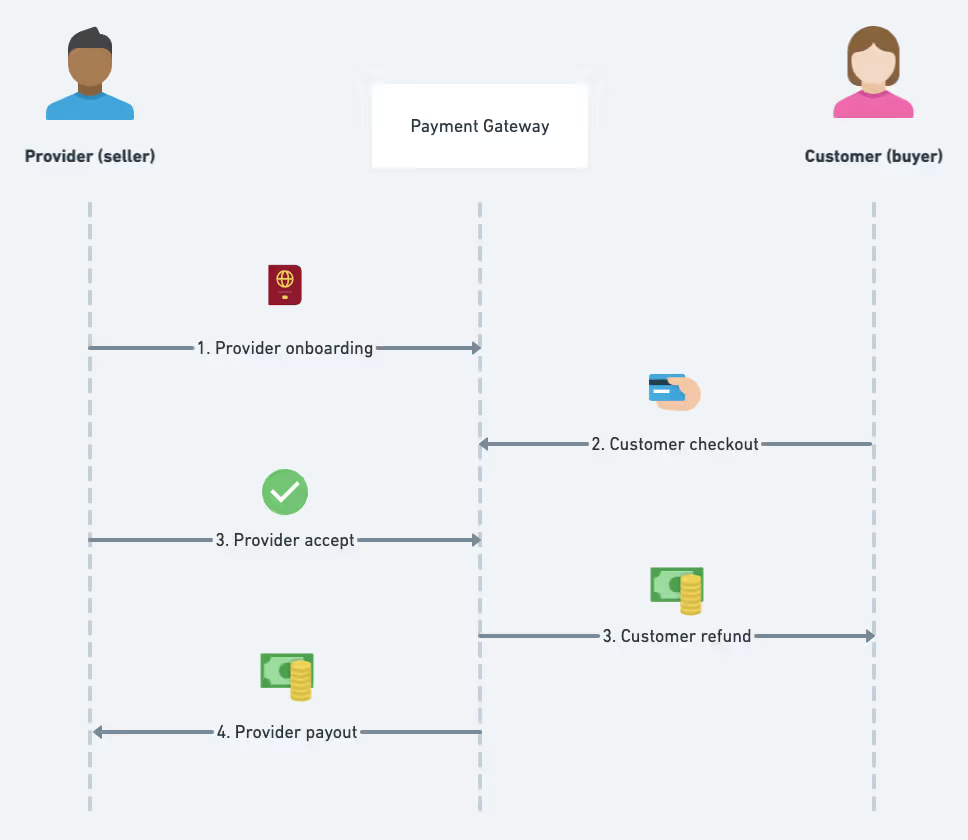
4. The engine room: Stripe Connect
By default, Sharetribe Marketplace Payment is powered by Stripe Connect.
Why Stripe? Because building a custom payment engine from scratch would cost you tens of thousands of dollars in development and legal fees. Stripe Connect is the gold standard for marketplaces because it handles the heavy lifting:
- Identity Verification: It handles seller identity verification as required by local regulations.
- Global Reach (With a Catch): Stripe accepts payments in 135+ currencies, meaning your buyers can be almost anywhere. However, note that your sellers must be located in one of the 46+ countries supported by Stripe to receive payouts.
- Dispute Handling: It provides a dashboard to manage refunds and chargebacks.
Pro Tip: While Sharetribe integrates seamlessly with Stripe, remember that Stripe allows you to customize the statement descriptor. Make sure buyers see your platform's name on their bank statement, not just "Stripe," to reduce confusion and chargebacks.
View our earlier post to see why Stripe is not the only choice for payment gateway in Sharetribe.
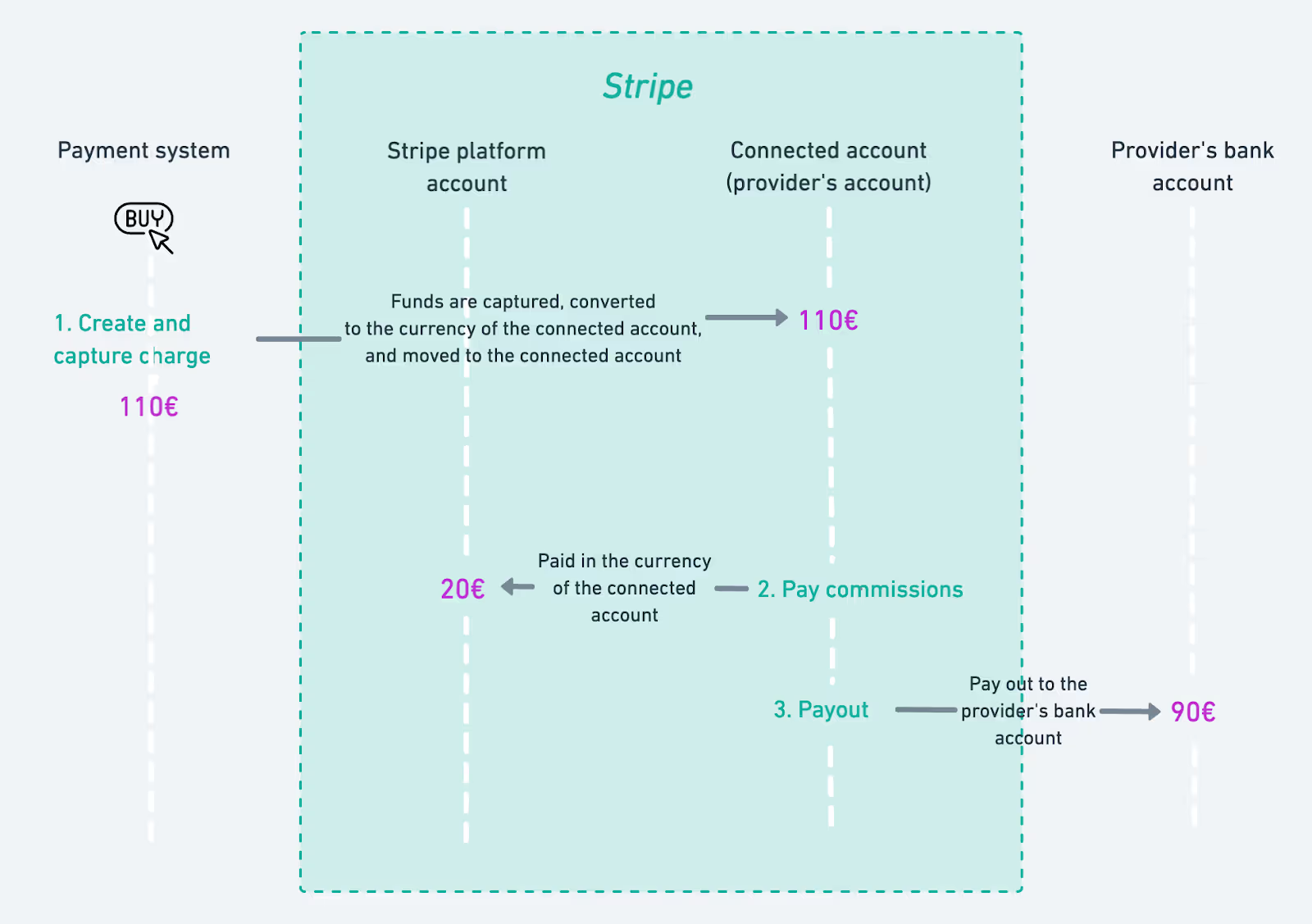
5. Push vs Pull payments: Designing the experience
When choosing your payment methods, you will often hear about "Push" and "Pull" payments. Understanding the difference is crucial for your user experience (UX).
5.1. Pull payments
In a pull payment, the buyer authorizes you to "pull" money from their account.
- Examples: Credit Cards, Debit Cards, Apple Pay, Google Pay.
- Pros: Extremely fast. Enables "one-click" payments and easy pre-authorizations (holding funds).
- Verdict: This is the standard for 90% of Sharetribe marketplaces because it reduces friction.
5.2. Push payments
In a push payment, the buyer must actively log in to their bank or app and "push" the money to you.
- Examples: Bank Transfers, Alipay, iDEAL (Netherlands), Bancontact (Belgium).
- Pros: Highly trusted in specific regions where credit cards are not popular.
- Cons: Harder to automate refunds and usually does not support "holding" funds effectively.
- Verdict: Best suited for local markets where bank-based payments are trusted and delayed payouts are not required.
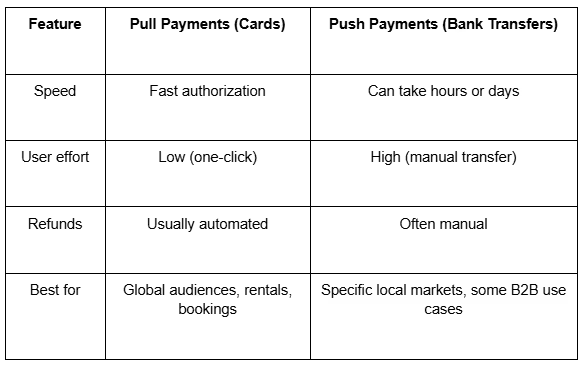
5.3. Push vs Pull payments: At a glance
6. Going beyond Stripe: Custom and local payment gateways
6.1. Is Stripe always the right payment solution?
This is a question we hear often at Journeyhorizon:
“Is Stripe always the right payment solution for my marketplace?”
The short answer: Stripe is a strong default, but it is not always the best long-term choice.
Sharetribe comes with Stripe pre-integrated and works well for many marketplaces in the US, Europe, and Australia. However, payment decisions should follow market behavior, not just default setups.
As marketplaces grow, Stripe alone may fall short when:
- Expanding into regions where bank-based payments or local wallets are more trusted than cards
- Serving users who prefer local transfer systems over international card networks
- Seeing lower checkout conversion due to limited local payment adoption
For example, marketplaces expanding into Indonesia, regional payment providers like Xendit are commonly used to support local bank transfers and wallet-based payments.
6.2. What it takes to use a custom or local payment gateway
Because Sharetribe relies on Stripe to handle core marketplace payment logic such as split payments, commissions, and payouts, introducing another payment provider requires custom implementation on top of Sharetribe’s marketplace APIs.
In practice, this means building and maintaining custom logic to:
- Collect payments from buyers using local or alternative payment methods
- Calculate and apply platform commissions correctly
- Distribute payouts to sellers in a compliant way based on local regulations
The key takeaway: choosing a custom or local payment gateway is not about replacing Stripe by default. It is a strategic decision driven by geography, user preferences, and growth plans. When aligned with the market, the right payment integration can unlock new regions and improve marketplace performance.
To explore how different payment gateways compare and when a custom solution actually makes sense, see our guide on choosing the best marketplace payment gateways.
Discover our Custom Marketplace Development: The Key to Building a Marketplace That Meets Your Needs to have guide to have a broader look of Custom Payment Gateways.
Journeyhorizon’s Field Notes: The "First Payout" Panic
From our experience launching 20+ Sharetribe marketplaces, we have identified a critical friction point that technical documentation often ignores: Seller Trust during the first transaction.
When using Stripe Connect Custom or Express, the very first payout to a new seller usually faces a mandatory 7-to-14 day holding period for risk assessment. We have seen marketplace owners panic because their early adopters (sellers) thought the platform was a scam when they didn't receive money immediately.
Our Advice to Clients: Don't just rely on Stripe’s default emails. We recommend building a dedicated "Seller Onboarding UI" or an automated email sequence that explicitly warns new sellers: "Your first payout will take 7 days to verify. Subsequent payouts will be processed in 2 days."
Managing expectations is just as important as managing the code.
7. Key strategic considerations
7.1. Geography: Where are your sellers?
This is the most critical question. With Sharetribe’s default Stripe setup, there is a golden rule:
- Buyers can be anywhere in the world (Stripe supports 135+ currencies).
- Sellers must be located in one of the 46+ countries supported by Stripe (mostly North America, Europe, Australia, and parts of Asia).
Note: If your sellers are based in countries not supported for Stripe payouts, the default payment flow will not work for them. In those cases, a custom payment gateway solution may be required. Always check seller payout availability with your payment provider before launching or expanding to a new market.
7.2. Compliance and trust
Your payment system is your first line of defense.
- Sellers are required to complete identity verification as mandated by the payment provider, typically Stripe, through Sharetribe’s onboarding flow.
- Verified sellers help reduce fraud risk and ensure your marketplace aligns with regulatory requirements.
7.3. The fee structure: Who pays what?
Founders often underestimate the true cost of a single transaction. Marketplace payments usually involve multiple layers of fees:
- Payment processing fees charged by the payment provider, which vary by country and payment method.
- Currency conversion fees when buyers and sellers use different currencies.
- Payout-related fees associated with transferring funds to sellers.
The strategy: You need to decide who eats these costs.
- Option A: You absorb them (Lower margins, happier users).
- Option B: You pass them to the seller (Higher commission).
- Option C: You add a "Service Fee" to the buyer at checkout to cover the processing costs.
7.4. Refund policy: Automation vs. Manual
Disputes will happen. You need a clear policy.
Note: Sharetribe handles full refunds automatically if a booking is rejected. However, complex rules (like "50% refund if cancelled 24h prior") usually require manual handling in the Stripe Dashboard or custom development. Be transparent with your users about what is automated and what takes time to process.
8. Journeyhorizon - A trusted partner for Sharetribe marketplace payment
Journeyhorizon helps founders design and implement Sharetribe marketplace payment systems that are compliant, scalable, and built for real-world marketplace operations.
Building on this payment expertise, Journeyhorizon also supports founders in building and scaling modern digital marketplaces using Sharetribe, providing the strategy, technology, and growth systems needed to move beyond launch and scale with confidence.
Our work spans the full marketplace lifecycle, including:
- Marketplace strategy and validation, helping founders choose the right business model, pricing logic, and market focus
- Sharetribe marketplace development End-to-end Sharetribe implementation, from initial setup to advanced customization using the Sharetribe platform and APIs.
- Marketplace operations design, covering seller onboarding, trust mechanisms, reviews, and transaction workflows
- Marketplace growth and SEO, driving qualified demand, organic traffic, and sustainable seller acquisition
- Replatforming and marketplace migration, supporting transitions from legacy platforms or early MVP setups to scalable architectures
Journeyhorizon helps founders design marketplaces where core systems, including payments, operations, and growth, work together as a cohesive engine rather than isolated features.
Beyond marketplace implementation, we also provides dedicated marketing services to help marketplaces grow. Discover our full range of Marketing services here.
9. Conclusion: Trust is Your Currency
A great Sharetribe Marketplace Payment setup is about more than just accepting money; it is about creating an environment where strangers feel safe doing business with each other.
Whether you need to integrate a local payment gateway, configure complex commission rules, or simply ensure your Sharetribe setup is launch-ready, Journeyhorizon is here to help. We specialize in turning complex marketplace ideas into smooth, working platforms.
10. FAQs
1. Is Stripe required for Sharetribe marketplace payment?
Yes. Stripe is the default payment provider for Sharetribe marketplaces, and most platforms use it. Other providers are possible but require custom development.
2. How does Sharetribe take platform commissions?
Sharetribe uses split payments to automatically deduct the platform commission and send the remaining amount to the seller without manual handling.
3. Does Sharetribe act as an escrow service?
No. Sharetribe does not provide escrow. Payments use delayed payouts managed by the payment provider, typically Stripe.
4. What payment methods are supported in Sharetribe?
Sharetribe supports cards, digital wallets like Apple Pay and Google Pay, and local bank-based methods, depending on country and provider support.
5. Can Sharetribe support international sellers and multiple currencies?
Yes. Sharetribe supports international payments and multiple currencies where the payment provider allows seller onboarding and payouts.
.avif)