Sharetribe vs Medusa: Which Platform Fits Your Marketplace
Building a marketplace requires choosing the right foundation from the start. The decision between platforms shapes everything from how quickly you launch to how much control you retain over your business logic. For marketplace founders, two platforms often emerge as frontrunners: Sharetribe and Medusa. Both are powerful, but they solve fundamentally different problems. Understanding which fits your business requires looking beyond the feature checklist to consider your team, timeline, budget, and long-term vision.
Journeyhorizon, a marketplace growth partner, works with founders building on both platforms and understands the nuances of this decision intimately. The choice between Sharetribe and Medusa often determines whether you reach profitability quickly or build a competitive moat through custom capabilities.

Sharetribe vs Medusa: What You're Actually Choosing
When comparing Sharetribe vs Medusa, you're not just comparing two platforms. You're choosing between two fundamentally different business models and operational realities. Sharetribe is a complete, hosted solution. It comes with everything pre-built: user authentication, payment processing, listings, messaging, and a marketplace interface. Medusa, by contrast, is an open-source backend engine. It gives you the commerce building blocks but requires you to build the marketplace experience around it.
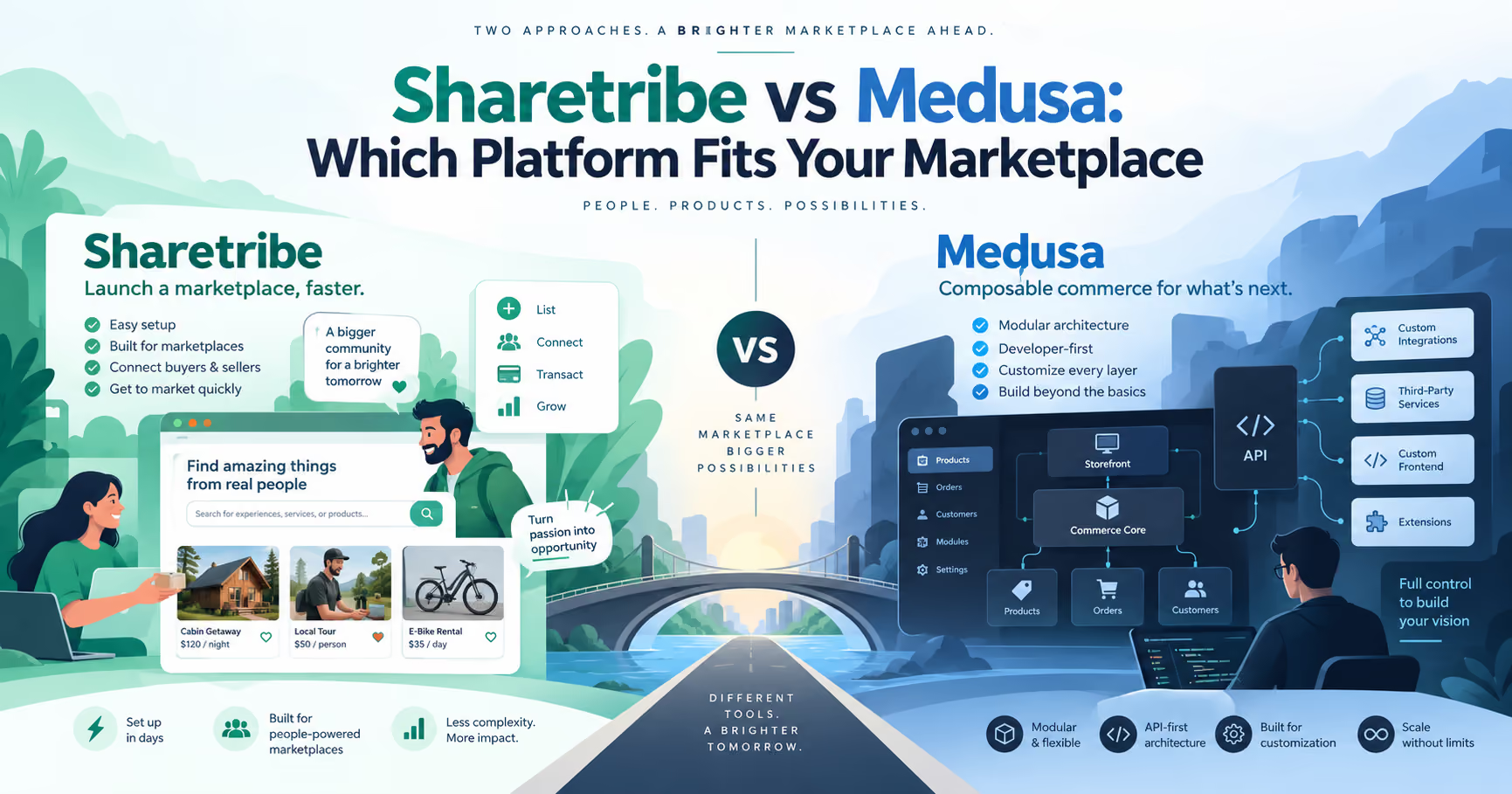
This distinction matters enormously. Choosing Sharetribe means prioritising speed to market and operational simplicity. You launch in days, not months. There's no server to manage, no infrastructure costs, no need for a dedicated technical team. Choosing Medusa means prioritising long-term control, customization, and the ability to build exactly what your business needs. It requires development resources, but gives you complete ownership of your data, code, and future direction.
=>>> Read More: How to Create a Marketplace Like Airbnb: Strategic Guide
Speed and Simplicity: Why Founders Choose Sharetribe
Sharetribe's core value proposition is undeniable for many marketplace founders. It removes the technical barrier to entry. You don't need to hire developers, set up servers, or understand databases. The platform handles hosting, security updates, and infrastructure scaling. Your job is validating your business model, acquiring your first vendors and buyers, and building a community.
For founders testing a rental marketplace, a services platform, or a peer-to-peer model, Sharetribe delivers this speed reliably. Its templated workflows match the patterns of successful two-sided marketplaces: listings, searches, booking flows, payments, and ratings. If your business model aligns with these patterns, you benefit from out-of-the-box functionality that took other marketplaces months to build.
The transaction fee model is predictable. You pay a monthly platform fee and a commission on sales. This is straightforward, though it means Sharetribe shares revenue as you scale. At high transaction volumes, those fees add up. Some founders find this acceptable as the cost of outsourcing platform operations entirely. Others see it as a long-term expense that compounds.
When considering Sharetribe vs Medusa, cost clarity matters. Sharetribe's financial model is transparent upfront. What you see is roughly what you'll pay.

Control and Customization: Why Developers Choose Medusa
Medusa represents the opposite philosophy. It's built for founders with development capability or budgets for technical teams. Rather than a finished product, Medusa is a modular framework. You get components like carts, orders, and products as building blocks. You integrate them into custom storefronts built with React, Next.js, or any modern framework.
The power lies in this modularity. You can replace any component. You can add custom pricing logic, complex inventory rules, vendor-specific workflows, or unique payment integrations. Product variants, warehouse management, B2B workflows, subscription products – Medusa doesn't force you into a particular business model. You architect the system your business actually needs.
For marketplace founders building on Medusa, this flexibility becomes a competitive advantage. One founder rebuilt their entire fulfillment system when their business model evolved. With Sharetribe, major changes often mean outgrowing the platform. With Medusa, you modify the engine.
The cost model differs fundamentally. Medusa is open-source and free. Your costs come from development time (whether in-house or outsourced) and hosting infrastructure. At scale, this can be more cost-effective than Sharetribe's transaction fees. At the beginning, the development investment is steeper.
=>>> Read More: Sharetribe vs Arcadier: Which Marketplace Platform is Right?
When Your Business Requires More Than Sharetribe Offers
The conversation around Sharetribe vs Medusa often turns practical when businesses hit platform constraints. A multi-vendor marketplace with complex product variants may struggle with Sharetribe's limitations. A services marketplace needing custom approval workflows or trust systems may find the platform too rigid. A product marketplace handling thousands of SKUs with inventory across multiple warehouses may need Medusa's flexibility.
Sharetribe can be customized, but within bounds. Developers connect to the Sharetribe API and build a custom frontend in React. This works well for design and user experience customization. But if your core business logic diverges significantly from Sharetribe's assumptions, you hit a ceiling. The backend remains proprietary. You can't modify transaction flows, inventory logic, or data models.
Many growing marketplaces eventually migrate from Sharetribe to a custom-built or Medusa-based solution precisely because they've outgrown these constraints. A platform that launched with Sharetribe's speed advantage can find itself limited when trying to scale or pivot.
The Team Question: Can You Support Your Choice?
Perhaps the most overlooked factor in the Sharetribe vs Medusa decision is team capability. Sharetribe requires minimal technical input. You can run it with a non-technical founder, a product manager, and a part-time designer. Growth comes through marketing, vendor relationships, and product refinement – not through development.
Medusa requires development resources. Not necessarily a full-time team, but access to developers who understand the codebase, can modify modules, handle deployments, and respond to bugs. This might be an in-house developer, a fractional technical cofounder, or an outsourced development team. Without this support, Medusa becomes expensive and difficult to operate.
This is why the decision is so personal. Some founders have developer talent available. Others don't. Choosing Medusa without development capability is setting yourself up for operational friction. Choosing Sharetribe when you have strong technical talent might mean leaving money on the table through higher platform fees as you scale.
The Growth Angle: Marketplace SEO and Authority
One underexplored angle in the Sharetribe vs Medusa discussion is search engine optimization and content authority. Both platforms can be optimized for SEO, but they require different approaches. Sharetribe's templated structure is clean and well-built, but every marketplace on the platform shares similar architecture. Your listings, category pages, and site structure follow predictable patterns. This is fine for brand visibility, but may limit your content authority.
Medusa, being headless and fully customizable, allows you to build unique content systems, category hierarchies, and vendor-specific landing pages that set you apart. Founders building growth-focused marketplaces often combine Medusa with sophisticated content strategies – blog posts, guides, vendor spotlights – because the platform doesn't constrain how you structure information.
For marketplaces where content, authority, and SEO are growth drivers, this flexibility matters. A rental marketplace with detailed guides for renters and sellers has a structural advantage over a generic marketplace. Medusa allows you to build this. Sharetribe constrains it.
Migration Realities: Moving Platforms Is Costly and Complex
Another practical consideration: platform migrations rarely go smoothly. If you start with Sharetribe and later outgrow it, moving to Medusa or a custom platform is a significant undertaking. Data migration, business logic translation, feature parity, testing, and user experience redesign all take time and money. The longer you operate on a platform, the deeper the integration, the more painful the migration.
This argues for thinking carefully about your long-term direction before choosing. If you believe your marketplace will eventually need Medusa's flexibility, you might start there despite the higher initial cost. If you're genuinely uncertain and want to validate your idea quickly, Sharetribe's lower risk makes sense – just understand the potential costs of outgrowing it later.
A Practical Framework for Your Decision
Start by asking yourself a few direct questions. First, how much development capability do you have access to? This answer largely determines whether Medusa is even viable. Second, does your business model align with Sharetribe's native strengths (P2P, rentals, services)? If yes, Sharetribe may be your best path. Third, how certain are you about your business model? If you're still validating, Sharetribe's speed is an asset. If you know your model and it's complex, Medusa's flexibility justifies the effort.
Fourth, what's your timeline and budget? Sharetribe gets you live faster and cheaper upfront. Medusa requires more time and money but costs less per transaction at scale. Fifth, how important is platform independence? If you value owning your stack completely, Medusa wins. If you're comfortable outsourcing platform operations, Sharetribe is simpler.
The choice between Sharetribe vs Medusa isn't a feature comparison. It's a strategic choice about how you'll build your business, how much technical debt you'll manage, and how much flexibility you'll need as your marketplace evolves.
Building on Your Choice: Where Growth Partnerships Matter
Regardless of which platform you choose, the difference between a struggling marketplace and a thriving one often comes down to execution. Sharetribe founders need strong product thinking and marketing capability. Medusa founders need development reliability and architectural clarity. Both need growth expertise – SEO, content, vendor acquisition, and community building.
Many marketplace founders build on Sharetribe marketplace development specifically because they want speed without sacrificing customization quality. Others choose Medusa because they need custom marketplace development that goes beyond standard patterns. What matters most isn't which platform you choose, but how well you execute on it and whether you have partners who understand your choice.
The marketplace founders building the most successful platforms today understand one thing: the platform is infrastructure. The real competitive advantage comes from how you grow it. This requires combining technical foundation with marketing strategy, SEO expertise, and marketplace-specific growth knowledge.
Conclusion: Choose Based on Your Reality, Not Just Your Vision
The Sharetribe vs Medusa question often gets framed as a technical decision. But it's really a business decision masquerading as a technology question. You're deciding how you want to operate. Do you want speed and simplicity, outsourcing platform management to let you focus on growth? Or do you want control and customization, accepting the operational burden in exchange for a uniquely tailored marketplace?
There's no universally correct answer. A service marketplace launched on Sharetribe with strong marketing and community focus can outcompete a Medusa platform built by a small team with limited growth capability. Conversely, a Medusa marketplace with a skilled development team and clear differentiation strategy can build moats that Sharetribe can't match.
What matters is making a conscious choice based on your situation, not defaulting based on what's trendy in discussions. Consider your development capability, your timeline, your budget, your business model clarity, and your long-term vision. Then commit to the platform that serves your actual situation – not the one that seems technically superior or fashionable in conversations.
The founders building thriving marketplaces today aren't those who spent months debating Sharetribe vs Medusa. They're the ones who made a decision quickly, executed well on their chosen platform, and focused on the real drivers of growth: validating their model, acquiring vendors and buyers, and building community. Your platform choice enables that growth. It doesn't determine it.
=>>> Related Post: Sharetribe vs Bubble: Which Platform Is Best for Your Marketplace?
Frequently Asked Questions
Can you migrate from Sharetribe to Medusa?
Technically yes, but it's complex and costly. You'd need to migrate data, rebuild workflows, redesign the user experience, and test thoroughly. Many founders find it's easier to rebuild on the new platform than migrate perfectly. The longer you operate on Sharetribe, the more painful this becomes. This is why choosing carefully upfront matters.
Which platform is better for sharetribe vs medusa marketplaces at different scales?
Sharetribe typically works best for early validation (0 to 50k transactions/month) and some mature marketplaces where customization needs are contained. Medusa works better for marketplaces with complex needs or specific technical requirements from the start. At very high scale (millions in GMV), many founders eventually choose custom-built solutions over both.
What's the true cost of each platform?
Sharetribe's cost is predictable: platform fee plus transaction fee. Medusa's cost is front-loaded (development) but ongoing costs are lower. At modest scale (under 100k/month GMV), Sharetribe is often cheaper. At large scale (millions/month), Medusa is typically more cost-effective due to transaction fees on Sharetribe compounds significantly.
Can you use Sharetribe and Medusa together?
Some advanced teams run parallel marketplaces or use both platforms for different purposes, but this adds complexity. Most founders choose one or the other. Hybrid approaches are possible but require strong technical management and careful planning.

.avif)