Sharetribe vs Bubble: Which Platform Is Best for Your Marketplace?

For marketplace founders evaluating platform options, the choice between Sharetribe vs Bubble often feels binary. It's not. Both solve the marketplace problem, but they solve it differently. Sharetribe starts you with structured marketplace logic already in place. Bubble starts you with a blank canvas and the tools to build that logic yourself. The real question isn't which platform is universally better, but which approach fits your business model, technical capacity, and growth timeline.
The Sharetribe vs Bubble decision affects how fast you launch, how much control you have over customization, and how scalable your architecture becomes. This guide cuts through the comparison noise and shows founders the practical differences that actually matter.
The fundamental difference: Platform design intent
Sharetribe and Bubble represent two completely different philosophies of marketplace software. Understanding this distinction makes the rest of the comparison clear.
Sharetribe is purpose-built for marketplaces. It ships with listing management, buyer-seller transactions, commission logic, and payment workflows already built in. You configure the marketplace, not the infrastructure underneath it. This means Sharetribe assumes a specific transaction model and constrains customization to work within that model.
Bubble is a general-purpose no-code application builder. It gives you database design, workflow logic, and UI control. You can build anything with it, including a marketplace, but you're starting from zero. The marketplace logic you need must be designed and implemented by you.
The Sharetribe vs Bubble decision is really about this: Do you want structured marketplace foundation with less flexibility, or maximum flexibility with more build responsibility?
=>>> Read More: Sharetribe vs Arcadier: Which Marketplace Platform is Right?
Speed to marketplace launch and MVP validation
For founders worried about time-to-market, this is the most practical consideration in the Sharetribe vs Bubble comparison. Both platforms claim to help you launch quickly, but the timeline differs significantly based on marketplace complexity.
Sharetribe typically delivers an MVP marketplace faster when your transaction model fits the platform's standard structure. Because listing creation, buyer-seller matching, and payment processing are already implemented, you can focus on configuration and market validation. Many Sharetribe customers launch within days or weeks. The catch: if your marketplace deviates from a standard two-sided model, you lose this speed advantage.
Bubble requires more upfront architectural thinking. You must design how listings work, how buyers and sellers interact, how payments are split, and how disputes are handled. This adds weeks or months to launch, depending on complexity. But if your business model is non-standard, Bubble's flexibility can actually be faster than fighting Sharetribe's constraints.
The practical framework: If your marketplace follows building a traditional service marketplace, rental, or product exchange model, Sharetribe is probably faster to MVP. If your marketplace has custom workflows or hybrid transaction types, Bubble may reach validation sooner, despite more initial build work.
Customization freedom versus architectural safety
Marketplace founders eventually face customization needs. The question becomes: How much control do you need, and what's the cost of having it?
In the Sharetribe vs Bubble comparison, Sharetribe constrains customization to preserve marketplace integrity. You can modify the UI, add fields, integrate external tools, and extend functionality through plugins. But you cannot fundamentally change how transactions work or how the platform handles core marketplace logic. This constraint is deliberate. It prevents architectural decisions that break the marketplace later.
Bubble gives you unlimited customization freedom. If you want a unique transaction flow, custom commission structure, or hybrid buyer-seller model, you build it. The tradeoff is that you own the entire architecture. Mistakes in database design or workflow logic compound as you scale. What feels fast and flexible at launch can become a maintenance burden at scale.
Successful marketplace founders on Bubble often say they had to learn marketplace architecture the hard way. Successful marketplace founders on Sharetribe often say they focused on business differentiation instead of building plumbing.
=>>> Related Post: How to Create a Marketplace Like Airbnb: Strategic Guide
SEO and marketplace discoverability
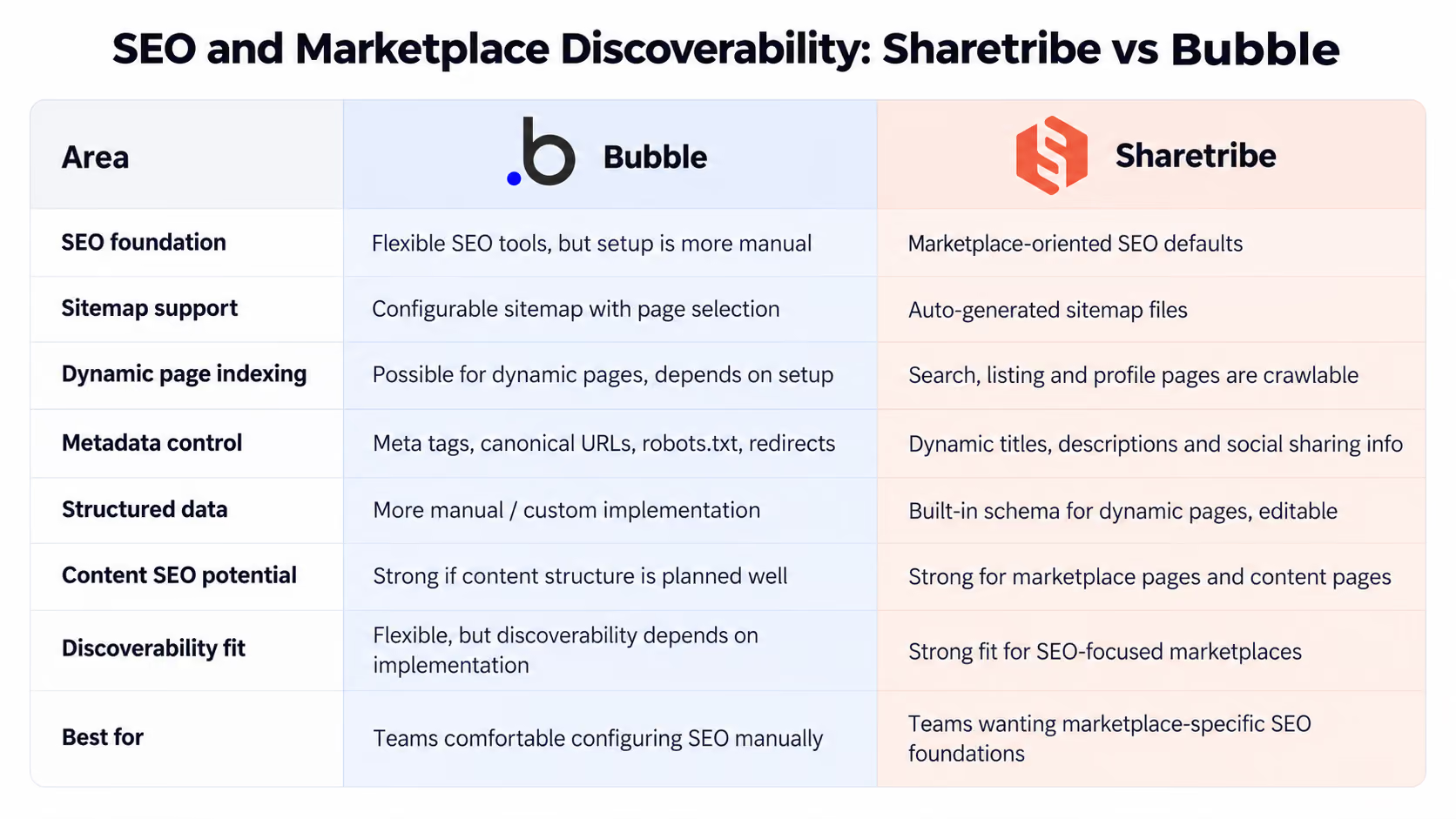
For marketplaces built to grow, search visibility matters enormously. Listings, categories, and content need to rank. The Sharetribe vs Bubble SEO comparison shows different strengths.
Sharetribe provides built-in category structure and listing architecture designed for search. URLs are clean, category hierarchies are editable, and listing metadata is structured. This head start helps, but SEO still requires strategy. You need clear category logic, keyword-aligned content, internal linking, and attention to page speed. Sharetribe makes this easier by handling the foundational architecture, but success still depends on execution.
Bubble gives you full URL control and metadata flexibility, but you must architect the entire listing and category system yourself. You decide the URL structure, metadata fields, internal linking, and page generation logic. This flexibility is powerful if you understand marketplace SEO. It's a liability if you don't. Technical SEO expertise becomes more critical with Bubble because mistakes in URL strategy or page structure can cripple discoverability.
Realistically, both platforms can support strong marketplace SEO. The difference is that Sharetribe requires less SEO design work upfront, while Bubble requires more strategic planning to avoid pitfalls.
=>>> See More: Sharetribe vs Medusa: Which Platform Fits Your Marketplace
Scalability and long-term architecture
As marketplaces grow from hundreds of listings to thousands to millions, architecture decisions made early start to matter intensely. The Sharetribe vs Bubble scalability question is: Which platform prevents architectural mistakes that sink performance later?
Sharetribe scales predictably when your marketplace stays within structured transaction models. The platform handles listing databases, transaction processing, and payment workflows at scale. You don't redesign the core system as traffic increases. This reliability comes from constraints. Sharetribe designed its architecture for marketplace growth, and you benefit from that foresight.
Bubble scales based on how well you designed it. If your workflows are efficient, your database queries are optimized, and your logic is lean, Bubble scales. If you built inefficient transaction flows, over-complicated listing logic, or bloated workflows, performance degrades as traffic grows. Scaling Bubble often requires refactoring work that could have been prevented with better upfront architecture.
Pragmatically, marketplace founders who scaled successfully on Bubble often invested in custom marketplace development help early. Founders who scaled on Sharetribe typically added features and optimizations within the platform's structure.
Making the choice: When to pick each platform

The Sharetribe vs Bubble decision becomes clear when you map your specific needs. Use this framework to decide:
Choose Sharetribe if:
Choose Bubble if:
Honest truth: Most founders underestimate the complexity of marketplace architecture. Even founders building on Bubble often end up wishing they'd started on a structured platform. If you're unsure which bucket you fall into, default toward Sharetribe's structure. You can always add customization later. Adding structure after building poorly is much harder.
Partnering for marketplace success
Many marketplace founders choose their platform but lack the expertise to implement it optimally. Whether you're building on Sharetribe or Bubble, strategic custom marketplace development matters.
Journeyhorizon works with founders across both platforms, but specialises in Sharetribe marketplace development, optimization, and growth. As a Sharetribe partner, Journeyhorizon helps founders launch marketplace MVPs quickly, structure listings and categories for SEO, integrate with external tools, and build custom plugins that extend the platform. The focus is on combining technical implementation with marketplace growth strategy so your platform supports real business goals.
For Bubble-based marketplace projects, the principles are similar: strong architecture, SEO-ready structure, and growth-focused implementation. The difference is that Bubble projects often require more architectural guidance upfront to avoid decisions that create problems later.
Frequently Asked Questions
What's the cheapest way to build a marketplace, Sharetribe or Bubble?
Price depends on complexity more than platform. Both charge subscription fees. Sharetribe pricing is based on transaction volume and marketplace size. Bubble pricing is based on usage and application complexity. For a standard marketplace MVP, Sharetribe is often cheaper because you're not building from scratch. For highly customized marketplaces, pricing depends on implementation scope, not platform choice.
Can I migrate from Bubble to Sharetribe or vice versa?
Technically possible but not simple. You'd need to export data, transform it to match the new platform's structure, and rebuild any custom logic. Migration is a significant project. Choose your platform assuming you'll stay there for at least 2-3 years. If you're uncertain at launch, default toward the structured platform (Sharetribe) and add customization later, rather than starting custom and adding constraints.
Which platform is better for international marketplaces?
Both support multi-currency and multi-language. Sharetribe has built-in payment integrations across regions. Bubble requires you to configure payment gateways and currency handling. For purely global operation, Sharetribe's infrastructure is simpler. For complex regional requirements, Bubble's flexibility may be necessary.
Do I need a developer for Sharetribe vs Bubble?
Sharetribe requires less development for core functionality but benefits from technical help for optimization, integrations, and customization. Bubble requires more development upfront because you're building marketplace logic, not just configuring it. Both platforms can benefit from expert help, especially in the first year.