Sharetribe vs Izberg: Which Marketplace Platform Fits Your Business?

Choosing the right marketplace platform is one of the most critical decisions you'll make as a founder. Your choice affects everything from how quickly you can launch, how much you can customize your platform, and ultimately, how efficiently you can scale. When comparing Sharetribe vs Izberg, you're looking at two platforms with very different philosophies: Sharetribe has built its reputation as a SaaS marketplace solution with a balance between pre-built features and customization, while Izberg positions itself as a modular, API-first marketplace platform designed for businesses that need deeper flexibility from day one.
Both platforms attract marketplace founders, but they serve different needs. Understanding their strengths, limitations, and where they diverge will help you make a more confident decision. This comparison cuts through the sales messaging and focuses on what actually matters to founders building real marketplaces.
What Are Sharetribe and Izberg?
Sharetribe is a SaaS marketplace platform that launched over a decade ago and has become one of the more recognizable names in the space. It positions itself as a complete marketplace solution with out-of-the-box features for handling two-sided marketplaces, vendor management, payments, and basic customization. Sharetribe attracts founders who want to move fast with a proven product without building everything from scratch.
Izberg is a more recent entrant that takes a different approach. Rather than offering a traditional SaaS product, Izberg is built on a REST API architecture. It emphasizes modularity, meaning you choose which components you need and integrate them into your own infrastructure. This makes Izberg appeal to founders who either have technical capacity internally or are comfortable working with custom development partners.
The key difference isn't just feature set: it's about control, flexibility, and how tightly you're locked into each vendor's vision of what a marketplace should be.

=>>> Read More: Sharetribe vs Medusa: Which Platform Fits Your Marketplace
Platform Architecture and Customisation Capabilities
Where Sharetribe vs Izberg diverge most clearly is in architecture. Sharetribe is a hosted SaaS platform. You sign up, configure your marketplace within the constraints of what Sharetribe has built, and go live. Customization happens through Sharetribe's admin interface, some configuration options, and limited custom development. If you need something outside the platform's design, you're often forced to work around it or hire a Sharetribe specialist to implement custom logic.
Izberg's API-first approach is fundamentally different. You're not locked into a single platform interface. Instead, you're building your marketplace using modular components via REST APIs. This means you can integrate other services, build custom workflows, and design an experience tailored to your exact requirements. The tradeoff is that you need more technical expertise or a development team to assemble these pieces.
For founders with straightforward marketplace needs, Sharetribe's approach is faster. You get a working marketplace quickly. For founders with specific requirements or unique value propositions that depend on customization, Izberg's modularity gives you more control but requires more development investment upfront.
=>>> Related Post: Sharetribe vs Arcadier: Which Marketplace Platform is Right?
Pricing and Transparency
Sharetribe publishes its pricing openly. You can see the costs on their website, understand the tiers, and calculate roughly what you'll pay as you scale. This transparency makes budgeting easier, though Sharetribe's costs do increase as transaction volume grows. For early-stage marketplaces, the entry price is manageable. As you scale, you need to evaluate whether their per-transaction fees remain competitive for your business model.
Izberg doesn't list public pricing. Instead, they work on a custom quote model. This approach gives Izberg flexibility to tailor pricing to your use case, but it means you can't easily compare upfront or predict costs without a sales conversation. For founders bootstrapping or moving through quick iterations, this opacity can be frustrating. For larger operations, custom pricing negotiation may actually work in your favor.
When evaluating Sharetribe vs Izberg on cost, consider not just platform fees but also development costs. Izberg's flexibility sounds attractive until you realize you'll likely need a skilled development team to realize that flexibility. Sharetribe's simplicity keeps development costs low initially but may lock you into higher platform fees long-term.
=>>> Related Post: Sharetribe vs Bubble: Which Platform Is Best for Your Marketplace?
Features and Marketplace Capabilities
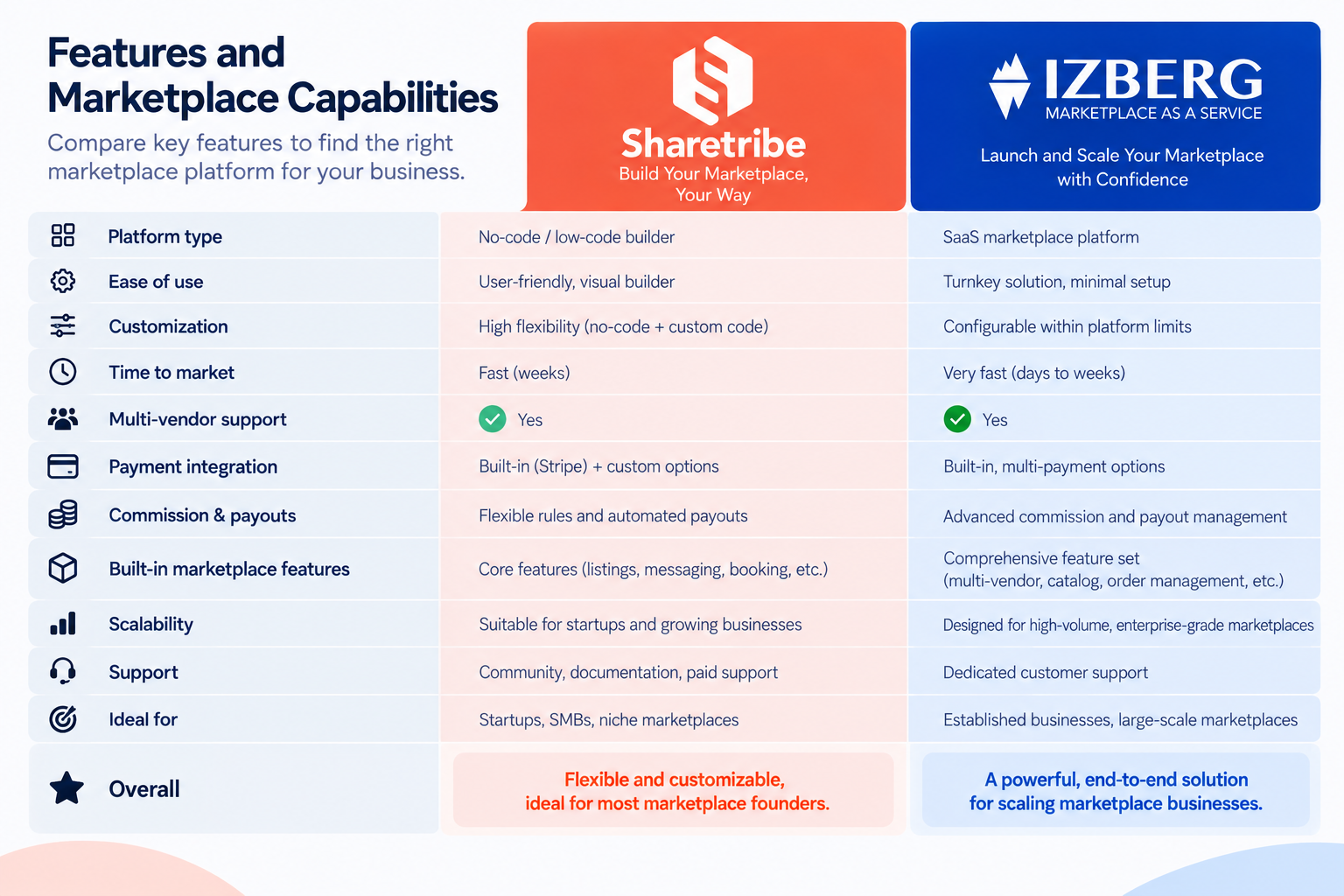
Both platforms handle core marketplace functions: two-sided transactions, vendor onboarding, payment processing, ratings and reviews, and order management. Where they differ is in how opinionated the implementation is and how easily you can adapt it.
Sharetribe includes built-in features for commission management, vendor payouts, dispute resolution, and mobile app templates. These features are solid and designed from experience running thousands of marketplaces. The downside: you use them the way Sharetribe designed them. If your marketplace needs a different commission model, a unique payout schedule, or custom vendor workflows, you'll hit limitations quickly.
Izberg's modular approach means you get to decide what features you want to implement. Need a complex commission structure with tiered vendor levels? You can build it. Need real-time inventory sync with third-party suppliers? You can integrate it. This flexibility is powerful, but it requires technical vision and development capacity to make decisions about what to build.
On emerging capabilities like AI-powered recommendations, dynamic pricing, and advanced vendor analytics, both platforms are evolving. Sharetribe is adding these incrementally to its platform. Izberg's API approach means you can integrate specialized AI tools independently. Neither has a decisive edge here, but your choice depends on whether you prefer bundled features or the ability to handpick best-of-breed solutions.
=> See More: Sharetribe vs Kreezalid: Choose Your Marketplace Platform
Which Platform Should You Choose?
The decision between Sharetribe and Izberg comes down to three factors: speed to launch, customization needs, and technical capacity.
Choose Sharetribe if you want to launch quickly with minimal custom development, your business fits within standard marketplace patterns, and you value predictable, published pricing. Sharetribe works well for service marketplaces, rental platforms, and product-focused two-sided networks that don't require highly customized experiences. The community of Sharetribe developers is also mature, so hiring support is easier.
Choose Izberg if you have unique marketplace requirements that a standard SaaS platform won't accommodate, you can afford custom marketplace development, or you have technical capacity on your team. Izberg suits enterprise marketplaces, specialized B2B platforms, and businesses where differentiation depends on platform capabilities you can't get off-the-shelf. Izberg is also worth considering if you want to retain more control over your technology stack long-term.
The middle ground matters too. Many marketplace founders start with one platform and later realize they need customization beyond what it offers. Whether you choose Sharetribe or Izberg, knowing when to engage Journeyhorizon or another custom development partner makes the difference. A specialist partner can extend Sharetribe through custom plugins and integrations, or help you architect and build on Izberg's API-first approach. The platform choice isn't final if you have the right support.
=> Read More: Sharetribe vs Mirakl: Platform Comparison for Marketplace Founders
Frequently Asked Questions
Can you migrate from Sharetribe to Izberg later if your needs change?
Yes, but it's not trivial. Both platforms support data export and API access, so theoretically you can move your data and recreate your marketplace on a new platform. In practice, user experience changes, workflow adjustments, and integration rebuilds make migration a significant project. Plan your initial platform choice assuming you might be on it for at least two years.
Does Sharetribe vs Izberg matter more for marketplace success than marketing and growth?
Not really. Platform choice affects execution speed and customization options, but marketplace success is driven by network effects, supply-side activation, and demand-side acquisition. A founder with a great marketplace idea, solid go-to-market strategy, and adequate development resources can succeed on either platform. Choose the one that removes friction from your path to market.
What if I need both speed and customization?
That's where custom development comes in. Many successful marketplace founders launch on Sharetribe for speed, then layer custom development on top to add differentiation as they grow. Alternatively, some start with Izberg's flexibility but use pre-built vendor packages or templates to accelerate development. The key is matching your launch timeline with your customization roadmap.
Which platform scales better for large marketplaces?
Both scale, but differently. Sharetribe scales to millions in GMV, but at higher platform costs. Izberg's API-first architecture means infrastructure scales based on what you build, giving you more control but requiring architectural decisions. Large marketplace operators often use Izberg because custom infrastructure can be more cost-efficient at scale. For mid-market marketplaces, Sharetribe's all-in-one approach often remains competitive.
The choice between Sharetribe vs Izberg is ultimately a trade-off between simplicity and control. Neither platform is universally better, and both are run by capable teams. What matters is matching your platform to your timeline, budget, and technical capacity. If you're still uncertain after this comparison, talking through your specific requirements with experienced marketplace developers can clarify which direction makes sense for your business.