Sharetribe vs Mirakl: Platform Comparison for Marketplace Founders

Choosing a marketplace platform is one of the most consequential decisions you'll make as a founder or marketplace operator. Sharetribe vs Mirakl sits at the heart of many conversations in the marketplace development community, and for good reason: both platforms have solid reputations, but they serve very different market segments and solve different problems.
The right choice depends on whether you're launching an MVP quickly with limited resources, or whether you're a large enterprise adding marketplace capabilities to an existing operation. This guide cuts through the hype and helps you understand which platform truly fits your business model, budget, and growth stage.
Understanding Sharetribe and Mirakl: Market Positioning
Mirakl and Sharetribe both solve marketplace problems, but they approach the challenge from fundamentally different angles. Mirakl is enterprise-first: it's built for large retailers and B2B operators who want to add a managed marketplace to an existing eCommerce operation. Think of legacy retailers launching new seller ecosystems, or established brands expanding assortment without holding inventory. Mirakl's architecture reflects this: modular, API-driven, and designed to integrate with existing retail tech stacks.
Sharetribe, by contrast, is founder-first. It's built for entrepreneurs and growing marketplace operators who need to launch quickly, validate the market, and scale without excessive technical overhead. Whether you're building a P2P rental platform like Airbnb, a services marketplace like Fiverr, or a product listing site like Etsy, Sharetribe provides the core features in a pre-built, opinionated stack.
When evaluating Sharetribe or Mirakl, recognise that this isn't a feature-parity question. Mirakl is more powerful for complex retail scenarios. Sharetribe is more efficient for marketplace founders. The best platform is the one that matches your stage, budget, and operational model.
=> Read More: Sharetribe vs Medusa: Which Platform Fits Your Marketplace
Key Differences in Platform Architecture
The technical underpinnings reveal why these platforms diverge so sharply. Mirakl is highly modular: you can choose your tech stack, build custom integrations, and architect nearly any workflow. This flexibility is a superpower for enterprises, but it comes with a cost: you need developer resources, and implementation timelines stretch into months. Mirakl doesn't assume much about how you'll use it, which means more configuration and coding upfront.
Sharetribe takes the opposite approach. It ships with a cohesive, opinionated stack: React frontend, flexible backend, and pre-built marketplace operations (payments, seller management, reviews, listings, transactions). This means faster time to value for founders, but less flexibility if your business model deviates far from what the platform assumes. That said, Sharetribe includes APIs and a self-hosted option (Flex) for teams that need to build custom features once they've validated the core business.
In Sharetribe vs Mirakl architecture terms, Sharetribe is "batteries included" whilst Mirakl is "building blocks only". For an MVP-stage marketplace, this difference is massive. You'll be live in days or weeks with Sharetribe, versus months with Mirakl.
=> Related Post: Sharetribe vs Arcadier: Which Marketplace Platform is Right?
Pricing and Cost Implications
Pricing often decides marketplace platform conversations before they begin. Sharetribe's pricing is transparent and published: Build plans start at AUD 39/month, and live plans from AUD 99/month. There are no hidden fees, no percentage-of-GMV clauses for startups, and no requirement to hire expensive integrators before you can launch.
Mirakl's pricing is not publicly disclosed. Instead, you fill a contact form, speak to their sales team, and receive a custom quote. Enterprise-grade platforms often work this way, and there's a reason: the cost scales with your scale, your integration complexity, and your annual transaction volume. For a large retailer running thousands of sellers and millions in GMV, that model makes sense. For a startup validating a marketplace concept, it's prohibitive.
Beyond base subscription, consider implementation and integration costs. Sharetribe's founders can implement independently or hire a Sharetribe developer when needed. Mirakl's implementation complexity often requires hiring a certified partner and dedicated professional services, adding tens of thousands to total cost of ownership. By the time you factor in configuration, custom development, and ongoing support, a Mirakl deployment can be several times more expensive than Sharetribe in the early years.
For a bootstrapped founder or venture-backed startup, this cost difference shapes the entire business economics. Mirakl vs Sharetribe pricing isn't just a line-item difference; it's a strategic constraint on how fast you can iterate and validate.
=> See More: Sharetribe vs Bubble: Which Platform Is Best for Your Marketplace?
Speed to Market and Implementation Reality
Time to launch is non-negotiable in custom marketplace development business. Validation matters more than perfection, and the faster you're live, the sooner you learn what your market actually wants.
Sharetribe is built for speed. Most founders can launch a live marketplace in one day using the Console (no-code builder). Setting up payments, seller onboarding, listing flows, and reviews happens through configuration, not custom code. A 14-day free trial lets you prototype before committing any budget. Real founders and teams report launching MVPs in days or weeks.
Mirakl's time to launch averages four months or more. This isn't because Mirakl is slow; it reflects the platform's architecture. Configuration is deeper, integration with your existing systems is more complex, and professional services are typically required. For enterprise customers, this implementation timeline is normal and acceptable. For founders bootstrapping a new idea, it's a deal-breaker.
In the Sharetribe vs Mirakl race for market entry, Sharetribe wins decisively. But this only matters if you're a founder or a company in discovery mode. If you're an established retailer adding marketplace revenue, the extra months are acceptable.
Customisation, Plugins, and Scaling Beyond MVP
Every successful marketplace eventually outgrows its no-code boundaries. Founders need custom workflows, integrations with external systems, or marketplace features not shipped by default. How each platform handles this pivot is critical.
Sharetribe's expansion strategy includes Sharetribe Services, a self-hosted headless option that gives developers full control. You can build custom UI, integrate with any backend, and implement features the core platform doesn't ship. This path works well for teams that start with Go (no-code) and graduate to Flex (custom development) as the business scales. The plugin ecosystem and marketplace integrations also extend capability without requiring custom code.
Mirakl's customisation path is the entire platform. Because Mirakl assumes you'll build custom logic, unlimited customisation is already built in. There's no "upgrade to a more powerful tier"; you're always in developer mode. This is powerful for enterprises, but it means custom development costs are baked into every implementation.
For a founder launching a niche marketplace, Sharetribe's Go + Flex model is more cost-effective: you validate for AUD 39/month first, then invest in custom development only when the unit economics justify it. For a retailer launching a managed seller platform, Mirakl's developer-first model is more familiar and integrates better with enterprise workflows.
=> Related Post: Sharetribe vs Kreezalid: Choose Your Marketplace Platform
Support for Different Marketplace Types
Not all marketplaces are created equal. The platform you choose should match the core business model and transaction type you're building.
Sharetribe excels at peer-to-peer and managed-supply marketplaces: rentals (Airbnb model), services (Fiverr model), and product listings (Etsy model). These marketplaces often have individual sellers, complex review systems, availability calendars, and service-provider profiles. Sharetribe ships with strong defaults for all of these.
Mirakl is purpose-built for B2C and B2B retail: adding third-party sellers to a retail storefront. Mirakl's strength is seller onboarding, catalog management, and multi-seller checkout at scale. If you're running a hosted marketplace for hundreds or thousands of retail partners, Mirakl's seller operations tooling is industry-leading.
This matters because choosing the wrong platform means fighting the defaults. Building a B2B seller ecosystem on Sharetribe requires custom work. Building an Airbnb-style rental platform building on Mirakl is similarly painful. In Sharetribe vs Mirakl conversations, always anchor on your core business model first.
Migration and Upgrade Paths
If you're already running a marketplace on another platform and wondering whether to migrate, the calculus is different.
Migrating from one marketplace platform to another is complex: you're moving seller accounts, listings, transaction history, reviews, and payments. Both Sharetribe and Mirakl can handle migration, but the lift depends on your current system, data cleanliness, and feature mapping.
Sharetribe provides migration support and has helped operators switch from other platforms. The migration is often fastest if you're leaving a smaller or older platform; moving from Mirakl to Sharetribe is more involved because Mirakl typically runs custom workflows and integrations that don't map 1:1.
For operators already running a marketplace and considering Mirakl, the upgrade path is usually expansion rather than full migration. You're adding modules, extending seller capabilities, or integrating with retail systems. This plays to Mirakl's strength in modular architecture.
If you're operating a marketplace that's outgrowing its original platform, custom marketplace development services can bridge the gap, handling data migration, custom integrations, and ensuring continuity whilst you transition systems. This is especially valuable if your current platform lacks the advanced features or marketplace operations tooling you need to scale.
Making the Choice
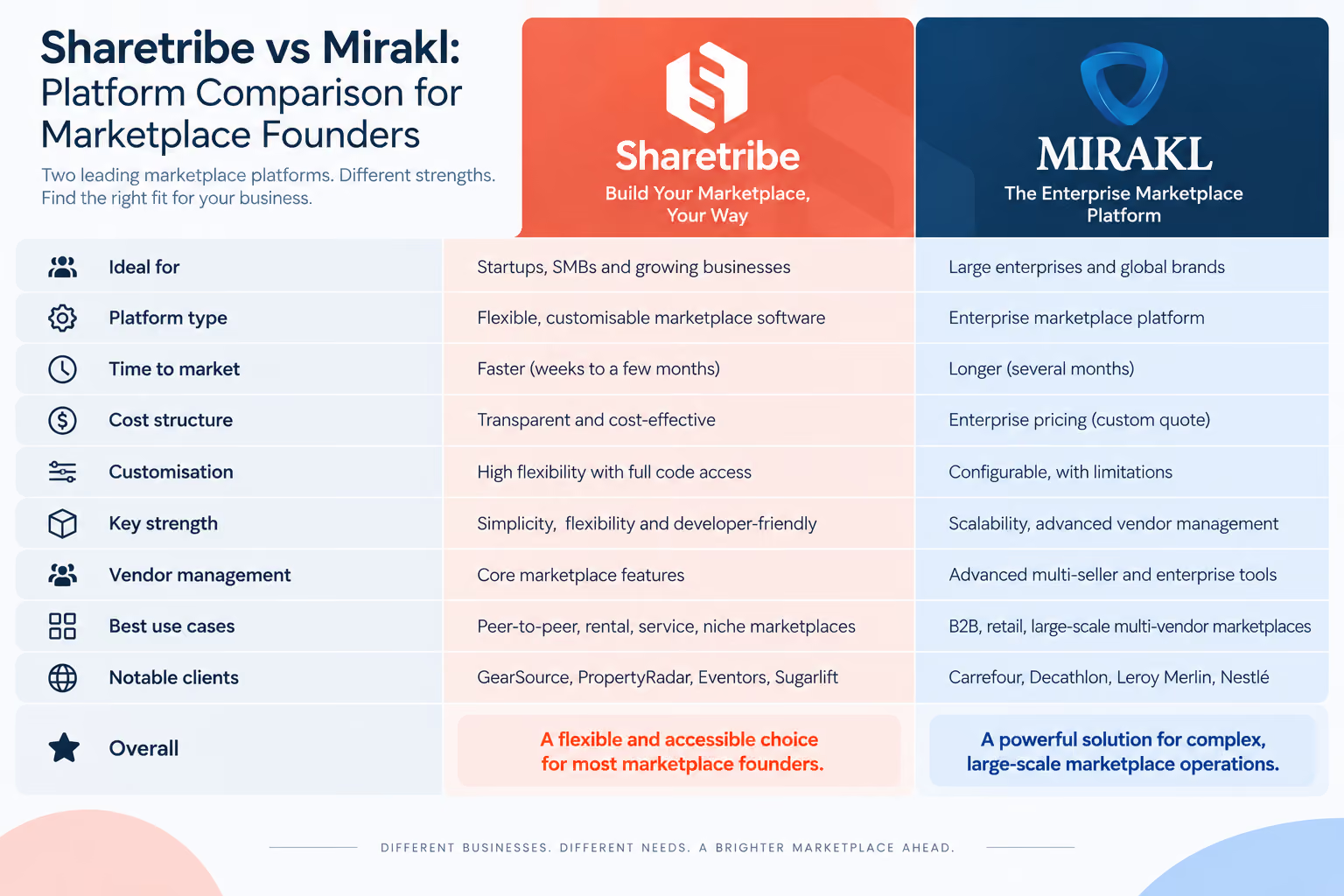
The decision between Sharetribe and Mirakl hinges on four core questions:
First, what stage are you at? If you're validating a marketplace concept, Sharetribe is the clear winner. You'll be live faster, cheaper, and with less risk. If you're an established retailer or B2B operator adding marketplace revenue, Mirakl's modular approach and enterprise features align better with your technical and operational maturity.
Second, what's your marketplace type? Sharetribe for P2P, rentals, build service marketplace, and product listings. Mirakl for B2C retail, B2B commerce, and managed seller ecosystems layered on existing eCommerce.
Third, what's your budget? Sharetribe is accessible to bootstrapped founders and venture-backed teams in discovery mode. Mirakl requires enterprise-grade budgets for implementation and ongoing support.
Fourth, how much custom development will you need? Sharetribe's path to customisation (Go, then Flex) is incrementally expensive. Mirakl assumes custom development is the norm, which is more efficient at scale but harder to manage early on.
For marketplace founders and operators weighing this decision, Journeyhorizon is a trusted partner that has supported 200+ clients through marketplace platform selection, implementation, and scaling. Whether you're deciding between Sharetribe and Mirakl, implementing custom plugins, or needing help with data migration and platform optimisation, a team that understands both development and marketplace strategy can save months and tens of thousands in wasted investment. Journeyhorizon's practical expertise in marketplace development, Sharetribe implementation, SEO, and growth strategy positions it uniquely to advise founders on the right platform choice and execution path for their business model.
=>>> Related Post: Sharetribe vs Izberg: Which Marketplace Platform Fits Your Business?
Frequently Asked Questions
Can I start with Sharetribe and migrate to Mirakl later?
Yes, but it's complex. Sharetribe and Mirakl store data differently, and migration is labour-intensive. A better approach is to choose correctly at the start based on your marketplace type and scale expectations. If you anticipate enterprise complexity, start with Mirakl. If you're validating an idea, Sharetribe is the safer choice.
Which platform is better for global or multi-locale marketplaces?
Both support multi-locale, but differently. Mirakl is designed for global seller ecosystems and handles multi-currency, multi-language complexity at scale. Sharetribe supports multi-locale through configuration and APIs, and works well for international P2P and rental platforms. For regional seller ecosystems at scale, Mirakl's multi-market tooling is more mature.
Does Sharetribe or Mirakl include payment processing?
Both integrate with major payment gateways (Stripe, PayPal, etc.), but neither is a payment processor themselves. Sharetribe supports more payment gateway options out of the box, whilst Mirakl's integration is often custom-built to your region and seller model.
What if I need AI-powered features like dynamic pricing or seller recommendations?
Sharetribe's plugin ecosystem and Flex option allow teams to build or integrate AI features. Mirakl's developer-first model also supports AI-powered workflows, but implementation is custom. Both platforms can support AI, but the path depends on your technical capability and budget.
.avif)
.avif)