Legacy Application Modernization Services
Modernize outdated, complex or hard-to-scale applications with the right modernization strategy. Improve performance, security, scalability and maintainability while preserving the business logic your teams already rely on.

What is Legacy Application Modernization?
Legacy application modernization is the process of improving outdated software so it becomes easier to maintain, scale, secure, and update.
It may include upgrading old technology, improving the architecture, moving parts of the system to the cloud, modernizing integrations, or rebuilding only what no longer works well.
The goal is to keep the valuable parts of the application while removing the technical limits that slow the business down.
Is Your Legacy Application Holding Your Business Back?
Many businesses continue using outdated applications because they still work. The problem becomes visible only when those systems start slowing down growth, increasing costs or making every change more difficult.
Every Update Takes Too Long
Small changes require extensive development work because the code is complex, tightly connected or poorly documented.
Maintenance Costs Keep Increasing
Your team spends more time fixing old issues than building new features or improving the product.
Performance Declines as You Grow
The application becomes slow or unstable as users, transactions, integrations or data volumes increase
Technology Is No Longer Supported
Frameworks, libraries or infrastructure are outdated, difficult to secure or no longer maintained.
Integrations Require Workarounds
Connecting the application with modern tools, APIs or platforms becomes expensive and unreliable.
Releases Feel Risky
Even minor updates can create unexpected issues because automated testing and deployment processes are limited.
Why Modernize Your Legacy Application?
End users want software that feels intuitive from the start and effortless to use every day.
Customers and clients expect fast, reliable, mobile-ready access to information, services, and support whenever they need it.
Functional team members rely on applications that streamline daily operations, eliminate manual work, and help teams stay productive.
Technical teams require modern architecture, tools, and infrastructure that make applications easier to maintain, integrate, scale, and improve.
What We Modernize
Depending on your application, the modernization scope may cover one or several of the following areas:
The 7Rs Approach to Legacy Application Modernization
Not every legacy application needs the same solution. Journeyhorizon uses the 7Rs framework to identify the most practical path.
Retain
Keep stable applications or components that still meet business needs.
Retire
Remove systems, modules, or features that no longer provide enough value.
Rehost
Move the application to new infrastructure with minimal code changes.
Relocate
Move workloads to another environment without changing the application architecture.
Repurchase
Replace custom software with a suitable SaaS or off-the-shelf solution.
Replatform
Upgrade the underlying platform, runtime, database, or infrastructure while keeping most business logic.
Refactor or Re-architect
Restructure code and architecture to improve scalability, maintainability, and development speed.
Different parts of the same application may require different approaches. The objective is to modernize only where it creates clear business value.
Applications We Modernize
SaaS Products
Modernize products that have become difficult to scale, maintain or extend.

Internal Business Systems
Improve applications used for daily operations, reporting and workflow management.

Customer Portals
Upgrade performance, usability, security and integrations for customer-facing systems.
Partner and Supplier Portals
Improve collaboration, data access and third-party workflows.
Booking and Transaction Systems
Modernize systems that manage bookings, payments, orders or high-volume transactions.
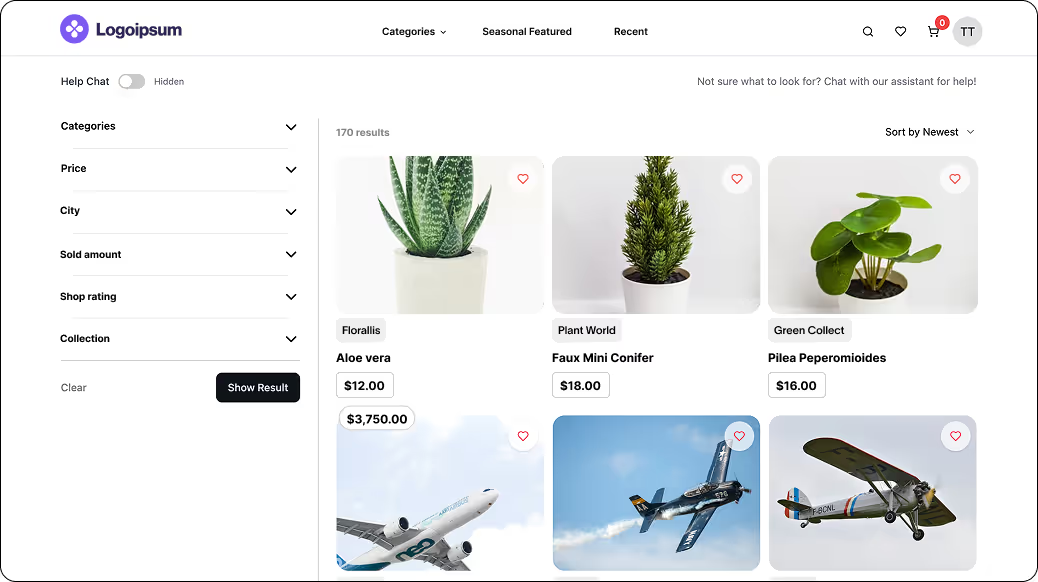
Enterprise Web Applications
Simplify complex custom applications built around long-standing business processes.

Marketplace Applications
Improve search, workflows, integrations, scalability and overall platform performance.

Industry-Specific Systems
Modernize software used in healthcare, finance, manufacturing, logistics and professional services.
Our Modernization Process
Assess
We review the application, architecture, codebase, infrastructure, integrations and business goals.
Prioritize
We identify what should be retained, improved, upgraded, replaced or removed.
Modernize
We implement improvements in controlled phases, starting with the areas that deliver the most value.
Validate and Support
We test, deploy, monitor and continue improving the modernized application.
A phased approach helps reduce risk, protect business continuity and deliver value earlier.
Why Choose Journeyhorizon for Application Modernization?
The best application modernization services do more than replace old technology. They protect business continuity, reduce unnecessary risk and create software that remains valuable over the long term.
We focus modernization efforts on the areas that create the greatest operational and commercial value.
We improve applications in manageable phases instead of forcing a high-risk replacement project.
Our team works with complex web applications, SaaS products, portals and business systems.
Automated testing is built into the modernization process to protect existing functionality.
You receive a practical plan showing priorities, risks, recommended changes and next steps.
Journeyhorizon can continue supporting, maintaining and improving the application after modernization.
Ready to Scale Your Enterprise eCommerce?
What are legacy application modernization services?
Legacy application modernization services improve outdated software by updating its code, architecture, infrastructure, integrations, security and user experience. The goal is to make the application easier to maintain, scale and extend without replacing everything unnecessarily.
How do I know if my application needs modernization?
Your application may need modernization if development is slow, maintenance costs are increasing, performance is declining, technology is unsupported or releases create frequent problems.
Is application modernization the same as rebuilding?
No. Application modernization improves an existing system and preserves valuable business logic. Rebuilding replaces the application completely and usually requires more time, investment and migration effort.
Can Journeyhorizon modernize only part of an application?
Yes. Modernization can focus on selected modules, integrations, workflows, databases or user interfaces without changing the entire application.
How long does legacy application modernization take?
The timeline depends on the size, complexity and condition of the application. Smaller improvements may take weeks, while broader modernization programs are usually delivered in phases over several months.