How to Build an Equipment Rental Marketplace: A Step-by-Step Guide
.avif)
The equipment rental market is large, fragmented, and well suited to marketplace disruption. Contractors frequently underutilize owned machinery, equipment owners struggle to reach new customers, and renters often waste time contacting multiple suppliers to find suitable equipment.
A well-designed rental marketplace can solve these problems by bringing equipment owners, rental companies, contractors, and commercial renters into one platform.
However, understanding how to build an equipment rental marketplace requires more than creating listings and adding an online booking system. Equipment rentals involve high-value assets, detailed specifications, insurance, logistics, maintenance schedules, and flexible payment terms.
Founders need a clear niche, a realistic operating model, specialized platform features, and a growth strategy that supports both sides of the marketplace.
Why Equipment Rental Marketplaces Are Positioned to Succeed

The equipment rental industry contains structural inefficiencies that make it suitable for a marketplace business model.
A contractor looking for an excavator may need to contact several rental yards, request manual quotes, compare specifications, and arrange transportation separately. Even after completing this process, the contractor may still be uncertain about availability or price.
Equipment owners face the opposite problem. Expensive machinery may remain unused between projects while continuing to incur storage, maintenance, financing, and depreciation costs.
A marketplace improves equipment utilization by making available machinery visible to a wider group of renters. It also reduces geographic fragmentation by helping contractors discover inventory outside their existing supplier networks.
For equipment owners, even a modest increase in utilization can generate meaningful additional revenue. For renters, aggregated inventory creates greater choice, faster sourcing, and more transparent comparisons.
Build the Marketplace Around the Right Business Model
An equipment rental marketplace is generally a two-sided platform connecting equipment suppliers with businesses that need temporary access to machinery.
Before selecting technology or features, founders should define a clear marketplace strategy, including how the platform will create value for each participant and generate revenue.
The Supply Side
Marketplace suppliers may include:
- National equipment rental companies
- Regional rental businesses
- Equipment dealers
- Construction companies with idle machinery
- Independent contractors
- Specialized equipment suppliers
Each supplier type has different needs.
A national company may require inventory synchronization across multiple branches. A regional supplier may want to reach customers outside its existing service area. An independent owner may only need a simple way to list equipment and manage inquiries.
The platform should support these differences without making supplier workflows unnecessarily complicated.
High-value equipment may also require more rigorous onboarding, including business verification, insurance certificates, maintenance records, and proof of ownership.
The Demand Side
Potential renters may include:
- General contractors
- Demolition companies
- Utility contractors
- Landscaping businesses
- Government agencies
- Agricultural companies
- Mining and industrial operators
Each customer segment has different procurement, payment, and compliance requirements.
A small contractor may pay online when confirming a booking. A large construction company may require internal approval, a purchase order, and 30- or 60-day payment terms.
Understanding these differences is essential when deciding how to build an equipment rental marketplace that can support real commercial transactions.
The Transaction Model
A typical equipment rental transaction may involve:
- Searching by category and technical specifications
- Confirming location and availability
- Comparing rental rates
- Requesting or negotiating a quote
- Verifying insurance and business details
- Coordinating delivery or collection
- Managing deposits and payment
- Inspecting equipment before and after use
- Handling extensions, maintenance, or damage claims
The marketplace must organize these steps without creating unnecessary friction.
Founders should also decide whether the platform will act as a simple lead-generation directory or manage the complete booking, payment, insurance, logistics, and dispute process.
More control can produce a better customer experience, but it also increases technical complexity and operational responsibility.
Essential Equipment Rental Marketplace Features
Journeyhorizon’s guide to the must-have features for a rental marketplace explains the broader functionality expected from a rental platform. Equipment marketplaces also require several specialized capabilities.
Advanced Equipment Specifications
Contractors search using precise technical requirements rather than broad categories.
An excavator listing may need to include:
- Operating weight
- Bucket capacity
- Digging depth
- Engine power
- Attachment compatibility
- Maintenance history
- Age and operating hours
- Safety certifications
The platform should allow renters to search, filter, and compare listings using these attributes.
Specifications should also change by equipment category. An excavator, forklift, crane, and generator require different listing fields. Category-specific forms improve listing quality and search relevance.
Real-Time Availability
Availability changes because of existing bookings, maintenance, inspections, rental extensions, and transportation time.
The platform should support:
- Booking calendars
- Maintenance blocks
- Delivery and collection buffers
- Multi-location inventory
- Supplier system integrations
- Request-to-book and instant-booking workflows
Reliable availability is especially important when learning how to build an equipment rental marketplace that contractors will use repeatedly. Customers will quickly lose confidence if listed equipment is frequently unavailable.
Not every supplier will maintain an accurate real-time calendar. Supporting both instant booking and approval-based requests allows the marketplace to serve businesses at different levels of operational maturity.
Location-Based Search
Transportation costs can significantly affect the total rental price.
Your marketplace should allow users to:
- Search within a defined radius
- Filter by city or region
- View supplier service areas
- Calculate distance from a project site
- Compare estimated delivered prices
A nearby machine with a higher daily rate may ultimately cost less than a cheaper option located farther away.
Location and category pages can also support organic discovery for searches such as “excavator rental in Denver” or “construction equipment rental near Austin.”
Logistics and Delivery
Heavy equipment may require specialized carriers, oversized-load permits, loading equipment, and scheduled delivery.
The platform may need to support:
- Supplier delivery zones
- Distance-based fees
- Delivery and collection scheduling
- Equipment size and weight calculations
- Third-party logistics integrations
- Delivery status updates
Some suppliers may manage transportation themselves, while others rely on external carriers. Early-stage marketplaces can coordinate logistics manually, but the platform should be designed to support greater automation as volume increases.
Insurance and Verification
Trust is essential when expensive machinery is involved.
The platform may include:
- Business identity checks
- Insurance document uploads
- License verification
- Equipment ownership records
- Supplier approval workflows
- Fraud prevention
- Reviews and transaction history
The system should also track document expiration and notify users when updated insurance or licensing information is required.
Verification should be treated as core infrastructure, not a feature to add after launch.
Project-Based Booking
Construction projects often require multiple machines delivered at coordinated times.
Project-based functionality can allow renters to manage:
- Multiple equipment bookings
- Shared delivery schedules
- Project budgets
- Team access
- Rental extensions
- Documents and change orders
This is particularly valuable for general contractors and larger commercial customers.
It can also increase average transaction value by allowing the marketplace to recommend complementary equipment or attachments for the same project.
Flexible Payments
Equipment rental payment requirements vary considerably.
The platform may need to support:
- Card payments
- Bank transfers
- Deposits and authorization holds
- Credit accounts
- Progressive billing
- Long-term rental invoices
- Refunds and adjustments
- Supplier payouts
- Accounting integrations
Before choosing a payment provider, confirm that it supports marketplace transactions, split payouts, deposits, refunds, and the relevant countries.
For high-value rentals, bank transfers or invoice-based payments may be more practical than processing the full amount by card.
Messaging and Quote Management
Many rentals require discussion before confirmation.
Renters may need to clarify technical requirements, attachments, delivery conditions, or site access. Suppliers may need additional information before approving the request.
Useful functionality includes:
- In-platform messaging
- Quote requests and revisions
- File and image attachments
- Automated reminders
- Transaction-linked communication history
Keeping conversations inside the marketplace improves transparency and helps the platform understand why inquiries convert or fail.
Inspection and Damage Reporting
Equipment condition should be documented before and after every rental.
A mobile-friendly inspection workflow may include:
- Timestamped photographs
- Equipment-hour records
- Condition checklists
- Existing damage reports
- Digital signatures
- Post-rental damage claims
This creates a shared record and reduces disputes over deposits or equipment condition.
Choose a Focused Niche and Location
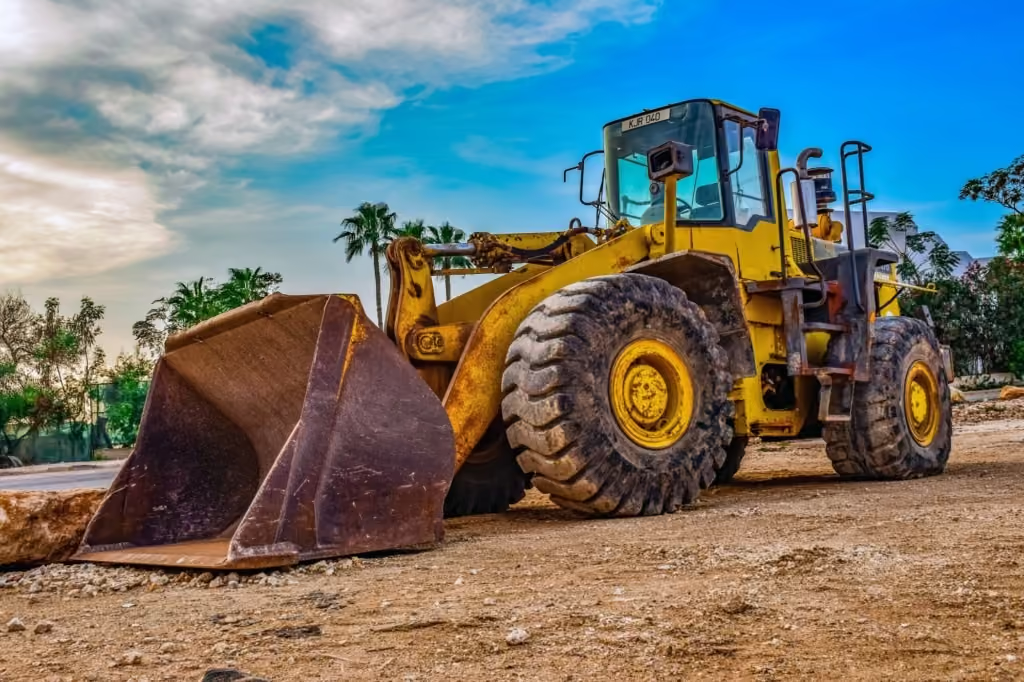
One of the most important decisions when determining how to build an equipment rental marketplace is where to start.
Most successful marketplaces begin with a specific geography, equipment category, or customer segment instead of attempting nationwide coverage immediately.
Start With One Geographic Market
Equipment rental is usually local or regional because transportation costs limit how far machinery can economically travel.
A promising initial market may have:
- Active construction projects
- Multiple equipment suppliers
- A large contractor population
- Fragmented inventory
- Limited digital rental options
Concentrating on one city or region makes it easier to recruit suppliers, support early transactions, and create marketplace density.
A strong network in one location is more valuable than scattered inventory across an entire country.
Focus on an Equipment Category
Possible starting categories include:
- Earthmoving equipment
- Excavators and loaders
- Aerial work platforms
- Agricultural machinery
- Landscaping equipment
- Material-handling equipment
- Specialty construction tools
Specialization makes it easier to build category-specific features, supplier relationships, and industry authority.
It also creates a clearer marketing proposition than launching with a small selection across many unrelated equipment types.
Target a Customer Segment
The marketplace can also focus on a specific renter group, such as independent contractors, government agencies, utilities, agricultural operators, or event companies.
Each segment may require different workflows.
Government customers may need formal quote requests, approved suppliers, and purchase orders. Independent contractors may prioritize transparent prices, fast booking, and straightforward delivery.
A focused audience makes it easier to design relevant platform workflows.
Validate the Marketplace Before Development
A common mistake is investing heavily in development before confirming that suppliers and renters will use the platform.
Validation should be part of the broader marketplace development process, not something that happens only after launch.
Interview at least 20 to 30 potential participants across both sides.
Ask renters:
- How do you currently find equipment?
- What delays the rental process?
- Which information is difficult to obtain?
- Would you book through a marketplace?
- What would prevent them from completing a transaction?
Ask suppliers:
- How much inventory is underutilized?
- How do they attract customers?
- Which booking steps are still manual?
- Would they list on a third-party marketplace?
- What commission or fee would they accept?
- Which systems need to be integrated?
Founders can also validate demand by manually facilitating several transactions.
A simple landing page can collect rental requests while the team contacts suppliers and coordinates bookings by phone or email. This approach reveals which parts of the process require software and which require human support.
Choose the Right Development Approach
There are three primary ways to build the platform.
Custom Development
Building from scratch provides full control over architecture, user experience, integrations, and transaction workflows.
However, the development team must create all core functionality, including accounts, listings, search, calendars, messaging, booking, payments, reviews, and administration tools.
A custom platform may require six to twelve months and approximately $150,000 to $500,000 or more, depending on complexity.
This approach is most suitable for well-funded founders with highly differentiated requirements. Before committing, assess whether custom marketplace development is necessary immediately or whether a platform-based MVP could validate the concept first.
Marketplace Platform Solutions
Platforms such as Sharetribe provide essential marketplace infrastructure, including:
- User accounts
- Listings
- Search
- Messaging
- Booking
- Payments
- Reviews
- Transaction management
The development team can then customize the platform for equipment specifications, delivery calculations, verification, supplier integrations, and project bookings.
Founders can review Journeyhorizon’s Sharetribe marketplace development services to understand how the platform can be adapted to a specific rental model.
Depending on complexity, this approach may take two to six months and cost approximately $25,000 to $150,000.
For many early-stage marketplaces, this offers the best balance between launch speed, customization, and cost.
Hybrid Development
A hybrid approach uses a marketplace platform for core infrastructure while adding custom-built systems for competitive features.
For example, Sharetribe may manage users, listings, and transactions, while custom services handle equipment databases, logistics, insurance, or supplier inventory.
Founders can also add custom marketplace features and integrations without rebuilding the entire platform.
This approach allows the team to launch quickly while investing more heavily in the functionality that differentiates the marketplace.
How the Marketplace Can Make Money
The revenue model affects payments, supplier onboarding, reporting, and transaction design.
Common options include:
Transaction Commissions
The marketplace charges a percentage or fixed fee when a rental is completed.
This reduces the barrier for suppliers to join but requires transactions to remain on the platform.
Supplier Subscriptions
Suppliers pay monthly or annual fees for listing capacity, analytics, inventory integrations, premium placement, or reduced commission rates.
Subscriptions create predictable revenue but can be difficult to sell before the marketplace consistently generates demand.
Lead-Generation Fees
Suppliers pay for qualified inquiries.
This can work when transactions are too complex to complete online, although the marketplace must define what qualifies as a valid lead.
Premium Services
Additional revenue may come from:
- Featured listings
- Delivery coordination
- Insurance referrals
- Equipment financing
- Inspection services
- Maintenance partnerships
Many marketplaces begin with transaction commissions and introduce subscriptions or premium services as the network grows.
Growing Beyond the Initial Market
Once the marketplace facilitates reliable transactions, expansion can follow several paths.
Geographic Expansion
Choose new markets based on supplier density, construction activity, customer demand, logistics, and competition.
Adjacent markets are often easier because existing suppliers may already serve those areas.
Category Expansion
A marketplace that begins with excavation equipment could later add aerial platforms, compactors, generators, attachments, and construction tools.
This can be more efficient than entering a new geography because the platform already has relevant customers and suppliers.
Customer Segment Expansion
The marketplace may expand into government, enterprise, industrial, or other customer groups.
Each new segment may require different payment terms, approvals, procurement documentation, and reporting.
Operational Automation
As volume increases, automate:
- Supplier onboarding
- Equipment verification
- Availability updates
- Quote follow-ups
- Insurance checks
- Booking notifications
- Supplier payouts
An ongoing marketplace support and maintenance model can help manage integrations, technical issues, platform improvements, and long-term stability.
Common Mistakes to Avoid
Building Too Much Before Validation
Start with the minimum functionality required to complete a successful transaction. Advanced automation and dashboards can be added after real customers begin using the platform.
Underestimating Logistics
Transport cost, delivery availability, loading requirements, and permits can determine whether a transaction is viable. Logistics should be considered during the initial platform design.
Launching With Insufficient Supply
Renters will not return if they find only a few unsuitable listings.
Recruit enough relevant equipment within the initial category and region before investing heavily in customer acquisition.
Treating Insurance as Optional
Insurance and verification protect owners, improve trust, and reduce risk. They should not be postponed until after launch.
Ignoring Supplier Workflows
Suppliers may already use inventory, accounting, and branch-management systems.
If the marketplace creates too much additional work, they may stop updating listings or responding to inquiries. Bulk uploads, integrations, and clear dashboards can improve supplier participation.
Allowing Transactions to Move Off Platform
If users connect through the marketplace but complete future rentals privately, the platform loses revenue.
Payments, insurance, documentation, dispute support, logistics, and project management can provide reasons to keep transactions on the platform.
Align Development With Growth Strategy
The strongest equipment rental marketplaces connect platform development with customer acquisition.
For example:
- Geographic expansion requires multi-location inventory.
- Category expansion requires flexible specification structures.
- Enterprise customers require approvals and purchase orders.
- SEO growth requires indexable category and location pages.
- Supplier acquisition requires simple inventory uploads.
- Repeat bookings require saved projects and booking history.
SEO should be considered during development rather than added after launch.
Journeyhorizon’s marketplace SEO playbook explains how site architecture, listings, categories, and content can support organic discovery.
Important SEO foundations include:
- Searchable category pages
- Location landing pages
- Indexable equipment listings
- Unique supplier content
- Clear internal linking
- Structured data
- Canonical controls for filters
- Fast mobile performance
Once the core transaction works reliably, founders can apply more systematic marketplace growth strategies to balance supply and demand, strengthen retention, and enter new markets.
Build Your Equipment Rental Marketplace With Journeyhorizon
Successfully building an equipment rental marketplace requires expertise across technology, platform operations, supplier management, logistics, and customer acquisition.
Journeyhorizon combines marketplace development expertise with growth strategy and marketing support.
The team can help founders develop:
- Equipment listing systems
- Advanced filters
- Availability calendars
- Multi-location inventory
- Logistics integrations
- Verification workflows
- Project-based bookings
- Payment systems
- Supplier dashboards
- Administration tools
Instead of forcing equipment rental workflows into a generic platform structure, Journeyhorizon customizes the marketplace around the operational requirements of the selected niche.
On the growth side, Journeyhorizon provides marketplace marketing services, including SEO, content strategy, conversion optimization, and growth planning.
This integrated approach helps ensure that the technical roadmap supports supplier recruitment, customer acquisition, retention, and geographic expansion.
Founders can explore Journeyhorizon’s broader marketplace development services for support with strategy, development, integrations, launch, and ongoing optimization.
Moving From an Idea to a Working Marketplace
Learning how to build an equipment rental marketplace begins with identifying the specific transaction problem you want to solve.
Choose a focused equipment category, customer segment, or geographic market. Interview suppliers and renters, document the current rental process, and identify its main friction points.
Validate demand through manually facilitated transactions or a lightweight prototype. Use those early interactions to determine which features are essential.
Then select a development approach based on your budget, timeline, and differentiation requirements. Build the first version around specifications, availability, verification, logistics, payments, and transaction support.
Launch with sufficient supply, support early customers closely, and improve the marketplace based on real transaction data.
The opportunity is significant because both sides have strong economic incentives. Equipment owners want better utilization, while contractors want faster access to suitable machinery.
The marketplaces that succeed will be those that solve these operational problems systematically while creating enough supplier and renter density to produce lasting network effects.
Frequently Asked Questions
What is the biggest challenge when building an equipment rental marketplace?
The biggest challenge is balancing platform complexity with launch speed.
Equipment rentals require specifications, availability management, logistics, insurance, and flexible payments. However, building every possible feature before validating demand increases cost and delays the launch.
Start with the features required to complete successful transactions in your initial niche.
How important is geographic focus?
Geographic focus is critical because transportation can represent a significant part of the total rental cost.
Launching in one city or region makes it easier to build supplier density, manage logistics, and support early transactions.
Can Sharetribe be used to build an equipment rental marketplace?
Yes, although equipment-specific customization will usually be required.
Sharetribe can provide accounts, listings, messaging, booking, payments, and reviews. Custom development can then add technical specifications, maintenance schedules, logistics, verification, and commercial payment workflows.
An experienced Sharetribe developer can identify which requirements are available natively and which require customization.
Is a mobile app required at launch?
Not necessarily.
A responsive web platform is often sufficient for validating demand. A mobile app becomes more valuable when users need on-site inspections, image uploads, delivery tracking, signatures, or frequent repeat bookings.
Founders considering this option can review Journeyhorizon’s guide on how to build a marketplace app.
What is the first step in learning how to build an equipment rental marketplace?
Begin by validating a focused market.
Choose a location, equipment category, or customer segment, then interview suppliers and renters. Their workflows and pain points should determine the marketplace model, feature priorities, and development approach.

.avif)