LLM API Pricing Comparison for Marketplaces: Hidden Costs Guide

When you're building a marketplace platform, choosing the right LLM API isn't just about finding the cheapest per-token rate. A quick LLM API pricing comparison will tell you that Claude Sonnet 5.5 costs $2 per million input tokens and $10 per million output tokens, while Claude Haiku 5.5 or OpenAI's gpt-6-luna cost $0.10 and $0.50. What it won't tell you is what happens to your margin when you're processing hundreds or thousands of transactions a day, each with different computational demands. This matters most if you're integrating AI features into your marketplace for the first time, where cost surprises can derail profitability.
Journeyhorizon, as a marketplace development partner, sees this mistake repeatedly. Founders spend weeks comparing token prices, then launch AI features only to discover that real-world costs look nothing like the calculators predicted. The difference between a thriving marketplace feature and a profit killer often comes down to understanding LLM API pricing beyond the headline numbers.
LLM API Pricing at a Glance (October 2026)
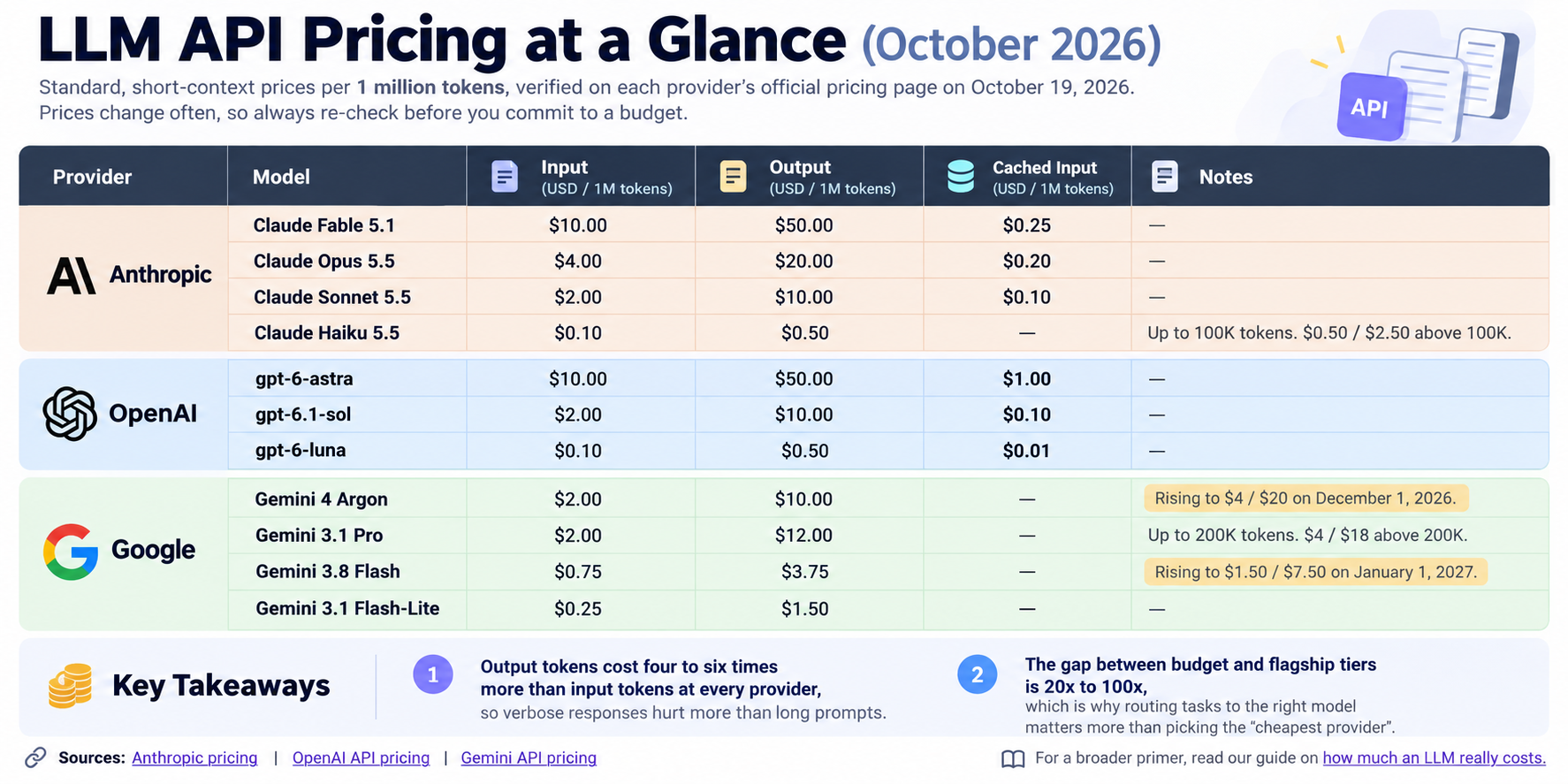
Standard, short-context prices per 1 million tokens, verified on each provider's official pricing page on October 19, 2026. Prices change often, so always re-check before you commit to a budget.
- Claude Fable 5.1 (Anthropic): $10 input / $50 output / $0.25 cached input
- Claude Opus 5.5 (Anthropic): $4 input / $20 output / $0.20 cached input
- Claude Sonnet 5.5 (Anthropic): $2 input / $10 output / $0.10 cached input
- Claude Haiku 5.5 (Anthropic): $0.10 input / $0.50 output for prompts up to 100K tokens; $0.50 / $2.50 above 100K
- gpt-6-astra (OpenAI): $10 input / $50 output / $1 cached input
- gpt-6.1-sol (OpenAI): $2 input / $10 output / $0.10 cached input
- gpt-6-luna (OpenAI): $0.10 input / $0.50 output / $0.01 cached input
- Gemini 4 Argon (Google): $2 input / $10 output (rising to $4 / $20 on December 1, 2026)
- Gemini 3.1 Pro (Google): $2 input / $12 output up to 200K tokens; $4 / $18 above 200K
- Gemini 3.8 Flash (Google): $0.75 input / $3.75 output (rising to $1.50 / $7.50 on January 1, 2027)
- Gemini 3.1 Flash-Lite (Google): $0.25 input / $1.50 output
Sources: Anthropic pricing, OpenAI API pricing, Gemini API pricing. Two patterns stand out. First, output tokens cost four to six times more than input tokens at every provider, so verbose responses hurt more than long prompts. Second, the gap between budget and flagship tiers is 20x to 100x, which is why routing tasks to the right model matters more than picking the "cheapest provider". If you want a broader primer, read our guide on how much an LLM really costs.
Why LLM API Pricing Matters for Marketplace Founders
Marketplaces have cost dynamics that pure software companies don't face. Every transaction triggers AI processing. A peer-to-peer platform processing 1,000 transactions daily isn't just paying for tokens; it's paying for each vendor interaction, each content moderation run, each recommendation calculation. Scale this across 100,000 daily transactions and your LLM costs move from operational overhead to a core unit economics question.
The problem with a basic price comparison is that it treats all use cases the same. A chatbot application has predictable token volumes. A marketplace has variable, unpredictable demand. Peak hours during flash sales or seasonal surges can multiply your API costs several times over. If you've only optimised for average-case pricing, you'll hit unexpected spend walls.
Beyond Token Counting: The Real Cost of LLM APIs
Token pricing is only the starting point. Consider what actually happens when you call an LLM API at scale:
Error handling and retries add to your actual spend, because a failed or timed-out call still consumes tokens. Rate limits force you to keep fallback models ready, and infrastructure to orchestrate model selection, handle response times and build fallback chains isn't included in API pricing, but it's a very real expense. A slow response also has a hidden business cost: worse user experience, which affects marketplace engagement and retention.
Then there's provider-specific behaviour. Claude's prompt caching feature lets you cache system prompts and reuse them across calls: cached reads are billed at 10% of the normal input price, so the cached portion of a prompt costs up to 90% less. OpenAI's batch processing, along with Anthropic's and Google's batch APIs, offers a 50% discount if you can queue requests instead of needing real-time responses. Neither shows up in a basic price table because both require architectural decisions, not just token counting.
LLM API Cost Examples for Marketplace Use Cases
Real marketplace cost structures look different for each platform type. Here is a worked example with explicit assumptions so you can adapt it to your own numbers.
Take a skilled trades service marketplace handling 500 service requests a day. Each request triggers three LLM calls (intake summarisation, provider matching and fraud screening), using about 6,000 input tokens and 1,500 output tokens in total. That is 3 million input tokens and 750,000 output tokens a day, or roughly 90 million input and 22.5 million output tokens a month:
- All on Claude Sonnet 5.5 or gpt-6.1-sol: about $405 per month
- All on Gemini 3.8 Flash: about $150 per month
- All on Claude Haiku 5.5 or gpt-6-luna: about $20 per month
Scale the same platform to 50,000 requests a day and the premium-model bill becomes roughly $40,500 per month, while the budget-model bill is around $2,000. Note that output tokens make up more than half of the premium bill even though there are four times fewer of them.
The variable component is the hard part. Peak days can multiply your spend several times over. If your marketplace hits viral adoption and transaction volume doubles overnight, your LLM costs follow immediately. Most founders don't budget for this volatility, which is why you need to monitor LLM spend from day one.
In peer-to-peer and multi-vendor marketplaces, you're processing AI per transaction or per upload: listing generation, moderation and fraud checks scale directly with seller activity. Service marketplaces face different economics. You're paying for AI search, matching and recommendations, which run for every user browsing the platform, not just per completed transaction. A platform with 10,000 active users browsing simultaneously can generate millions of tokens an hour, depending on how often results are regenerated and how much is cached.
Hidden Factors That Actually Drive Costs
The cheapest-per-token option often isn't the cheapest in production. Several factors shift real-world costs:
Caching and batch processing. If you process content moderation with a consistent system prompt, the cached part of every call is billed at a tenth of the input price. In the example above, caching a 1,500-token system prompt on Claude Sonnet 5.5 cuts the input bill from about $180 to about $52 a month. Keep in mind that writing to the cache costs 1.25x the input price and the default cache lives for five minutes, so savings depend on steady traffic.
Reasoning (thinking) tokens. Reasoning models generate internal "thinking" tokens that are billed at the output rate but never appear in the response. A task that returns 300 visible tokens can bill several thousand. Use reasoning models only where the quality gain justifies it.
Long-context surcharges. Some models charge more once a prompt crosses a threshold: Gemini 3.1 Pro doubles its input price above 200K tokens, and Claude Haiku 5.5 rises fivefold above 100K. Splitting or trimming long documents can keep you in the cheaper tier, but forcing multiple calls where one long call would do can cost more overall. Choose a context strategy that matches your actual use case.
Model lifecycle. Newer models are often cheaper than the ones they replace: Claude Opus 5.5 costs $4 per million input tokens versus $5 for the legacy Opus 5. Providers also retire older models and announce price changes (both Gemini 4 Argon and Gemini 3.8 Flash have scheduled increases), so build on models with a clear roadmap and keep switching costs low.
Regional and premium options. Data residency and speed options carry multipliers. For example, Anthropic charges 1.1x for US-only inference and 2x for Opus 5.5 fast mode.
Cost Optimization Strategies for Marketplace Platforms

The most successful marketplaces use layered LLM strategies:
Model cascading sends cheap, fast models first. Easy moderation tasks go to a budget model such as Claude Haiku 5.5, gpt-6-luna or Gemini Flash-Lite. Only complex cases escalate to premium models. Routing 70% of requests to a budget model and 30% to a premium one cuts the $405 example above to roughly $135 a month, a saving of about two-thirds while maintaining quality where it counts.
Prompt optimisation is ruthless. Every token in your system prompt costs money at scale. Removing redundancy, trimming examples and parameterising dynamic content can reduce prompt size by 30-50%. Our guide on how to reduce token usage covers the techniques in detail. Capping output length matters even more, since output tokens cost four to six times as much as input.
Batch processing for asynchronous tasks saves 50% if your architecture allows queuing. Recommendation refreshes, analytics processing and non-urgent content moderation can all use batch APIs, which return results within 24 hours, instead of real-time calls.
Smart routing by capability prevents overpaying for what you don't need. A task that requires reasoning but not vision should go to a reasoning-optimised model, not a multi-modal flagship. The right-sized model for each task reduces wasted capacity.
How to Choose: A Decision Framework
When evaluating LLM APIs for your marketplace, work through this decision tree:
First, define your quality requirements. What's the actual cost of a mistake? Content moderation errors cause platform trust damage. Matching errors affect user satisfaction. Higher-quality models prevent these problems but cost more. Some marketplace tasks tolerate errors; others don't.
Second, map your actual volume and pattern. Don't estimate. Prototype and measure. Build a small feature, track token usage, run it for a week with real traffic, and extrapolate. Calculators are wrong because real usage patterns are messier than simple averages.
Third, calculate switching costs. How much engineering effort would it take to migrate from one provider to another? If it's high, you want a provider with a clear roadmap and strong financial stability. A smaller LLM provider might be cheaper, but if it folds in two years, migration costs destroy your savings.
Finally, account for total cost of ownership, not just token pricing. Include infrastructure, fallback logic, error handling and team time to optimise prompts and routes. The cheapest token price often isn't the cheapest total cost once these factors enter the picture.
Frequently Asked Questions
Which LLM API provider is cheapest for marketplace use cases?
It depends on your workload. As of October 2026, Claude Haiku 5.5 and OpenAI's gpt-6-luna list at $0.10 per million input tokens and $0.50 per million output tokens, and open-weight models such as DeepSeek are also very cheap per token. But prompt caching, batch discounts and output length can change the ranking for a specific workflow, so test your actual workload against two or three providers before deciding.
Should I build my own LLM or use APIs?
For most marketplace founders, APIs are the right choice. Self-hosting requires infrastructure investment, model fine-tuning expertise and ongoing maintenance. Unless you process very large, steady volumes or have strict data-control requirements, API costs stay lower than self-hosting. If data residency or control is the driver, look at self-hosted or sovereign AI options before training a custom model, which is expensive and rarely needed.
How much do LLM APIs actually cost at scale?
It scales with volume, tokens per request and model choice. Using the assumptions above (6,000 input and 1,500 output tokens per request), 500 requests a day costs about $20 a month on a budget model and about $405 on a mid-tier model like Claude Sonnet 5.5. At 10,000 requests a day, that becomes roughly $400 and $8,100 a month. Recommendation-heavy service marketplaces usually spend the most, because AI runs on every browsing session, not just on completed transactions.
What's the difference between token pricing and real-world costs?
The price list is a starting point. Real costs come out lower if you cache, batch, route simple tasks to budget models and keep outputs short. They come out higher once you add retries, reasoning tokens, long-context surcharges, infrastructure and the business cost of slow responses. Closing that gap is the optimisation challenge.
Plan AI Costs Into Your Marketplace Architecture
Building a marketplace with AI features requires more than a basic LLM API pricing comparison. You need to understand your specific cost drivers, build for optimisation and choose providers with roadmaps that align with your long-term platform goals. The difference between a feature that scales profitably and one that becomes a margin killer often comes down to decisions made early. When you're planning marketplace app development, integrating AI cost considerations from the architectural phase prevents expensive refactoring later.
If you're building a marketplace and integrating AI features, the technical architecture and cost strategy are equally important. Journeyhorizon works with marketplace founders to design platforms where development decisions and cost optimisation go hand in hand. Whether you're integrating LLM APIs for content moderation, matching or recommendations, the right architecture from the start saves thousands in operational costs and prevents the hidden cost surprises that plague many platforms. This is exactly where our AI cost optimization services fit into your core marketplace development, keeping your AI features profitable as you scale.