LLM Cost Monitoring for Marketplaces: Control AI Spending

If you are building or scaling a marketplace with AI features, managing large language model (LLM) spend is now as important as managing server infrastructure. Most teams discover the problem the hard way: a feature ships, usage picks up, and a month later the provider invoice arrives at twice the expected amount. The billing dashboard tells you how much you spent, but not why. You cannot see which feature consumed the tokens, which users triggered the expensive workflows, or where retries and agent loops multiplied the bill.
That gap is what LLM cost monitoring closes. At Journeyhorizon, we have built marketplaces since 2018 and work with founders who hit exactly this wall as their AI features scale. This guide covers what to track, how to set it up, which alerts to configure, and how to turn the data into lower costs without hurting quality.
What LLM Cost Monitoring Actually Means
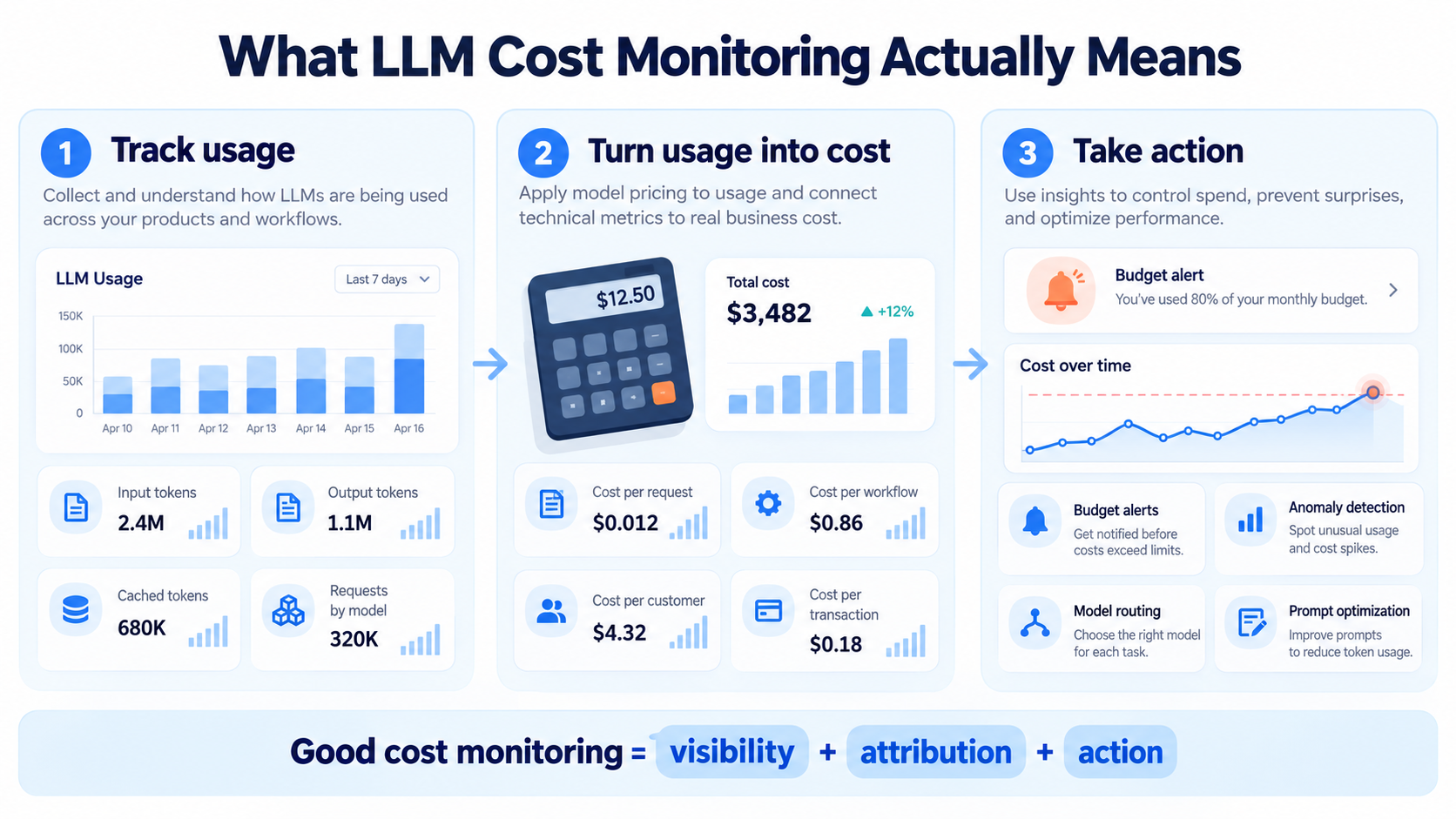
LLM cost monitoring is the practice of continuously measuring, attributing, and optimizing the spend generated by model API calls in production. Providers bill per token, with separate prices for input and output, and each model has its own rate card. That makes cost a function of three things you control: which model you call, how many tokens you send, and how many tokens you get back.
Observability vendors such as Datadog calculate cost the same way: token counts on each LLM span multiplied by the provider's public prices, with the option to override them with negotiated rates. Datadog's documentation also breaks input tokens into non-cached, cache-read, and cache-write tokens, and treats reasoning tokens as a subset of output. That level of detail matters, because cached input is often billed at a small fraction of the normal rate, and reasoning tokens can quietly inflate output costs.
For marketplace teams, granularity is the whole point. A retrieval pipeline that pulls product listings into the prompt can consume many times the tokens of a simple search query. An agent that retries a failed tool call can burn through budget in minutes. A bulk import that uses a frontier model where a small one would do burns money with no visible symptoms. Without per-call visibility, these patterns stay hidden until the invoice lands.
Why Marketplace LLM Costs Are Hard to Predict
Marketplaces face cost dynamics that single-sided SaaS products usually do not.
Multiple models across two sides of the market
Most AI-enabled marketplaces now run several models at once: one for seller-facing listing tools, another for buyer search and recommendations, and possibly a third for moderation or support. If you are still mapping where AI fits, our overview of how marketplaces use AI covers the common features. Each model has different pricing, and the gap between tiers is large. As of October 2026, Claude Sonnet 5.5 and OpenAI gpt-6.1-sol list at $2 per million input tokens and $10 per million output tokens, while Claude Haiku 5.5 and gpt-6-luna list at $0.10 and $0.50. That is a 20x difference for the same number of tokens. For a deeper breakdown of rate cards and hidden fees, see our LLM API pricing comparison for marketplaces.
Uneven, event-driven usage
Marketplace usage is rarely flat. A seller onboarding push can trigger thousands of listing enrichment calls in a day. A marketing campaign can multiply buyer search volume overnight. Without spend broken down by feature, cohort, or market segment, teams spend weeks guessing which change caused the jump.
Agentic workflows multiply calls
A single user request to an agent can trigger retrieval, routing, tool calls, retries, and guardrail checks. Gartner predicted in August 2026 that AI inference costs per agentic workflow will increase more than fivefold through 2028, even as per-token prices fall, because more capable workflows consume far more tokens. Cheaper tokens alone will not keep your bill flat.
Costs that never appear on the invoice line you expect
Embedding calls for search, re-ranking, vector database queries, and retries after timeouts all add cost. A feature that looks cheap in staging can become unaffordable under production load if it was not designed with token efficiency in mind. That is why cost visibility belongs in the build phase of any custom marketplace development project, not after launch.
The Metrics That Matter for Marketplace Cost Control
Not every metric deserves a dashboard tile. Focus on the ones that drive business decisions:
- Tokens per request: normalizes usage and makes bloated prompts easy to spot.
- Cost per marketplace operation: the cost of one listing enrichment, one search, one support reply, or one moderation check. This is the number product decisions should rest on.
- Cost per user, tenant, and side of the market: enables showback and shows whether buyers or sellers drive spend.
- Output-to-input token ratio: output tokens cost several times more than input on most models, so verbose responses deserve attention.
- Cache hit rate: how much repeated context is served from cheaper cached tokens or a semantic cache.
- Share of traffic on premium models: reveals routine work that could move to a smaller model.
- Budget burn rate and anomalies: catches regressions, misconfigurations, and runaway loops before they reach the monthly bill.
- Quality score next to cost: an eval score or user feedback signal, so you never cut cost blindly.
Cost per operation is where monitoring meets business modeling. If AI listing enrichment costs more than the commission a typical listing generates in its first month, the feature needs a cheaper model or a different trigger. Our guide to AI unit economics for marketplaces shows how to fold these numbers into contribution margin, and our explainer on the marketplace commission model covers the revenue side.
A Worked Example: Listing Enrichment at Scale
Here is a simple illustration using October 2026 list prices. Assume each listing enrichment call sends about 1,500 input tokens (instructions, category schema, and seller text) and returns about 300 output tokens.
- On Claude Sonnet 5.5 ($2 / $10 per million): about $0.003 for input plus $0.003 for output, or roughly $0.006 per listing. At 100,000 listings a month, that is about $600.
- On Claude Haiku 5.5 ($0.10 / $0.50 per million): about $0.0003 per listing, or roughly $30 a month for the same volume.
- With a batch API: OpenAI, Anthropic, and Google offer batch processing at a 50% discount for jobs that can wait, which would halve either figure.
The exact numbers will differ for your prompts, but the pattern holds: model choice and processing mode can move the cost of the same feature by an order of magnitude. Monitoring is what tells you which features are worth that analysis. For a broader view of what model access costs at different scales, see how much an LLM costs.
Building a Cost Monitoring Foundation
A practical setup has three layers.
1. Unified observability
Route all inference traffic, whether to API models or a self-hosted cluster, through a single gateway or shared instrumentation layer. Capture metadata on every request: user or tenant ID, feature name, environment, and model. Tag consistently from day one, because cost without context is just a number. Common implementation options include:
- Middleware logging: a thin wrapper around your provider SDKs that writes token counts and cost to your existing logs or warehouse.
- OpenTelemetry spans: token and cost attributes on each LLM span, sent to Grafana, Datadog, or another backend.
- AI gateways and LLM observability tools: products such as Helicone, Portkey, LiteLLM, Langfuse, or Comet Opik calculate per-request cost automatically and add budgets, caching, and fallbacks.
2. Governance
Once you can see cost, enforce limits before budgets are exceeded. Set daily or monthly quotas by user, feature, tenant, or environment. A sensible starting pattern:
- A warning alert at around 80% of a daily or monthly budget.
- A critical alert, and optionally throttling, at 100%.
- An anomaly alert when spend runs at several times its normal hourly rate, which usually signals a loop or a bug.
- Per-user rate limits on expensive features so a single account, or an abusive script, cannot run up the bill.
Some teams block requests automatically at a hard cap; others notify a Slack channel so a human decides. Either way, a report that arrives after the invoice is too late. For larger organizations, formal AI governance services can extend these controls to access policies, data handling, and audit trails.
3. Continuous optimization
With visibility and guardrails in place, LLM cost monitoring becomes an ongoing loop of finding the biggest drivers and reducing them without sacrificing quality. That loop is covered in the next section.
Smart Cost Optimization Strategies
Model routing. Send simple, high-volume tasks such as classification, tagging, and short summaries to small models, and reserve frontier models for complex reasoning or high-value buyer interactions. Gartner recommends multimodel tiering and routing for exactly this reason. Mid-tier options such as Gemini 3.8 Flash, at $0.75 input and $3.75 output per million tokens, sit between the two extremes.
Prompt caching. Marketplace prompts often repeat long system instructions, category taxonomies, or policy text. Providers bill cached input at a steep discount; for example, cached reads on Claude Sonnet 5.5 cost $0.10 per million tokens versus $2 for regular input. Put stable content at the start of the prompt so it can be cached.
Semantic caching. Store responses and reuse them for near-identical queries, such as popular buyer searches or repeated support questions. Track the cache hit rate to confirm it is paying off.
Batch processing. Bulk imports, catalog re-categorization, and nightly enrichment jobs rarely need real-time responses. Moving them to batch APIs cuts the price of those calls in half.
Leaner prompts and structured outputs. Trim redundant instructions, limit how much conversation history you resend, and constrain outputs with a schema so responses are short and predictable. Fewer malformed outputs also means fewer retries. Our guide on how to reduce token usage walks through these techniques in detail.
Agent loop limits. Cap the number of tool calls and retries per request, and log when an agent hits the cap. Loops are one of the most common causes of sudden spikes.
Self-hosting at stable volume. Open-weight models deployed on your own infrastructure can undercut API per-token rates when usage is high and predictable. Factor in GPU costs, engineering time, and maintenance before switching, and use your monitoring data to model the break-even point.
Connecting Cost Monitoring to Marketplace Development
Cost assumptions shape architecture. A marketplace app development partner that builds without understanding token economics can deliver features that work well in staging but become unsustainable under production load. Instrument cost from the first sprint, review cost estimates during technical design, and treat cost as a performance metric alongside latency and throughput.
This applies to off-the-shelf AI components too. If you add an AI-powered feature such as an AI search box for Sharetribe, tag its calls separately so you can see what search actually costs per session and per converted buyer.
Getting Started: A 30-Day Checklist
- Week 1: Wrap every LLM call in one shared client that logs tokens, model, cost, feature, and user or tenant ID.
- Week 1: Reconcile your logged totals against the provider invoice to confirm your pricing table is right.
- Week 2: Build a simple dashboard showing total spend, spend by feature, spend by model, and cost per marketplace operation.
- Week 2: Configure budget warnings, hard caps, and an anomaly alert.
- Week 3: Rank features by cost and pick the top three to five drivers. In many products, a small number of features accounts for most of the bill.
- Week 3 to 4: For each driver, test one change: a cheaper model, a shorter prompt, caching, or batch processing. Measure cost and quality together.
- Week 4: Ship the changes that hold quality, revert the ones that do not, and schedule a recurring monthly review.
Teams that treat this as an ongoing discipline, not a one-time audit, stay ahead of cost surprises and keep AI features economically sustainable as they scale.
Frequently Asked Questions
What is LLM cost monitoring?
It is the practice of tracking token usage and spend for every model call in production, attributing that spend to features, users, and models, and using alerts and budgets to keep it under control.
Why is the provider billing dashboard not enough?
Provider dashboards show totals by model and API key. They do not know which marketplace feature, user, or workflow made each call, so they cannot tell you why spend changed or which feature is unprofitable.
Which metrics should a marketplace track first?
Start with cost per feature, cost per marketplace operation, tokens per request, and spend by model. Add cache hit rate, output-to-input ratio, and quality scores once the basics are in place.
Do I need a dedicated tool, or can I build it myself?
Early-stage teams can start with middleware logging to an existing log or analytics stack. As call volume, models, and features grow, an AI gateway or LLM observability platform saves engineering time and adds budgets, caching, and routing out of the box.
How much can monitoring reduce LLM costs?
Monitoring itself saves nothing; the changes it reveals do. Switching a high-volume task to a small model can cut its cost by more than 90% at current list prices, and batch APIs halve the price of eligible jobs. Real-world savings depend on how much of your traffic can move without hurting quality.
How often should we review LLM spend?
Alerts should run continuously. Review the cost dashboard weekly during launches or rapid growth, and at least monthly once usage stabilizes, as well as whenever a provider changes its pricing.
Make AI Features Pay Their Way
Treating cost as a first-class metric from day one leads to better technical decisions and makes scaling AI features far less risky. Journeyhorizon's team of nearly 60 specialists has delivered 200+ projects, combining marketplace development with hands-on LLM integration. If your AI bill is growing faster than your marketplace, our AI cost optimization services can help you instrument, benchmark, and cut spend without sacrificing the features your users rely on.