AI Unit Economics for Marketplaces: Cost & Profitability Guide

As AI features become standard across digital marketplaces, understanding AI unit economics has shifted from nice-to-know to essential strategy. For marketplace founders and operators, the math behind your AI spend decides whether automation delivers a competitive advantage or quietly erodes your margins. That pressure grows as you scale transactions, personalize the buyer experience, and compete on speed and relevance.
The challenge is not whether to adopt AI. It is how to deploy it profitably. At Journeyhorizon, we have built and grown marketplaces since 2018, and we increasingly meet founders who have shipped AI features but lack clarity on their financial impact. They know the AI works. They are not sure it pays.
Quick answer: how to get AI unit economics right in a marketplace
- Measure AI cost per transaction, not just your monthly model bill, and compare it with the take-rate revenue each transaction earns.
- Price every AI action in tokens: input tokens times the input price plus output tokens times the output price, then multiply by actions per completed transaction.
- Count the hidden costs too: retrieval and embeddings, monitoring, evaluation, human review, and engineering time.
- Route routine tasks to small models, cache repeated context, and batch anything that does not need a real-time answer.
- Spend AI where it moves transactions (search, matching, trust and safety, listing quality) and use rules everywhere else.
- Revisit the model monthly with real usage data, because model prices and user behavior both change quickly.
What AI Unit Economics Actually Means for Marketplaces
Unit economics is simple at its core: the revenue you make per unit, minus the direct cost of delivering that unit. Apply that logic to AI, and AI unit economics becomes the revenue generated per AI-powered action measured against the full cost of running that action.
For a marketplace, the natural unit is the completed transaction. Say an AI-powered search assistant helps buyers find a listing. Some of those sessions end in a booking or purchase. Your revenue from that transaction (commission, service fee, or both) compared with the AI cost of all the sessions it took to produce it gives you a usable ratio. If AI cost per transaction exceeds the incremental revenue the AI created, the feature is destroying value. If incremental revenue is several times the cost, you have something worth scaling.
The calculation goes deeper than the invoice. AI costs include model inference (API tokens or GPU hosting), embeddings and vector search, fine-tuning if you do it, data pipeline maintenance, monitoring for quality drift, and the support burden when AI output is wrong. Many operators look only at the compute bill and miss the full picture. A cheap inference call becomes expensive when it rarely leads to a transaction, or when buyer trust slips because the assistant keeps surfacing irrelevant results.

Why Marketplace Unit Economics Differ from SaaS
Marketplaces operate under different constraints than SaaS products or retailers with their own inventory. Your core value is network efficiency: connecting buyers and sellers and removing friction between them.
That changes how you should evaluate AI. In a SaaS product, AI might reduce support costs or improve retention. In a marketplace, AI often decides whether a transaction happens at all. A weak recommendation costs you a match. A strong one compounds across both sides of the network. If you are still mapping where AI fits, our overview of how marketplaces use AI covers the most common use cases.
The bigger difference is the revenue base. A SaaS company can compare AI cost with its full subscription price. A marketplace has to fund AI out of its take rate, which is a slice of each transaction. That is why it pays to benchmark AI spend against net revenue, not gross merchandise value. If you need a refresher on how take rates are set, see our guide to the marketplace commission model.
This also explains why AI margins look tighter than software margins in general. In its essay "The New Business of AI," Andreessen Horowitz (a16z) observed that many AI companies ran gross margins in the 50 to 60% range, compared with 60 to 80% or more for comparable SaaS businesses, largely because compute is a real cost of goods sold that scales with usage. A marketplace with a 10% take rate has even less room for that kind of cost than a SaaS business does.
How to Calculate AI Cost per Transaction
For features built on large language models, cost starts with tokens. The basic formula is:
- Cost per AI action = (input tokens x input price per token) + (output tokens x output price per token)
- AI cost per transaction = cost per AI action x AI actions needed per completed transaction
- AI share of net revenue = AI cost per transaction / (average order value x take rate)
Here is how list prices looked on official provider pricing pages in October 2026, per 1 million tokens (input / output):
- Anthropic Claude Sonnet 5.5: $2 / $10, with cached input reads at $0.10
- Anthropic Claude Haiku 5.5: $0.10 / $0.50 (for prompts up to 100K tokens)
- OpenAI gpt-6.1-sol: $2 / $10
- OpenAI gpt-6-luna: $0.10 / $0.50
- Google Gemini 3.8 Flash: $0.75 / $3.75
- Batch APIs: roughly 50% off standard rates for work that can wait
Prices change often, so always confirm on the provider page before you commit. For a deeper look at how vendors compare once you factor in hidden costs, read our LLM API pricing comparison for marketplaces, and for a broader primer, see how much an LLM costs.
Worked example: an AI search assistant
Imagine a services marketplace with an average order value of $120 and a 10% take rate, so each completed booking earns $12 in net revenue. You launch a conversational search assistant. A typical session has six turns, and each turn sends about 4,000 input tokens (system prompt, conversation history, and retrieved listings) and returns about 300 output tokens. These figures are illustrative; use your own logs.
- On a mid-tier model at $2 / $10: each turn costs about $0.011, so a six-turn session costs about $0.066.
- If 4% of sessions end in a booking: you need 25 sessions per booking, so AI cost per transaction is about $1.65, or roughly 14% of the $12 you earn.
- With prompt caching on 3,000 of the 4,000 input tokens: each turn drops to about $0.005 and AI cost per transaction to roughly $0.80, about 7% of net revenue (before any cache-write charges).
- Routing simple turns to a small model at $0.10 / $0.50: a session costs well under a cent, and AI cost per transaction falls below $0.10.
The same feature can consume 14% of your take or less than 1% depending on model choice and architecture. That spread is the heart of AI unit economics. It also shows why conversion rate matters as much as price: double the share of sessions that convert and you halve AI cost per transaction without touching the model.
Worked example: AI listing descriptions
Seller-side features are usually much cheaper. Generating a listing description from 1,500 input tokens and 400 output tokens costs about $0.007 on a $2 / $10 model, about $0.0035 through a batch API, and a fraction of a cent on a small model. Because it runs once per listing rather than once per buyer session, this is often one of the easiest AI features to justify. Our AI product description generator for Sharetribe is built around exactly this pattern.
Real Costs That Don't Show in Your Model Bill
When evaluating AI unit economics, account for costs beyond the vendor invoice. This is where many marketplace operators get blindsided.
- Retrieval and embeddings. Search and recommendation features need embeddings, a vector index, and the infrastructure to keep listings in sync. These scale with catalog size, not just traffic.
- Data preparation. Cleaning listing data, normalizing categories, labeling examples, and maintaining pipelines is ongoing work, and at scale it often needs dedicated engineering time.
- Monitoring and evaluation. Marketplace dynamics shift as new sellers join and buyer preferences change, so output quality drifts. You need evaluations and dashboards to catch it, plus time to adjust prompts or models. Our guide to LLM cost monitoring explains how to track spend per feature and per user before it surprises you.
- Fallbacks and human review. When AI gets it wrong, you need graceful handling: review queues for flagged listings, escalation paths for disputes, and support time. This cost is real even when it is hard to quantify.
- Power users. A small share of heavy users can generate a large share of AI cost. Track cost per active user by usage tier, not just the average.
The Framework: Three Levers to Improve AI Unit Economics
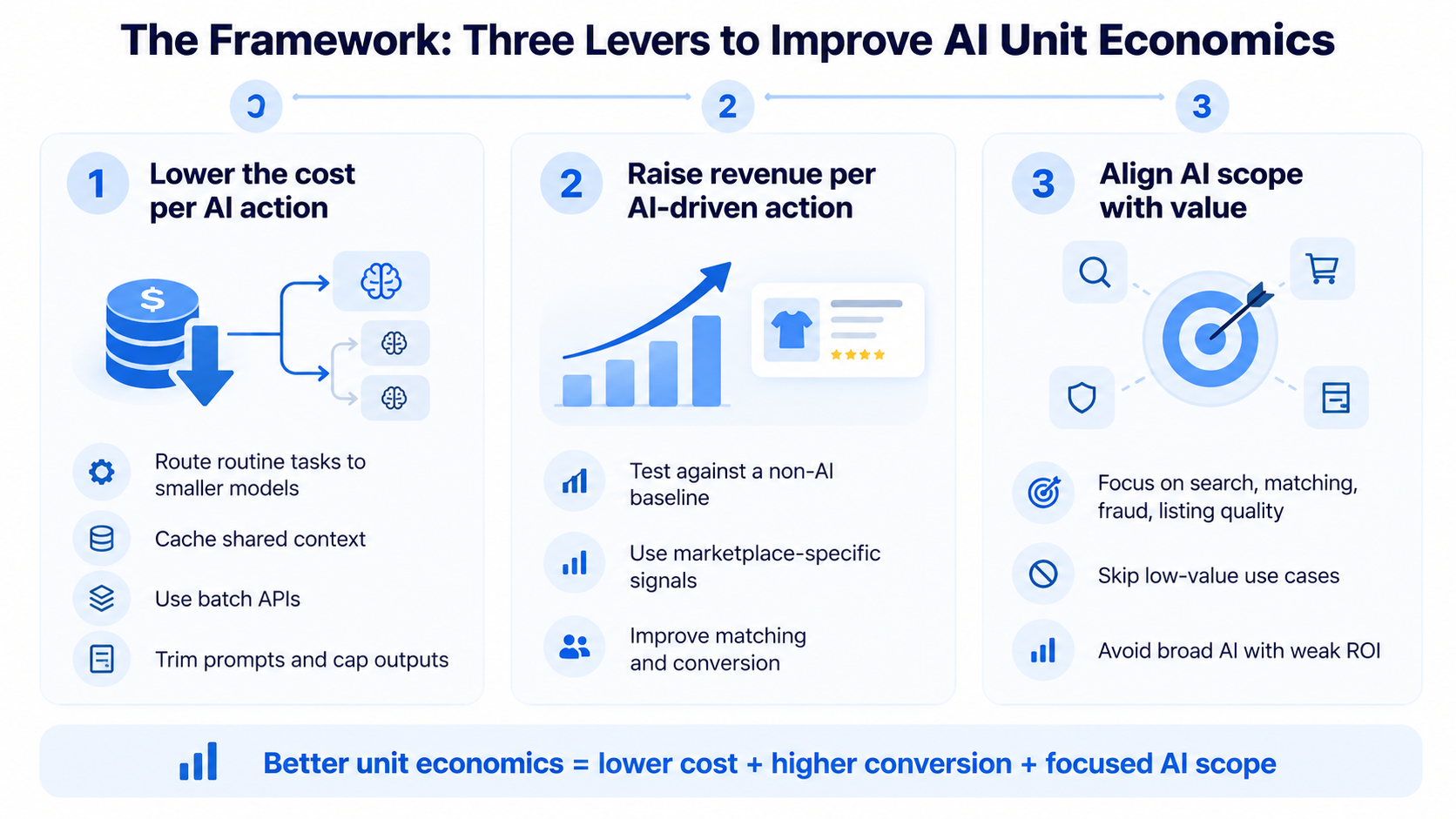
Improving AI unit economics is rarely about switching to the cheapest provider. It is about working three levers at the same time: lowering the cost per AI action, raising the revenue each action produces, and narrowing AI to the places where it matters.
1. Lower the cost per AI action
This is the most visible lever. Route routine tasks such as classification, tagging, and short answers to small models, and save larger models for complex reasoning. Cache shared context such as system prompts and category data. Send non-urgent work such as listing enrichment and nightly re-ranking through batch APIs. Trim prompts and cap output length. If you self-host open models, quantization and right-sized GPUs help too. Our guide on how to reduce token usage walks through these techniques step by step.
2. Raise revenue per AI-driven action
A recommendation that leads to a transaction is worth far more than one that does not. A/B test AI features against a non-AI baseline so you measure incremental lift, not just usage. Use marketplace-specific signals such as seller ratings, response times, and past buyer behavior rather than generic ranking. Better matching raises conversion, which directly lowers AI cost per transaction. Tools like an AI search box work best when they are tuned to your vertical's own signals.
3. Align AI scope with value
Do not AI-power everything. Prioritize high-value workflows: search ranking, buyer and seller matching, fraud checks on larger transactions, and listing quality. Skip AI for low-value interactions where a rule-based system works just as well. Many founders deploy AI broadly to impress investors or users, then face rising costs with little measurable return.
Building Your AI Unit Economics Model
Start with a simple spreadsheet and work through this checklist:
- List each AI feature and define its unit (a search session, a generated listing, a fraud check).
- Pull 30 days of real usage: actions per feature, tokens per action, and model used.
- Calculate fully loaded cost per action, including retrieval, infrastructure, and any human review.
- Estimate actions per completed transaction and convert that to AI cost per transaction.
- Compare it with net revenue per transaction (order value x take rate) and with the measured lift from A/B tests.
- Break results out by user segment and usage tier to find unprofitable pockets.
Then stress-test your assumptions. If the assistant assumes a 5% conversion lift, what happens at 2%? If a provider raises prices or retires the model you depend on, how much does cost per transaction move? Build in a buffer for both.
The real discipline is revisiting this model on a regular cadence, monthly while a feature is new and quarterly once it is stable. Compare predicted unit economics with observed results. When there is a gap, investigate. Often it reveals that the AI is solving the wrong problem or needs to be re-scoped.
When to Build vs. Buy vs. Partner
The decision to build custom AI, buy a third-party tool, or partner with specialists depends on your AI unit economics. Consider an illustrative marketplace processing 100,000 transactions a month with an $80 average order value and a 12% take rate. That is $960,000 in monthly net revenue. If you allocate 3% of it to AI, your budget is about $28,800 a month. Can you get a working solution for that amount, including engineering time?
A third-party API or plugin may deliver most of the value for a fraction of that budget, which makes buying the clear choice at this stage. At ten times the volume, the same 3% allocation funds a dedicated team, and a custom system that adds even a small lift in conversion can be worth far more than its cost. That is when building in-house starts to make sense.
The middle ground is partnership. Specialists in AI cost optimization can bring proven patterns to your marketplace, tune them for your unit economics, and refine them as you scale, without you carrying a full machine learning team. This works especially well for marketplaces that need sophisticated AI to compete but lack deep in-house AI engineering. If you are earlier in the journey, an AI strategy and architecture review can settle model, routing, and data decisions before they become expensive to change.
Avoiding the AI Unit Economics Trap
The most common mistake is shipping AI as a feature without measuring its financial impact. Founders build a recommendation engine because competitors have one, or an agent because it sounds impressive. Twelve months later, the feature costs more than it delivers. If you are scoping agents specifically, plan the cost model alongside the build, as we do in custom AI agent development.
The second mistake is treating data and quality management as a one-time cost. It is not. AI features need continuous monitoring, evaluation, and tuning.
The third is over-optimizing for quality at the expense of economics. A frontier model may produce slightly better answers at many times the price of a small model. If that gain does not materially improve conversion, retention, or cost savings, it is a bad trade.
The clearest path is to start small, measure carefully, and scale only what improves your unit economics. Pick one AI use case, ideally inside your marketplace MVP or an existing high-traffic flow. Ship it, measure revenue impact against cost, and invest further only when the ratio holds up at scale.
Frequently Asked Questions
What is AI unit economics?
It is the comparison between the revenue an AI feature generates per unit (a transaction, session, or user) and the full cost of delivering that unit, including model usage, infrastructure, data work, monitoring, and human review.
How much should a marketplace spend on AI per transaction?
There is no universal number, but AI cost per transaction should be a small, stable share of the net revenue that transaction earns, and clearly lower than the incremental revenue the feature creates. Many teams set an internal budget as a percentage of take-rate revenue and review it monthly.
Are AI inference costs part of cost of goods sold?
Generally, yes. Production inference that serves live users behaves like cost of goods sold because it scales with usage. Experiments and model development are usually treated as research and development. Check with your accountant for your specific situation.
What is the fastest way to cut AI costs without hurting quality?
Model routing usually has the biggest impact: send simple tasks to small models and reserve larger ones for hard cases. Prompt caching and batch processing are the next quickest wins, since cached reads and batch jobs are priced well below standard rates on major providers.
Should I build or buy AI features for my marketplace?
Buy or use plugins while volume is modest and your needs match common patterns. Build when volume is high enough that a custom system's performance lift clearly outweighs its engineering and maintenance cost, or when AI is core to your differentiation.
Make the Math Work Before You Scale
For marketplace founders, clarity on AI unit economics separates sustainable AI strategies from expensive experiments. Measure the impact, know the full cost, and make the math work before you scale. If you are building or growing a marketplace and want AI features that earn their keep, our team of nearly 60 specialists, with 200+ projects behind us, can help through our marketplace app development services, from architecture and model selection to launch and ongoing optimization.