Sharetribe vs Marketplacer: Which Platform is Right for Your Marketplace?

If you're building a marketplace, choosing between Sharetribe vs Marketplacer is one of the most consequential decisions you'll make early on. Both platforms have proven traction with founders, but they solve the problem of marketplace creation in fundamentally different ways. The choice isn't just about features. It's about your timeline, budget, technical resources, and long-term vision for sustainable growth. Get this wrong, and you could find yourself locked into a platform that constrains your ambitions. Get it right, and you've built the technical foundation that can scale with your business for years.
The team at Journeyhorizon works with marketplace founders at every stage: choosing platforms, building on them, integrating custom features, and scaling through SEO and growth strategy. We've seen firsthand what happens when founders choose based on launch speed alone, versus those who think strategically about platform fit. This comparison focuses on what actually matters for long-term marketplace success, not just getting live quickly.
Understanding How These Platforms Actually Differ
Sharetribe is a headless marketplace platform. It provides the backend logic, APIs, and business rules, but no user interface. You build your own front end, own the UX completely, and control how buyers and sellers interact with your marketplace. This flexibility is powerful, but it requires technical resources and a longer timeline to launch. You're building a platform, not configuring one.
Marketplacer is a traditional SaaS marketplace solution. You get a complete stack: front end, admin dashboard, payment processing, notifications, and basic customisation tools all built in. You launch in weeks, not months. The trade-off is flexibility. You're constrained by the platform's design decisions and feature set. Extending beyond what's built in is difficult and expensive.
When evaluating Sharetribe vs Marketplacer, you're fundamentally choosing between a development platform and a finished application. That distinction shapes everything that comes next: your development costs, launch timeline, ability to differentiate, integration flexibility, and long-term scaling path.
=>>> Read More: Sharetribe vs Medusa: Which Platform Fits Your Marketplace
Core Features and What You Can Actually Customise
Sharetribe's strength is extensibility. The architecture is API-first. Everything can be modified, extended, or replaced. Want a custom search algorithm that differs from standard marketplace logic? You build it. Need a bespoke notification system, reporting structure, or seller dashboard? You have full control. This is transformative for founders whose marketplace mechanics don't fit the standard two-sided model.
However, this flexibility comes with responsibility. You're not just choosing a platform, you're choosing to build software. That requires developers, DevOps resources, deployment infrastructure, and ongoing maintenance. The "time to launch" advantage that Marketplacer offers disappears entirely for Sharetribe without development capability.
Marketplacer comes with everything functional out of the box. The buyer and seller experiences are designed and tested. The admin interface is comprehensive. The payment flows are built in. You configure, not build. Customisation is possible but limited. If you need functionality outside the platform's model, you hit walls quickly. Custom development on Marketplacer is expensive because you're paying the vendor premium rates for modifications to their system.
For founders planning significant product differentiation, AI-powered features, or non-standard marketplace mechanics, Sharetribe removes artificial constraints. For those focused on speed to market with standard functionality, Marketplacer is faster and simpler.
=> Related Post: Sharetribe vs Izberg: Which Marketplace Platform Fits Your Business?
Pricing, Development Costs, and Long-Term Economics
Sharetribe pricing is straightforward: monthly subscription based on transaction volume. There are no surprise platform fees. However, you must budget for development. A basic Sharetribe marketplace with a polished custom front end typically costs GBP 3,000-8,000+ to build, depending on complexity. Complex marketplaces with integrations and custom features cost significantly more. After launch, hosting, maintenance, and feature development are your ongoing costs.
Marketplacer uses a hybrid model: setup fees, monthly subscriptions, and transaction fees. The appeal is predictability. You know roughly what you're paying upfront, and there are no surprise development costs because the platform handles everything. Launching quickly keeps costs down in the first few months. However, if you outgrow the platform's capabilities, custom development becomes very expensive because you're paying premium rates for work on someone else's system.
Cost analysis matters. A budget-conscious founder sees Marketplacer as cheaper. A strategic founder thinks about three-year costs. If you're building something complex or plan to scale significantly, Sharetribe often delivers better long-term economics. You're not paying inflated rates for every customisation. You own your technical decisions. But if your marketplace is straightforward and you don't anticipate significant feature development, Marketplacer's total cost of ownership is lower.
=> See More: Sharetribe vs Bubble: Which Platform Is Best for Your Marketplace?
Platform Choice and Your Ability to Scale Beyond the Technology
Most marketplace comparisons stop at platform features. They miss something essential: how platform choice affects everything beyond the software. Your choice of Sharetribe vs Marketplacer influences your development team structure, your ability to integrate with growth tools, your content strategy, and your path to organic visibility.
Marketplacer's closed architecture means integrations are limited. If you want to feed your product data into an SEO content system, build custom analytics, or connect with third-party tools for growth, you're constrained. Sharetribe's API-first design makes these integrations natural. This matters more than most founders realise when they're thinking about sustainable growth beyond paid marketing.
The same applies to development partnership. Marketplace developers who work with Sharetribe can extend your platform, build custom features, and integrate systems that help you grow. They work with your codebase and architecture. On Marketplacer, you're dependent on the vendor's roadmap and development team. You have less control over your technical future.
When Sharetribe Is the Right Choice
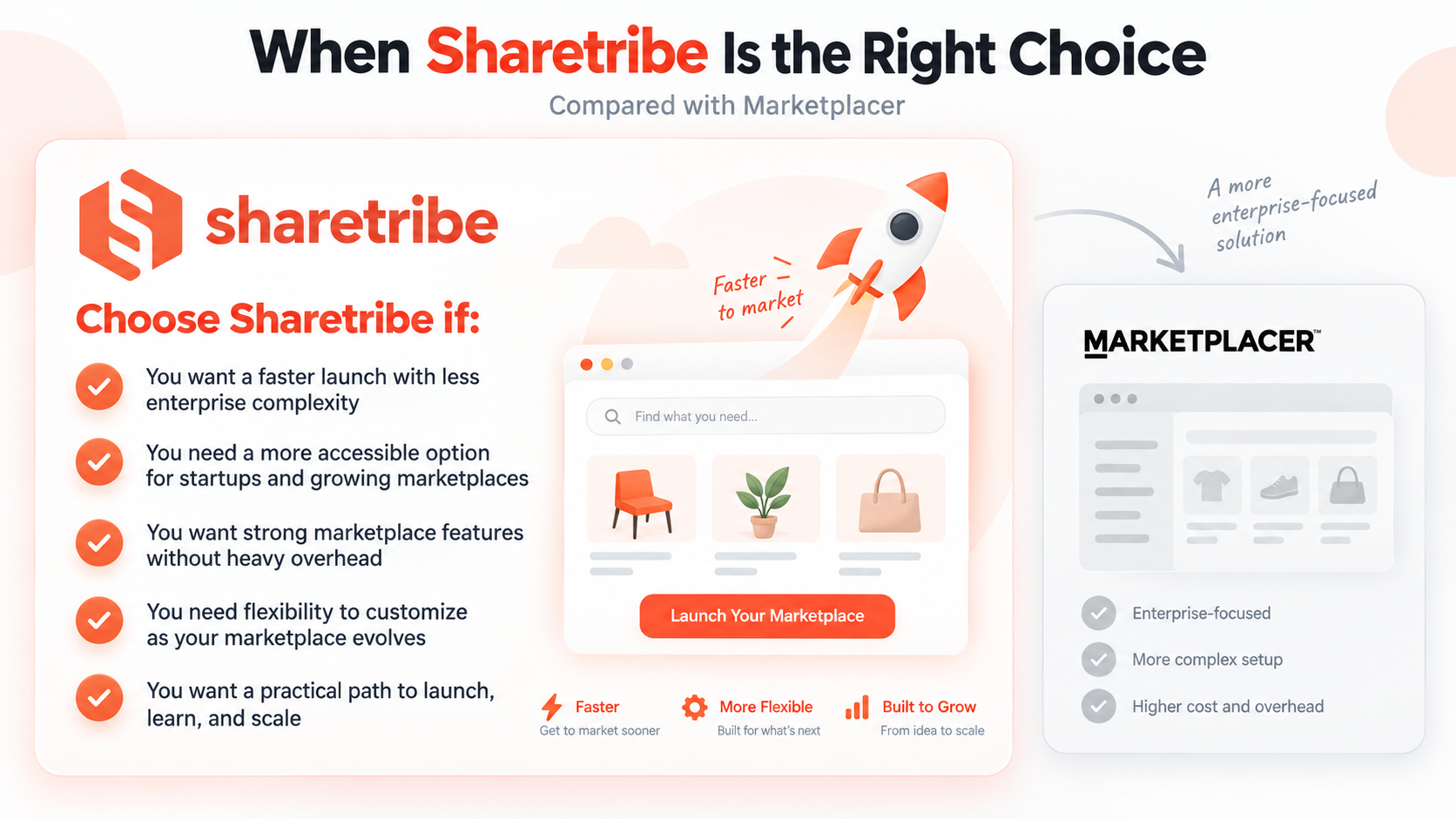
Choose Sharetribe if you're building something with differentiated mechanics, planning integrations beyond the standard feature set, or need bespoke features that give you competitive advantage. It's essential for verticals where standard marketplace logic doesn't apply: B2B procurement, specialised services, logistics networks, or hyperlocal marketplaces with unique mechanics.
Sharetribe is also the right choice if you're planning significant scale and want control over your infrastructure and feature roadmap. If you anticipate needing custom plugins, AI-powered features, or complex third-party integrations, Sharetribe gives you the flexibility to build without hitting platform constraints. The development investment is higher upfront, but it pays off over time.
Founders working with Sharetribe marketplace development partners benefit from expertise that extends beyond implementation. You want partners who understand platform architecture, can design custom features, and help you think strategically about integrations and long-term scaling. The right development relationship shapes what's possible with Sharetribe.
=> Related Post: Sharetribe vs Mirakl: Platform Comparison for Marketplace Founders
When Marketplacer Makes Sense
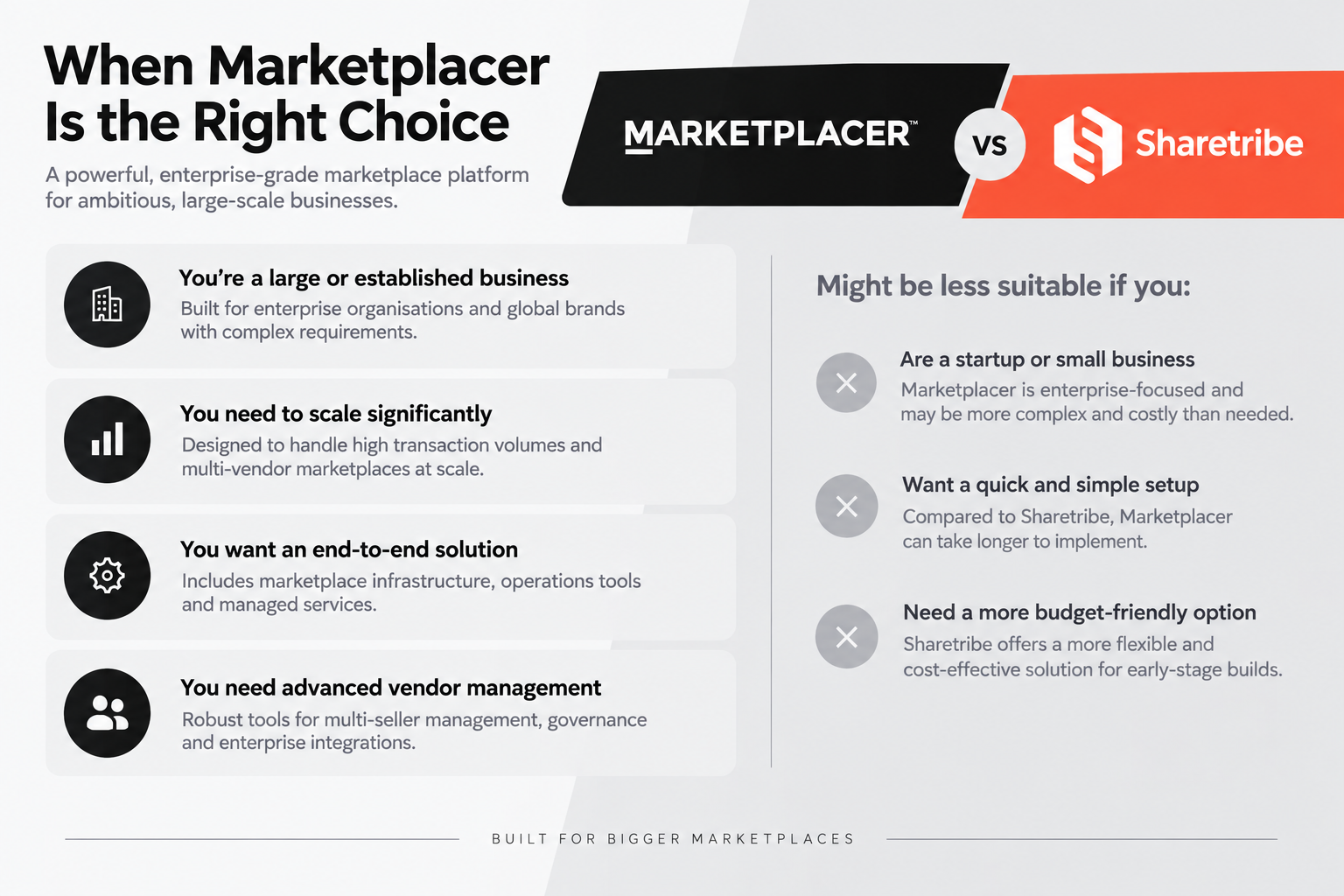
Marketplacer is appropriate if you're launching a traditional, two-sided marketplace with standard mechanics. You want to validate the marketplace hypothesis quickly, with minimal budget. You're running a seasonal or experimental marketplace. You lack internal development resources and want to avoid the complexity of managing a development team or external developers. In all these scenarios, Marketplacer gets you to launch faster and with less overhead.
It also makes sense if your marketplace model is straightforward and you don't anticipate needing significant customisation. Rental marketplaces, service marketplaces with standard mechanics, consumer product marketplaces, and similar use cases often work well on Marketplacer. You get a fully functional marketplace without the development complexity.
Making the Right Strategic Choice
The decision framework is simple but often ignored. Honestly assess three things: your technical resources, your timeline, and your long-term vision for differentiation.
If you have strong technical resources (internal developers or a trusted development partner) and plan to build something with unique mechanics or significant custom features, Sharetribe's flexibility usually justifies the development investment. If you're resource-constrained, need to validate the concept quickly, and your marketplace model is standard, Marketplacer gets you moving faster. If you're somewhere in the middle, consider your vertical. Unique marketplace mechanics often justify the Sharetribe investment. Standard two-sided models often work well on Marketplacer.
A common mistake founders make is choosing based on perceived simplicity rather than actual fit. They pick Marketplacer because it seems faster, then spend months fighting its constraints. Others pick Sharetribe, underestimate the development cost, and burn through runway before achieving product-market fit. The platform isn't your bottleneck. Your clarity about what you're building, your technical strategy, and your choice of partners are.
Another mistake is treating platform choice as irreversible. Migration from Marketplacer to Sharetribe is painful. The longer you stay on a platform that doesn't fit, the more costly the migration becomes. Data, integrations, and user experience all need rebuilding. If you suspect you might outgrow a platform in 12-24 months, investing in Sharetribe early is usually cheaper than migrating later.
Building for Growth Beyond Platform Features
The strongest marketplace founders think beyond the platform to sustainable growth. They consider how their technical choice enables or constrains growth strategy. They ask: Can I integrate content systems that support SEO? Can I build features that create network effects? Can I partner with specialists who extend the platform rather than being constrained by vendor limitations?
This is where custom marketplace development expertise becomes essential. The right partners help you think strategically about platform selection, build custom features that create competitive advantage, integrate systems that support organic growth, and execute the technical strategy that scales. They bridge the gap between platform capabilities and your actual growth needs.
Whether you choose Sharetribe or Marketplacer, success depends on clarity about your marketplace mechanics, realistic assessment of your resources, and intentional decisions about how technology supports your growth. The best comparison isn't feature-for-feature. It's strategic fit with your actual business model and your path to sustainable scale.
=> Read More: Sharetribe vs Yo!Kart: Which Platform for Your Marketplace?
Frequently Asked Questions
Can I migrate from Marketplacer to Sharetribe later if I outgrow it?
Migration is technically possible but operationally painful. You'll need to export buyer and seller data, recreate listings, rebuild your user interface, reconfigure integrations, and manage customer migration. The longer you stay on Marketplacer, the more complex the migration becomes. If you suspect you might outgrow the platform within 12-24 months, Sharetribe is the safer long-term bet despite higher upfront costs.
What's the realistic timeline to launch on each platform?
Marketplacer: 4-8 weeks to a functioning marketplace with standard configurations. Sharetribe: 3-6 months for a fully custom, polished experience, depending on complexity and your development resources. This timeline difference matters for early-stage validation but is less significant for long-term success and scaling.
How do these platforms compare for high-volume marketplaces?
Both scale technically, but Sharetribe gives you more control over scaling decisions and infrastructure. Marketplacer's scaling is handled by the platform, which simplifies operations but can be costly at very high transaction volumes. For marketplaces planning sustained high volume and growth, Sharetribe's long-term economics typically favour you.
Which platform is better for integrations with other business tools?
Sharetribe's API-first architecture makes integrations with CRM, analytics, content systems, and other tools straightforward. Marketplacer has built-in integrations but is limited for unconventional integration needs. If integrations are central to your operation or growth strategy, Sharetribe is significantly more accommodating.