What Is Hreflang in SEO? A Guide for Marketplace Founders

If your marketplace operates across more than one language or country, there is one technical SEO detail that quietly shapes how search engines decide which version of your site to show users. What is hreflang in SEO is a question that tends to arise once a marketplace begins expanding into new regions, and the answer matters far more than most founders initially realise. At Journeyhorizon, we work with marketplace operators on international growth, and hreflang implementation is one of the most consistently misunderstood elements in the technical SEO stack.
Put simply, hreflang is an HTML attribute that signals to search engines which version of a page should appear for a given language or region. But that definition leaves out the operational complexity. Getting hreflang right requires knowing what it actually does, when you genuinely need it, and how it interacts with the broader structure of your marketplace.
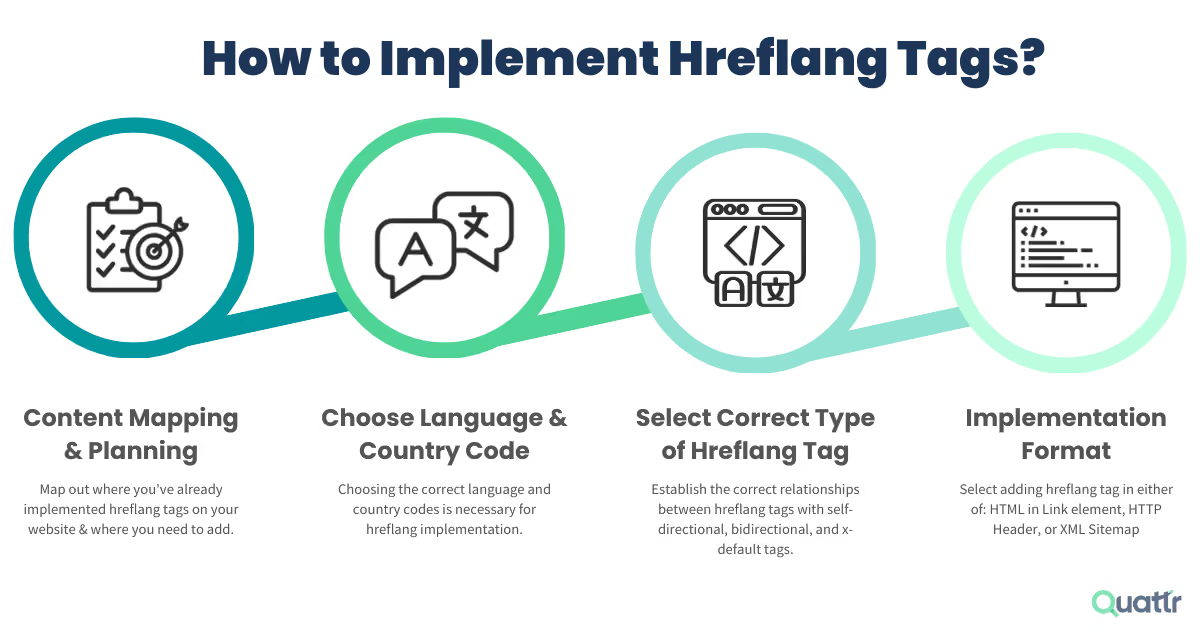
What hreflang does and why it matters for marketplace SEO
Search engines want to serve users the most relevant content for their location and language. Without clear signals, they may index your English-language listing pages and serve them to Spanish-speaking users, or show your Australian users content structured around US pricing and terminology. Hreflang in SEO solves this by creating explicit signals that map each URL variant to its intended audience.
Beyond user experience, the hreflang attribute also plays a critical role in preventing duplicate content issues. If you have a marketplace serving both the UK and Australia with near-identical content, Google may choose to consolidate those pages around one canonical version, effectively ignoring the other. Hreflang communicates that both pages are intentional and serve distinct audiences, preserving the organic visibility of each.
According to Google's official guidance on localised page versions, hreflang is treated as a strong signal but not a directive. Search engines will attempt to honour it, but they can override it when the signal is inconsistent or when pages are seen as substantially identical without genuine localisation effort.
How a hreflang tag is structured

The hreflang attribute uses a consistent syntax. A typical tag placed in the HTML head looks like this:
<link rel="alternate" hreflang="en-au" href="https://yourmarketplace.com/au/" />
The hreflang value combines an ISO 639-1 language code with an optional ISO 3166-1 Alpha-2 country code. So en-au targets English speakers in Australia, while es targets Spanish speakers globally. The x-default value is used to indicate a fallback page for users who do not match any specified language or region.
There are three methods for implementing hreflang: directly in the HTML head of each page, via HTTP response headers for non-HTML files such as PDFs, or through your XML sitemap. For most marketplace builds, implementing via the sitemap is the most scalable approach, particularly when managing hundreds of listing and category pages across multiple regions.
The rules that make hreflang work correctly
Hreflang only functions properly when a few foundational rules are followed consistently. Missing any of them is one of the most common reasons why international marketplaces see poor localisation in search results, despite having hreflang tags in place.
The first rule is bidirectionality. If page A references page B as an alternate version, page B must also reference page A. Search engines use this mutual confirmation to verify that both pages genuinely belong to the same cluster. A one-sided declaration is typically ignored.
The second rule is self-referencing. Every page in an hreflang cluster should include a tag pointing to itself. This reinforces the page's own identity within the cluster and prevents ambiguity when crawlers process the signals.
The third rule concerns x-default. This optional but recommended tag tells search engines where to send users when no language or country match is found. For a marketplace targeting multiple regions, setting x-default to your primary or most commercially important version is sound practice.
When your marketplace actually needs hreflang
Not every marketplace needs hreflang, and implementing it unnecessarily adds technical complexity without any SEO benefit. You genuinely need it when your site serves content in more than one language, or when you have region-specific versions in the same language that differ in meaningful ways. A marketplace operating in both the UK and Australia with localised pricing, currency, and terminology is a strong candidate. A single-language marketplace serving one primary region is not.
A common misconception is that hreflang will solve poor organic performance in a new market. It does not create visibility where there is none. It organises existing content correctly for different audiences. If your marketplace lacks market-specific landing pages, localised category content, or region-relevant listings, hreflang alone will not improve your rankings.
The decision should be framed as part of a broader SEO strategy rather than a standalone technical fix. Effective international growth requires technical accuracy alongside content relevance, structural authority, and in many cases, localised link signals. Understanding what technical SEO means for marketplace founders is a useful starting point before committing to an international implementation.
Common hreflang mistakes that damage organic visibility
Even experienced teams get hreflang wrong. The most common errors include using invalid language or region codes, pointing hreflang tags to non-canonical URLs, and failing to maintain bidirectional links when pages are added or removed. Each of these causes search engines to disregard some or all of the hreflang cluster, often without any visible error message in Search Console.
Another recurring problem is the conflict between hreflang and canonical tags. If a canonical tag on a translated page points back to the original language version, the two signals contradict each other. Search engines typically follow the canonical instruction, which effectively cancels out the hreflang tag entirely. Ensuring consistency between canonical declarations and hreflang is essential.
For marketplace platforms with large catalogues, maintaining hreflang accuracy across thousands of URLs requires a structured process. This is where platform choice and build quality become commercially significant. A well-structured custom marketplace build allows you to integrate hreflang logic directly into sitemap generation and URL architecture, rather than managing it manually at scale.
Platform considerations for hreflang implementation
How hreflang is implemented depends heavily on your underlying platform. For marketplaces built on Sharetribe, implementation requires technical customisation since the platform does not generate hreflang tags out of the box. A Sharetribe developer with SEO experience can integrate hreflang into your sitemap generation and page templates, making the setup maintainable as your listing volume grows.
For custom-built marketplaces, the implementation approach should be decided early in the development process. Retrofitting hreflang into an existing structure is significantly more time-consuming than designing URL and sitemap architecture to support it from the start. If internationalisation is on your roadmap, addressing the technical foundation before launching into new markets is the right call. Teams that work with a technical SEO specialist during the build phase avoid the most expensive mistakes.
The intersection of platform capability and SEO requirements is where many marketplaces lose ground. Getting these decisions right early creates a structural advantage that compounds over time as your international content grows.
For marketplace teams navigating this kind of implementation, Journeyhorizon's approach combines technical audit, platform-level customisation, and ongoing SEO oversight to make international targeting both accurate and sustainable.
Understanding what hreflang is in SEO is the starting point. Applying it correctly within your specific marketplace structure is where the real work begins. If international expansion sits on your roadmap, Journeyhorizon is the kind of partner that understands both the technical implementation and the growth strategy sitting behind it.
Frequently Asked Questions
What is hreflang in SEO?
Hreflang in SEO refers to an HTML attribute that tells search engines which language or regional version of a page to show to a specific user. It helps search engines surface the correct page variant based on a user's language preference or location, reducing duplicate content issues and improving the experience for international audiences.
Does hreflang directly affect rankings?
Hreflang does not directly improve rankings. It helps search engines surface the right version of your content to the right audience, which can improve click-through rates and reduce bounce from mismatched pages. Any ranking improvements are typically an indirect result of better content-audience alignment, not the attribute itself.
Does my marketplace need hreflang?
Your marketplace needs hreflang if you serve content in more than one language, or if you have region-specific versions of the same language that differ meaningfully in pricing, currency, or terminology. If your site is single-language and serves one primary region, hreflang adds technical complexity without benefit.
What happens if hreflang is implemented incorrectly?
Incorrect hreflang implementation typically means search engines ignore the tags entirely. This can result in the wrong language version appearing in search results, duplicate content issues where similar pages compete with each other, and missed visibility in the regions or languages you are actively targeting.