B2B Social Media Marketing: The Ultimate Strategy Guide for 2026
Most B2B marketers now rely on social media as a leading channel for both awareness and lead generation, with LinkedIn consistently standing out as the top platform for high‑quality B2B results. Modern social selling consistently outperforms traditional methods, especially when teams use formats like short, educational videos to communicate value quickly and authentically.
B2B social media marketing plays a crucial role in the modern buyer journey. B2B buyers today research independently on social media, comparing competitors, reading executive posts, and deciding before sales talks begin. Forget social as just branding. Smart founders need a strategic approach that produces measurable outcomes.
Journeyhorizon can help founders navigate this shift with clear, practical strategies that turn social channels into real growth. The goal of this playbook is to provide clarity, practical direction, and high-ROI frameworks. It translates modern social media behavior into a structured B2B social media strategy that any founder can use.
1. What is B2B social media marketing
B2B social media marketing is how businesses use social media platforms such as LinkedIn, YouTube, Instagram, X, or Facebook to share useful insights, build trust, and stay visible to decision-makers throughout a long and complex buying process.
It is not:
- A short-term performance marketing substitute
- A “post more and hope” activity
- A place to publish only company announcements
- A channel you judge by last-click attribution
Instead, B2B social media marketing is a pre-sales trust layer.
If you do it well, social media changes the quality of your inbound:
- Buyers show up already aligned with your POV.
- Sales calls start deeper.
- You encounter fewer price shoppers and more serious evaluators.
This is why the best B2B social strategies are led by people with real domain experience: founders, operators, consultants, technical leaders, and practitioners. Buyers do not trust “brands” as easily as they trust competent individuals.
To get a broader understanding of B2B marketing, you can explore our guide on What is B2B Marketing? Definition, Trends, Insights & Quick Actions for 2026.
2. Why most B2B social media marketing fails
Most B2B social media marketing programs do not fail because the channel is “too crowded” or because decision-makers “don’t use social.” They fail because the strategy is built like a B2C campaign.
In B2C, you can often win with:
- High-frequency posting
- Trend-based content
- Short-term offers
- Direct response loops
In B2B, those inputs rarely produce the outcome people care about: pipeline.
What failure looks like in practice:
- The company page posts product updates and feature announcements.
- The team posts irregularly, tied to campaigns.
- Content is generic (tips, quotes, or recycled industry news).
- Measurement is based on impressions, likes, or follower growth.
And then the conclusion arrives: “We tried LinkedIn. It didn’t work.”
Here is what is actually happening. B2B buyers use social media as a risk-reduction environment. They are not looking for vendors in the way they look for sneakers or skincare. They are trying to answer questions:
- Does this team genuinely understand the problem?
- Do they have real-world experience, or are they repeating theory?
- Do they sound credible enough to trust with a high-stakes decision?
When your social content does not help buyers reduce risk, it becomes background noise.
A strong B2B social presence is less like advertising and more like reputation - built slowly, reinforced consistently, and leveraged at the exact moment a buyer is ready to talk.
Discover more insights of B2B Marketing Strategies 2026: How to rank in AI overview & raise business conversion.
3. How B2B buyers use social media in 2026
To rank Top 3 for “B2B social media marketing,” you must align the article with the real search intent behind that keyword. Searchers want strategy, but they also want the reason the strategy works.
Modern B2B buying behavior in 2026 has three important characteristics:
3.1. Research is self-directed
Most buyers do not begin with your website. They begin with peers, search, and social - then arrive at your site once they believe you are worth a deeper look.
3.2. Decisions are multi-stakeholder
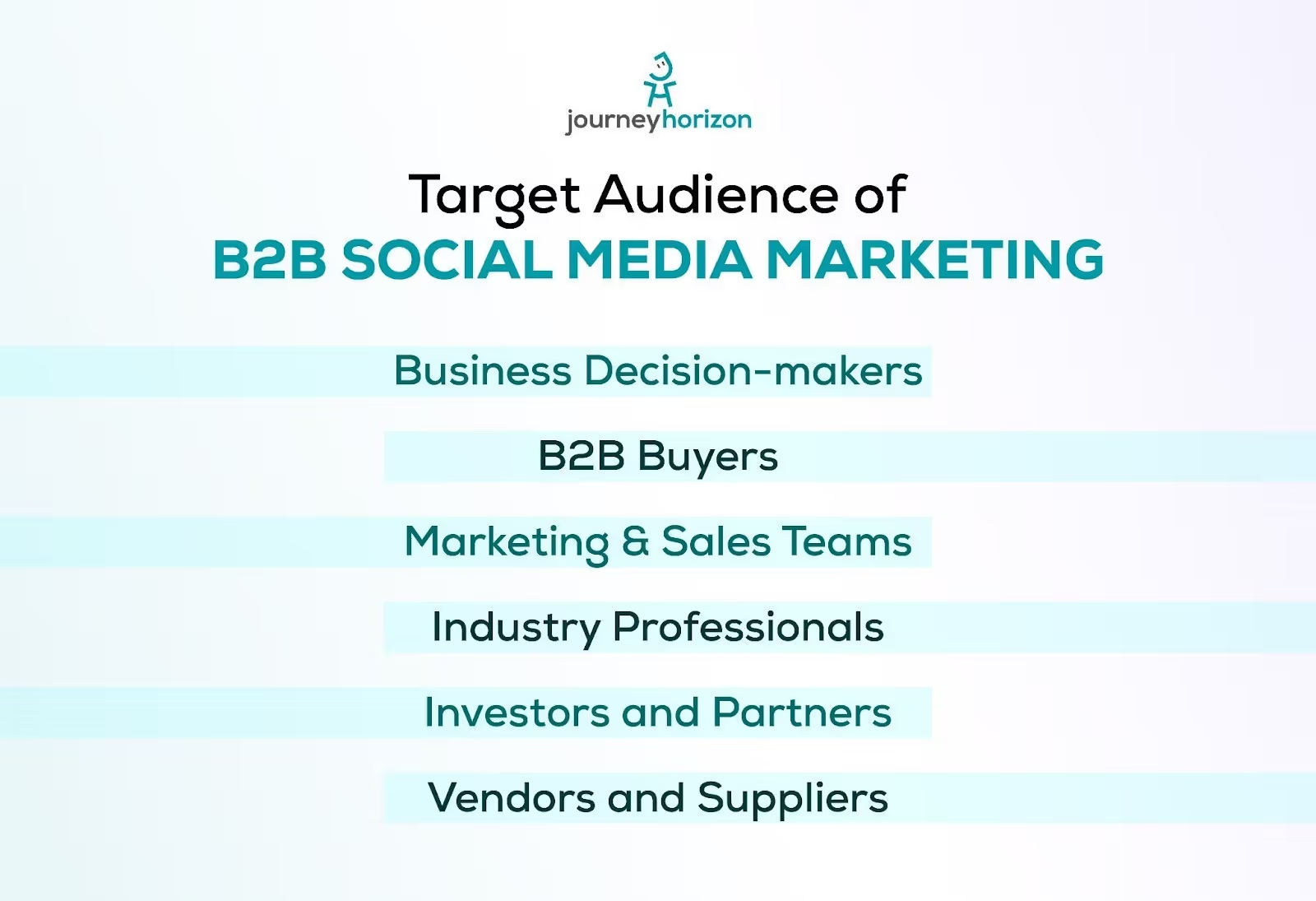
B2B deals are rarely won with a single persona. A buying committee may include:
- Economic buyer (budget authority)
- Functional owner (marketing/sales/ops)
- Technical evaluator (security, IT, architecture)
- Implementation owner (delivery, success)
Each person is reducing different risks.
3.3. Trust is built through reasoning
Buyers are drawn to people who can explain:
- Why the problem exists
- Why common approaches fail
- What works in practice
- What trade-offs matter
That is the core content advantage in B2B social media marketing: demonstrating reasoning publicly.
When your content shows that you can think clearly about a buyer’s problem, you shorten the credibility phase of the sales process - often before a single sales email is sent.
4. The Trust funnel: A practical way to understand B2B social media impact
Most teams try to apply the classic marketing funnel to social media: awareness → consideration → conversion. It is not wrong, but it is incomplete.
Based on Journeyhorizon’s experience working with B2B teams, a more practical way to understand how social media influences pipeline is through what we call the Trust funnel:
- Visibility: The right people repeatedly encounter your ideas.
- Credibility: Your content shows that you understand the problem in real-world terms.
- Authority: You become associated with the problem space and a clear solution philosophy.
- Conversation: Buyers initiate contact, respond to outreach, or ask for introductions.
- Pipeline: Social influence contributes to real opportunities and revenue.
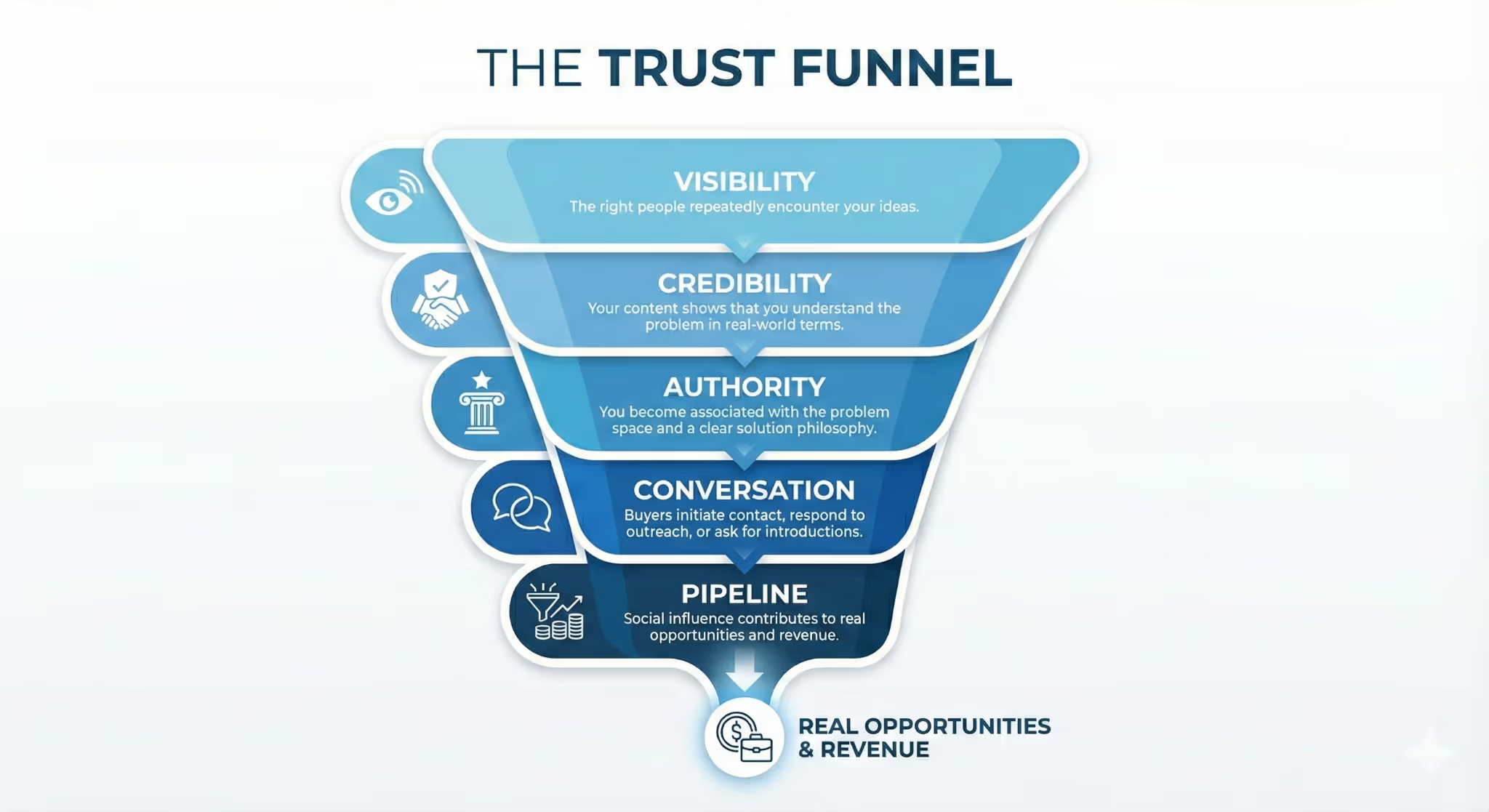
In practice, B2B social media marketing tends to be most effective when it consistently moves buyers through stages 1–3.
Stages 4–5 happen later, often through indirect paths:
- A buyer saw your posts for months, then clicked your site.
- A champion forwarded a video internally.
- A decision-maker recognized your brand in a shortlist.
This is also why last-click attribution undervalues social in B2B. Social often works like a reputation engine: it changes conversion rates upstream, not just at the final step.
5. Platform strategy deep dive
5.1. LinkedIn: The core revenue platform
According to HubSpot, LinkedIn remains one of the most effective platforms for B2B social media marketing. From Journeyhorizon’s own experience working with B2B clients, we have repeatedly observed a similar pattern: LinkedIn is where most meaningful social-driven B2B conversations and opportunities originate.
Across different industries, decision-makers, analysts, and industry specialists use LinkedIn daily to evaluate insights, follow practitioners, and identify voices they trust before engaging in deeper discussions.
LinkedIn is widely considered one of the most important channels in B2B social media marketing for three reasons:
- Your buyers are already there in a professional mindset.
- The network structure enables distribution via people (not only brands).
- The platform rewards conversation, insight, and credibility.
But “be on LinkedIn” is not a strategy. What works in LinkedIn B2B strategy is a “Point of View + Proof + Consistency” system.
5.1.1. The Linkedin post formula that consistently performs in B2B
A reliable structure for thought leadership posts:
Hook → Situation → Insight → Lesson → Soft CTA
- Hook: Challenge an assumption or name a painful truth.
- Situation: A real scenario buyers recognize.
- Insight: Your reframing, why things fail, what matters.
- Lesson: A practical takeaway.
- Soft CTA: Invite discussion, not a sales pitch.
Example:
Hook: “Most B2B social media marketing fails because it’s built for likes, not trust.”
Situation: “We reviewed 50 B2B company pages last quarter. Nearly all posted product updates and feature news, then wondered why inbound was weak.”
Insight: “Buyers don’t need more announcements. They need confidence that you understand the trade-offs they’re facing.”
Lesson: “If you publish one useful framework per week and one practitioner story per week, you’ll outperform 90% of B2B content on LinkedIn.”
Soft CTA: “If you want, reply with your industry and I’ll share 3 angles that work there.”
That post works because it does what buyers want: it reduces risk by showing reasoning.
5.1.2. What to post on LinkedIn (a simple content mix)
high-performing LinkedIn content often follows a balanced mix rather than a rigid formula. In practice, this mix typically looks something like:
- 40% Practitioner insights (what you’ve learned in real work)
- 30% Frameworks (models, checklists, decision guides)
- 20% Proof (case patterns, wins, failures, lessons)
- 10% Brand/product (only when it is genuinely useful)
These proportions are not fixed rules. They simply reflect a common pattern where experience and expertise dominate, which is where E-E-A-T becomes practical rather than theoretical.
5.1.3. Posting frequency (what is realistic)
For many B2B founders and practitioners, a sustainable cadence often includes:
- Around three posts per week on a personal profile
- One post per week on the company page, repurposing the strongest content
- Short daily engagement in comments, which often delivers outsized reach
Consistency generally matters more than intensity. In B2B, the goal is to build recognition and trust over time, not to chase short-term spikes.
5.2. YouTube: Authority at scale
If LinkedIn is where you win attention and conversation, YouTube is where you build depth.
YouTube works in B2B because it lets you demonstrate:
- How you think
- How you explain complexity
- How you handle trade-offs
That is exactly what buying committees want before approving a vendor.
High-Impact B2B YouTube Formats
Educational deep dives (10–20 min)
- Explain a problem category
- Compare approaches
- Show decision criteria
Product walkthroughs (5–12 min)
- Not feature tours - use-case tours
- Show the “before → after” workflow
Webinar replays
- Turn events into evergreen assets
- Add a short intro to frame who it’s for
- Podcast or interview episodes
- Bring in peer credibility
- Use clips for LinkedIn distribution
Short-form video has become a powerful tool even in B2B settings. According to LinkedIn's 2025 B2B Marketing Benchmark, video combined with authentic content boosts engagement 2.5x compared to polished studio videos. Many founders worry that video requires technical skills or studio equipment, but low-production videos often perform best because they feel direct and authentic.
5.3. X (Twitter) and niche communities
X and niche communities are optional, but useful when you are in a market where peer discussion is active.
Use them to:
- Share short insights
- Test ideas quickly
- Participate in industry threads
Do not treat them as your primary pipeline engine. Treat them as reputation reinforcement.
5.4. Other platforms: When they make sense (and when they don’t)
Not every platform deserves a deep-dive in a B2B social media marketing strategy.
Platforms like Facebook, Instagram, TikTok, Reddit, Slack, and Discord are often mentioned in generic B2B marketing guides. However, most of them play situational or supporting roles, not core authority-building roles.
Here is how to think about them realistically:
Facebook
Best suited for private groups, alumni communities, or customer groups. It works when you already have an audience, but it is weak for public authority-building and discovery in B2B.
Instagram
Occasionally useful for employer branding, culture, or visual-heavy industries. It is not effective for explaining complex B2B problems or influencing buying committees.
TikTok
Can drive reach and awareness in specific niches, but it is rarely trusted as a primary channel for high-consideration B2B decisions. Use it only if short-form video aligns strongly with your buyer profile.
Reddit
Powerful but risky. Reddit rewards authenticity and punishes promotion. It can work for insight gathering and selective participation, but it is not a reliable, scalable B2B distribution channel.
Slack / Discord
Excellent for owned communities and customer engagement, but they are not public platforms and provide no direct SEO or discovery benefits.
The rule of thumb is simple: if a platform does not help you consistently demonstrate reasoning, experience, and expertise to decision-makers, it should not be a core B2B social media channel.
For most B2B companies, LinkedIn and YouTube remain the only platforms that reliably compound authority over time.
6. Step-by-step B2B social media marketing strategy
6.1. Step 1: Define ideal customer profile (ICP) & buying committee
The biggest strategy error is targeting job titles instead of buying dynamics.
A strong ICP definition includes:
- Company size and maturity
- Industry and context
- Primary pain points
- Constraints (budget, compliance, tech stack)
- Buying committee roles
6.2. Step 2: Set objectives & KPIs that map to revenue
B2B social media marketing is most effective when it is evaluated using business-oriented signals rather than surface-level engagement metrics.
A practical way to think about measurement is to map social activity to outcomes that sales teams actually care about:
As a general principle, engagement quality tends to matter more than engagement volume.
Meaningful interaction from the right buyers is usually more valuable than large impression numbers from an irrelevant audience.
6.3. Step 3: Build a sustainable content engine
One of the easiest ways for B2B teams to burn out is treating social media as “creating something new every day.”
A more sustainable approach is to create repeatable content formats and use tools like PostEverywhere to automate social media posting, making it easier to manage your schedule without daily extra work
In practice, many B2B teams find it manageable to rotate between three core content types:
- One framework post
A model, checklist, or decision guide that helps buyers think more clearly. - One practitioner story
What worked, what failed, and what you learned from real experience. - One opinion post
A contrarian take, a common myth, or a practice you deliberately avoid.
This typically results in around three posts per week. Over time, this level of consistency can help reinforce your point of view and build familiarity with the right audience in many B2B contexts.
For a deeper look at how content pillars can transform your B2B strategy, check out our guide on 5 B2B Content Pillars to Transform B2B Content Marketing Strategy.
7. Repurposing: One insight, many assets (without losing authority)
In B2B social media marketing, repurposing is not about cutting a piece of content into smaller fragments. It is about translating the same underlying insight across different formats while preserving its meaning and authority.
A practical repurposing workflow usually starts with one deep asset, such as a YouTube video, a webinar, or even a long internal memo. From that asset, teams extract a small number of core insights, typically three to five ideas that are genuinely useful and specific. Each insight can then be adapted into multiple formats, including a LinkedIn text post, a simple framework carousel, or a short video clip designed for distribution.
The strongest insight often deserves further expansion. In many cases, it can be developed into a long-form blog post for SEO or turned into a short sales enablement note that supports conversations later in the buying process. When done well, this approach creates a connected ecosystem in which social media builds awareness, content provides depth, and sales converts accumulated trust into pipeline.
8. Proof of experience: Real-world patterns that tend to work consistently
You asked for proof and experience, not theory. Here are patterns that repeatedly show up in B2B markets.
8.1. Pattern 1: Founder-led POV beats brand-led promotion
When a founder or practitioner publishes consistent insights, buyers attach credibility to a person. That credibility transfers to the company.
What changes:
- More qualified inbound DMs
- Faster first-call conversion
- Stronger brand recall in competitive deals
8.2. Pattern 2: Opinionated insight beats generic advice
“10 tips” content is everywhere. Buyers ignore it.
What gets shared in B2B:
- Trade-offs
- Hard truths
- Decision frameworks
- Lessons from failures
8.3. Pattern 3: Consistency beats viral spikes
In B2B, trust is cumulative. A viral post may bring impressions; it rarely brings the right pipeline on its own.
Winning teams treat social media like a weekly discipline, not a campaign.
9. Common mistakes when doing B2B social media marketing
Many B2B social media efforts fail not because the channel is ineffective, but because the same avoidable mistakes are repeated over time.
- Posting without a point of view
- Treating social as a campaign instead of a system
- Over-promoting product features
- Ignoring comments and conversations
- Publishing content that isn’t tied to real buyer pain
If you fix only one thing: build a clear POV and publish consistently for 12 weeks.
10. Journeyhorizon - A trusted provider of B2B social media marketing services
Journeyhorizon helps B2B companies and B2B marketplaces use social media as a strategic, trust-building channel. The company approaches B2B social media marketing as part of a broader organic growth system, rather than a standalone publishing or engagement tactic.
In practice, Journeyhorizon as a B2B Digital Marketing Agency, supports B2B teams with:
- B2B social media strategy aligned with buyer behavior
Defining how social media supports long buying cycles, multi-stakeholder decisions, and overall go-to-market objectives. - Authority-led content for B2B platforms
Helping teams use platforms such as LinkedIn and YouTube to demonstrate expertise, reasoning, and real-world experience. - Integration with SEO and content marketing
Connecting social media activity with long-form content, organic visibility, and broader content strategy. - Sustainable execution and measurement
Designing realistic content systems and measurement approaches that reflect business impact rather than vanity metrics.
Journeyhorizon works closely with founders and go-to-market teams to ensure B2B social media marketing consistently supports credibility, visibility, and revenue conversations over time.
Read more of B2B Marketing Services or discover our full range of Marketing services.
11. FAQs
Does B2B social media marketing generate leads?
In most B2B contexts, yes – indirectly. It helps build trust that supports conversations and influenced pipeline over time.
Which platform matters most for B2B social media marketing?
For most B2B teams, LinkedIn is the foundation. YouTube often helps compound authority and deepen trust over longer buying cycles.
How long does B2B social media marketing take to work?
In many B2B cases, teams begin to see early momentum within 3–6 months when execution is consistent.
What should we post if we have no case studies yet?
Start with frameworks, trade-offs, and lessons learned from your own work. Even small wins and mistakes count as experience.
12. Final takeaways
B2B social media marketing is not about being active on every platform. It is about building trust, clarity, and visibility across long, multi-stakeholder buying journeys.
A practical approach focuses on clear ICP definition, consistent point-of-view-led content, and repurposing a small number of strong insights across formats, while measuring success through conversations and pipeline influence rather than vanity metrics.
Journeyhorizon helps teams apply this approach by designing B2B social media marketing systems grounded in real buyer behavior, E-E-A-T principles, and sustainable execution.
Ready to put this approach into action? Collaborate with Journeyhorizon now!
.avif)
