How to Build a Multi-Vendor Marketplace: A Strategic Guide for Founders
.avif)
Building a multi-vendor marketplace has become one of the most valuable business models in modern ecommerce. Instead of purchasing and managing inventory, the marketplace connects independent vendors with customers through one platform.
This model can generate revenue from commissions, subscriptions, listing fees, or additional vendor services. It can also scale without the inventory costs associated with traditional retail.
Journeyhorizon is a two-sided marketplace development specialist that helps founders plan, build, launch, and scale marketplaces across products, services, rentals, bookings, and B2B transactions. By combining marketplace development expertise with growth strategy, Journeyhorizon helps businesses align their technology, vendor experience, and customer acquisition from the beginning.
The technology required to launch is now more accessible than it was several years ago. However, understanding how to build a multi-vendor marketplace still requires careful decisions about the business model, platform architecture, vendor experience, payments, and customer acquisition.
The challenge is rarely technology alone. Marketplace founders must identify the right niche, attract both vendors and customers, and create enough transaction activity to keep both sides engaged.
What Makes a Multi-Vendor Marketplace Different
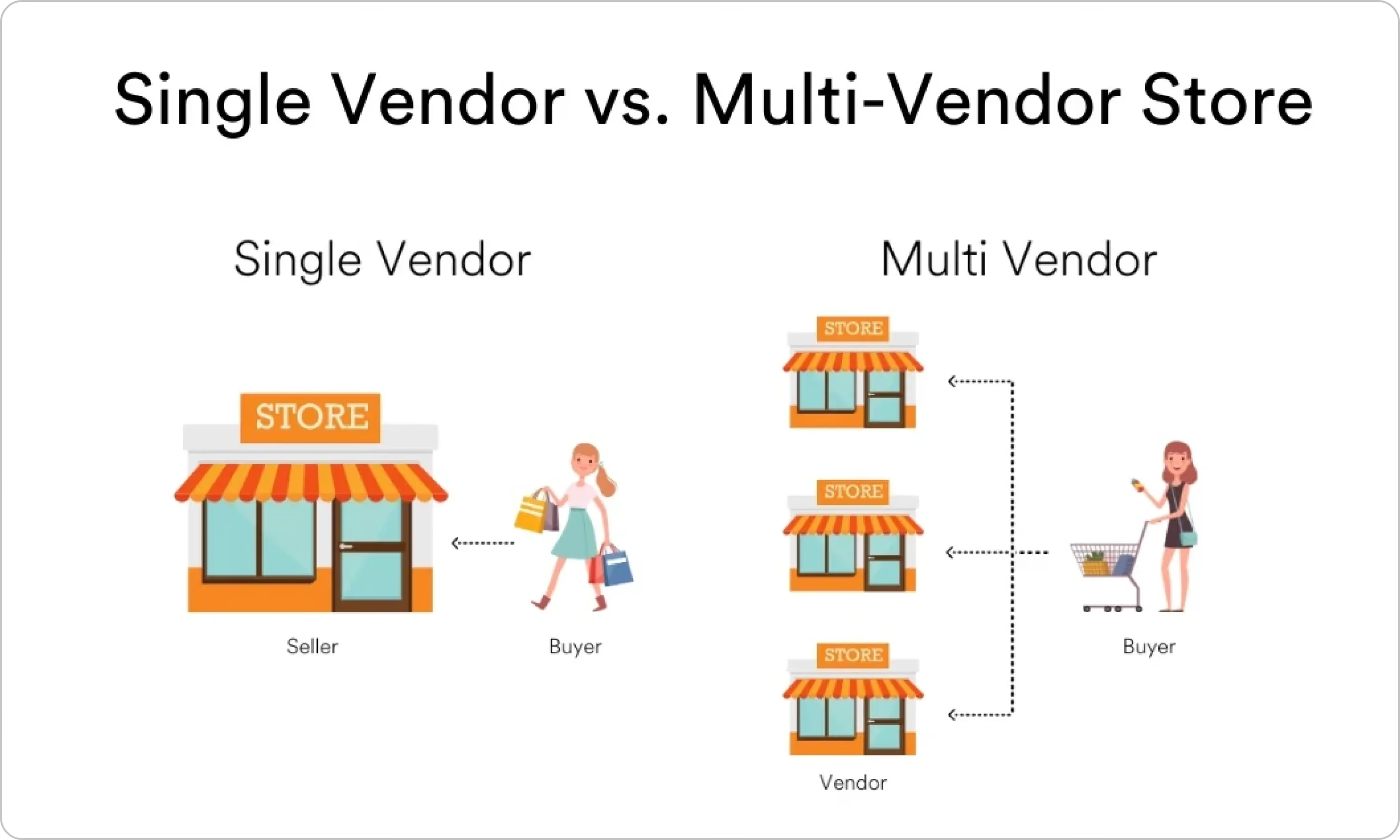
A multi-vendor marketplace is fundamentally different from a traditional e-commerce store. Instead of owning and managing inventory yourself, you provide a platform where independent sellers list their products or services. You earn revenue through commissions on transactions, subscription fees from vendors, or other platform monetization methods rather than product markups.
This model creates powerful network effects. More sellers attract more buyers, and more buyers attract more sellers. That's why Amazon and Etsy could scale without needing massive upfront inventory investment. But it also introduces complexity that single-vendor stores don't face. You have to solve the supply and demand problem simultaneously. You can't launch with zero vendors and expect customers to show up, just as you can't attract vendors to an empty platform.
Understanding this distinction is critical. Many founders mistake marketplace operations for simple e-commerce operations. A marketplace is a two-sided platform business. It requires different thinking around product development, marketing, vendor management, and customer acquisition. Getting this right from the start shapes every decision that follows, from your technology choice to your early go-to-market strategy.
Understanding this two-sided dynamic is one of the most important parts of learning how to build a multi-vendor marketplace that can create lasting value for both vendors and customers.
The Core Business Model Decision
Before choosing technology, you need to decide on your business model. How will you make money? Will you charge vendors a commission on each transaction, a subscription fee to list products, a flat listing fee, or some combination? Your revenue model directly impacts which vendors you can attract and whether your unit economics work.
A commission-based model (typically 10-30% depending on the category) aligns your incentives with vendor success but requires high transaction volume to be valuable. A subscription model creates predictable vendor revenue but may struggle to attract small sellers who aren't confident they'll generate sales. Many successful marketplaces use a hybrid: a small subscription to keep vendors committed, plus a commission on transactions.
You also need to decide what category you're serving. Are you building a horizontal marketplace like Amazon that sells everything, or a vertical marketplace focused on a specific niche like handmade goods (Etsy) or accommodations (Airbnb)? For a first-time founder, a vertical approach is almost always smarter. You build deeper relationships with vendors, understand the category better, and can achieve higher liquidity in a focused segment more quickly. Horizontal marketplaces require massive scale and capital to work. Vertical marketplaces can succeed with disciplined execution and focused growth.
Geography matters too. Are you launching locally, nationally, or globally? Cross-border logistics and payment complexities multiply with geography. Start where you can deliver real logistics and customer service before expanding.
Choosing Your Platform and Technology Stack
Once you've decided on your business model and niche, you need to choose your technology foundation. You have several options, each with different tradeoffs between speed, customisation, and cost.
No-code marketplace builders like Sharetribe or Shopify are the fastest path to launch. They handle vendor onboarding, product management, payment processing, and commission calculations out of the box. You can launch a functioning marketplace in days or weeks with no development team. The tradeoff is limited customisation. If you need specific features or workflows, you'll eventually hit the platform's limits. These platforms are excellent for validating your marketplace concept quickly without large upfront investment.
WordPress with marketplace plugins (WooCommerce with vendor plugins like Dokan or Multivendor) offers more flexibility than pure no-code builders, but requires more technical setup and maintenance. You'll need a developer to manage updates, security, and customisations. This is a middle-ground option for founders who need more control but don't want to build from scratch.
Custom-built solutions using frameworks like React or Vue with payment processors like Stripe offer maximum flexibility but require a technical team and significantly longer development timelines. If you have specific marketplace features that differentiate your platform (advanced matching algorithms, unique vendor workflows, AI-powered recommendations), custom development makes sense. But this is a decision to make after you've validated your business model with an MVP.
Many successful marketplace founders start with a no-code or WordPress solution to validate demand, then gradually move to custom development as they understand their market better. This staged approach reduces risk and ensures you're building features customers actually want. If your needs include integrations with vendor systems, advanced plugin development, or marketplace SEO infrastructure built into your platform, working with an experienced marketplace development partner can accelerate your timeline significantly.
Building Your MVP with Core Marketplace Features
Your initial product needs to solve the fundamental marketplace problem: connecting vendors with customers and enabling transactions. Don't build everything. Your MVP should include core features only.
Essential features include a vendor onboarding and approval system (so you can control quality), a product listing system where vendors manage their own catalog, a shopping cart and checkout experience for customers, secure payment processing with commission splits, and a basic review and rating system to build trust. That's it. These features are sufficient to prove whether your market actually works.
Common features that look essential but aren't: advanced search filters, mobile apps, marketing automation, analytics dashboards, and vendor analytics tools. These are valuable once you have traction. In the beginning, you need to focus on the core transaction loop and get it right.
One critical decision is payment handling. You need a payment processor that can handle split payments or marketplace payouts. Stripe, PayPal, and Wise all offer marketplace solutions that calculate commissions and pay vendors automatically. This removes significant operational friction from your launch and builds trust with vendors knowing they'll get paid on time and transparently.
Build Trust and a Strong Vendor Experience
A marketplace is only as reliable as the vendors operating within it. One poor seller experience can affect customer trust in the entire platform.
Begin with a clear vendor approval process. Depending on the category, this may include business verification, identity checks, product samples, licences, insurance, or references.
The standard should be strict enough to protect marketplace quality without making registration unnecessarily difficult.
Reviews and ratings give customers additional confidence, but the system should be designed to limit manipulation. Reviews should be linked to completed transactions, and unusual activity should be monitored.
The marketplace also needs clear policies for refunds, cancellations, damaged products, failed fulfilment, and disputes. Customers and vendors should understand their responsibilities before completing a transaction.
Vendor support is another important part of marketplace operations. Sellers may need help creating listings, uploading images, setting prices, fulfilling orders, and interpreting platform policies.
A structured marketplace seller onboarding process can reduce vendor confusion and shorten the time between registration and the first successful listing or sale.
The Often-Overlooked Role of Content and SEO
Most marketplace founders focus on the platform itself and forget that marketplace success also depends on customer acquisition. You need traffic to your marketplace, and that traffic primarily comes from organic search and content.
Building marketplace SEO properly means thinking about it during product development, not after launch. Your category pages, vendor pages, and product pages all need to be structured for search. That means proper heading hierarchy, schema markup for products, fast page speed, mobile optimisation, and unique content on category pages. If your marketplace is running generic product listings only, you'll struggle to rank.
Many successful vertical marketplaces also build a content hub around their niche. Etsy has extensive guides on starting a business. Airbnb publishes travel guides and stories. This content attracts potential users organically and builds brand authority. For a multi-vendor marketplace focused on a specific niche, this is a significant competitive advantage that's often overlooked in the early days.
Working with a partner who understands both marketplace development and technical SEO can help you build marketplace architecture that ranks naturally from day one, rather than requiring a costly restructure later.
Launching with Momentum and Validating Your Model
Launch date is important, but it's not the finish line. Plan your launch for a specific day, but don't spend six months polishing the platform before vendors and customers see it. You learn far more from real usage than from internal testing.
For your soft launch, recruit 5-10 vendors you believe in. These are founders, craftspeople, or service providers whose work you genuinely like. Ask them to list products and give you feedback. Start with a smaller cohort rather than trying to recruit dozens of vendors at once. You'll learn more, and your core vendors can help refine your offering.
Simultaneously, drive early customer traffic yourself. This might be friends, family, and your own network initially. Don't aim for scale yet. Aim for real transactions and real feedback. You want to see if customers actually buy, which vendors deliver reliably, what questions customers have, and what features would actually matter to both sides.
Track everything: vendor approval times, time to first sale, customer acquisition cost, average order value, repeat customer rates, and vendor satisfaction. These metrics will tell you if your model is actually working before you invest in scaling.
Most marketplaces fail not because the technology doesn't work but because they didn't achieve liquidity (enough supply and demand that users find what they need). This is achieved through testing, iteration, and disciplined focus. If you find that customers browse but don't buy, or vendors list but don't sell, the problem usually isn't the platform. It's the market or the customer experience. Iterate until both sides are satisfied.
Scaling With Confidence
Once you've validated that vendors and customers both want what you're building, scaling becomes more straightforward. You know your unit economics work. You know your market has demand. Now you can invest in vendor recruitment, customer acquisition, and feature development with more confidence.
As you scale, your technology needs may change. If you started on a no-code platform and it's now limiting your growth, migrating to a custom-built solution or a more flexible middleware becomes necessary. This is far less risky when you've already proven the market. You're investing in scaling a known model, not betting on an unproven concept.
At this stage, features like advanced vendor analytics, mobile apps, AI-powered recommendations, and integrations with vendor tools become valuable. Earlier, they were distractions. Now they're competitive advantages.
Growth also comes from content authority. Building a blog, publishing guides, and becoming a recognised voice in your category attracts organic traffic and builds trust. This compounds over time. SEO services and content marketing for marketplaces become increasingly important as you compete for visibility in your niche.
Key Decisions That Shape Success
Building a multi-vendor marketplace is fundamentally about decision-making at every stage. Your niche, business model, and technology choice set the foundation. Your MVP features and trust infrastructure shape user experience. Your content and SEO strategy determine whether you can acquire customers profitably. Your vendor support systems determine whether sellers stay and thrive.
The common thread across successful marketplaces is focus. Etsy succeeded in handmade goods. Airbnb focused on alternative accommodations. DoorDash started in a single city before expanding. Vertical focus, a clear business model, and relentless attention to both vendor and customer experience are what separate thriving marketplaces from failed platforms.
The technology is important but ultimately secondary to understanding your market and executing the fundamentals well. If you have a valuable niche, understand your vendors' and customers' needs, and iterate based on real feedback, the platform will support you. If you're betting on technology alone, no platform is good enough.
Many marketplace founders benefit from working with partners who have built multiple marketplaces and understand the typical patterns, pitfalls, and opportunities. Journeyhorizon has spent years helping marketplace founders launch and scale using Sharetribe and custom development, with integrated growth strategy from day one. If you're considering building your own marketplace, having a partner who understands both the technical and strategic dimensions can save you months of missteps and significantly improve your odds of success.
Understanding how to build a multi-vendor marketplace is ultimately an exercise in disciplined decision-making. Technology provides the infrastructure, but vendor quality, customer demand, transaction reliability, and marketplace liquidity determine whether the business succeeds.
Frequently Asked Questions
How long does it take to build a multi-vendor marketplace?
With a no-code platform like Sharetribe, you can launch a working marketplace in 2-4 weeks. With custom development, it typically takes 3-6 months to reach MVP stage. The time varies depending on your complexity requirements and how much customisation you need. Starting with no-code and migrating to custom development later is a common and smart path.
What's the difference between a marketplace and a single-vendor store?
A single-vendor store has you (or your company) as the seller. You own inventory, manage fulfillment, and make all the sales. A marketplace has multiple independent sellers listing products, managing their own inventory, and fulfilling their own orders. You earn revenue through commissions, not product markups. The operational and strategic complexity is significantly higher for a multi-vendor marketplace, but the upside is higher as well.
How do you solve the chicken-and-egg problem of needing vendors to attract customers and customers to attract vendors?
Start small and specific. Focus on a vertical niche where you can personally recruit vendors you believe in. Launch with a curated group of 5-20 vendors rather than an open platform. Simultaneously, recruit customers from your network and warm audiences. Once you have proof of concept—real transactions, happy customers, vendors making sales—expand from there. The key is proving the model works at a small scale before trying to scale.
What revenue model works best for a multi-vendor marketplace?
It depends on your market. Commission-based models (15-30% on transactions) align incentives well but require transaction volume. Subscription models create predictable revenue but may repel small vendors. Many successful marketplaces use a hybrid: a small vendor subscription plus a commission on transactions. Test with your early vendors to understand what they can sustain.
.avif)