What Can You Build With Webflow: A Strategic Guide

What can you build with Webflow is one of the most common questions marketplace founders and business leaders ask when evaluating website platforms. The answer is more nuanced than it first appears. Webflow is powerful for certain types of digital projects, but it has real constraints that determine whether it's the right choice for your specific use case. Rather than defaulting to WordPress or limiting yourself unnecessarily, understanding what Webflow actually excels at - and where it falls short- is critical to making the right platform decision.
As a growth partner for marketplaces and digital businesses, Journeyhorizon has seen firsthand which use cases work beautifully with Webflow and which ones become frustrating. Let's explore what you can actually build, where Webflow shines, and where you should be cautious.
The Difference Between What Webflow Can Build and What It Should Build

The first thing to understand is that what can you build with Webflow is not the same as what you should build with Webflow. Technically, Webflow's visual builder, CMS, interactions, and custom code capabilities give you broad flexibility. In practice, Webflow has a sweet spot-and stepping outside that sweet spot often means working against the platform rather than with it.
Webflow is fundamentally a website and web application builder focused on visual design, fast development, and modern web standards. It's not a general-purpose application framework. It wasn't designed to compete with custom-built SaaS platforms, complex enterprise software, or heavily real-time applications. That's an important distinction because it affects where you should invest your time and money.
The platform excels at delivering designed, content-driven, or membership-based websites that need to be beautiful, fast, and SEO-ready without the overhead of WordPress or legacy platforms.
Marketing Websites and Content Hubs for Marketplace Founders
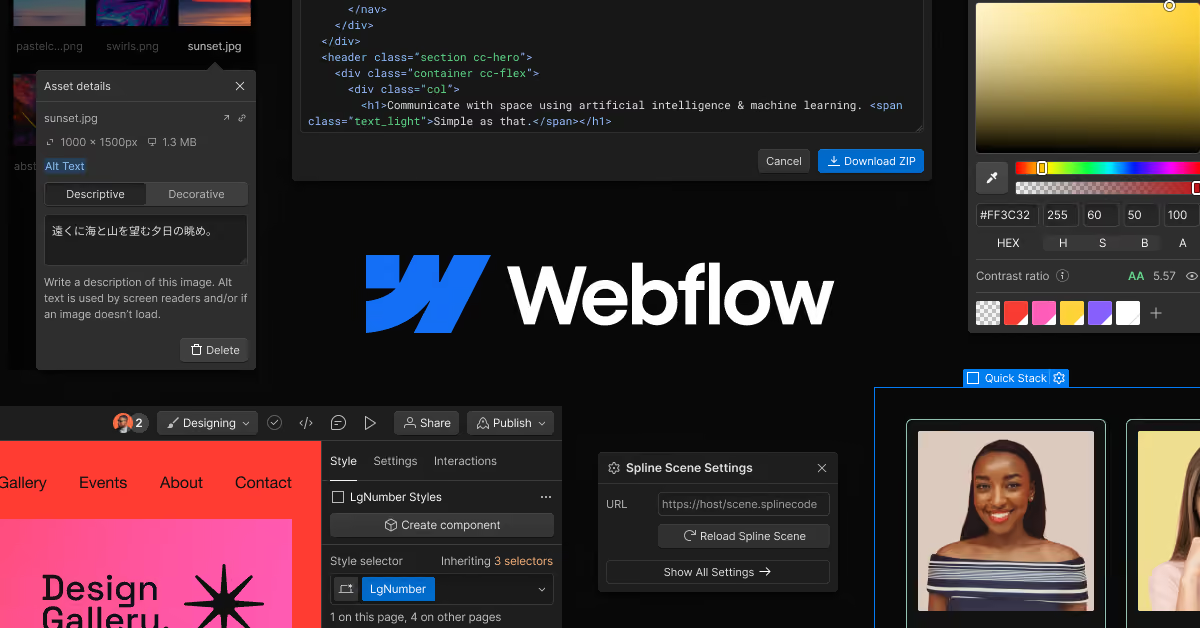
This is where Webflow genuinely shines, and it's particularly valuable for marketplace founders. Many marketplace businesses launch their core platform on Sharetribe, OpenMart, or another dedicated marketplace solution - and then realize they need a separate marketing website with strong SEO, content hubs, landing pages, and a scalable content infrastructure. This is where Webflow becomes a strategic asset.
A Webflow marketing website gives your marketplace a professional front door. You can build category landing pages optimized for SEO, publish a blog with a proper content management system, create resource hubs that attract organic traffic, and maintain complete design control. Unlike WordPress, where visual inconsistency and slow performance are common problems, Webflow gives you pixel-perfect design, fast load times, and native SEO capabilities.
For marketplace operators, the Webflow + Sharetribe combination is highly practical. Your marketplace handles transactions, user management, and core functionality. Your Webflow site handles brand presence, content-led growth, and organic visibility. The two platforms work together as part of an integrated growth strategy, and this is exactly the kind of architecture that experienced marketplace growth partners - like Journeyhorizon - specialize in.
You can also build multi-locale versions in Webflow, which means international marketplaces can maintain site consistency across different markets while optimizing for local SEO. This level of flexibility is difficult to achieve in other platforms without significant development work.
E-commerce Sites and Marketplace Features Within Webflow
You can build functional e-commerce experiences in Webflow, and many businesses do. Webflow's e-commerce features include product pages, shopping carts, payment integration (via Stripe, Apple Pay, and other gateways), inventory management, and order handling. If you're selling digital products, physical goods, or services, Webflow can handle that transaction layer.
However, it's worth understanding the scope. Webflow e-commerce is solid for straightforward selling scenarios - a portfolio of products, a subscription offering, or a digital product store. It works less smoothly if you need complex product variants, multi-seller capabilities, advanced analytics, or highly customized fulfillment workflows. That's where dedicated marketplace platforms like Sharetribe typically outperform Webflow, because they're built specifically for those use cases.
Many growing businesses find that starting with Webflow for simple e-commerce, then eventually migrating to a dedicated marketplace platform, is a practical path. The key is ensuring your Webflow site has solid SEO and content infrastructure so you don't lose organic visibility when you eventually evolve your platform architecture.
Membership Sites and Gated Content Platforms
Webflow has strong support for membership functionality. You can create gated content, restrict access to certain pages or resources based on membership tier, manage subscriptions, and build community-style features. This makes Webflow suitable for online course platforms, exclusive resource libraries, professional networks, and subscription-based content businesses.
The membership features are straightforward enough for many use cases, though advanced scenarios—like complex permission structures, dynamic content personalisation based on user behaviour, or sophisticated analytics - may require custom code or third-party integrations. For most membership businesses, though, Webflow's native functionality is sufficient and requires far less ongoing maintenance than building a custom solution.
Blogs, Content Platforms, and Authority Sites
Webflow's CMS is built for content creators and publishers. What can you build with Webflow includes entire content platforms, multi-author blogs, resource hubs, knowledge bases, and editorial sites. The CMS is more flexible than WordPress in many ways - you define your own content structures, design custom templates, and avoid the plugin fragmentation that slows down WordPress sites.
From an SEO perspective, Webflow is extremely strong for content-driven websites. The platform generates clean HTML, supports essential SEO features natively, and performs well in Core Web Vitals assessments. If you're building authority through content - a common strategy for B2B brands and SaaS companies - Webflow can be superior to traditional CMS platforms.
The content team can update and publish independently without touching code, which keeps workflows smooth as your organisation scales. You can also build editorial calendars, version history, and content scheduling directly into Webflow's interface.
Interactive Web Apps and Dynamic Experiences
Webflow can handle interactive elements, animations, real-time updates (to a degree), and dynamic content. If you're building web applications that need some interactivity but aren't deeply database-driven or processing-heavy, Webflow is viable. Examples include portfolio sites with interactive filters, project showcases, service booking platforms, calculators, and configurators.
However, Webflow's backend capabilities have limits. You can't easily build complex multi-user collaborative applications, real-time communication platforms, or software that requires sophisticated business logic and custom backend infrastructure. For those scenarios, frameworks like React, Vue, or custom-built solutions are more appropriate. The boundary between "what Webflow can technically do" and "what makes sense to build in Webflow" matters here.
Where Webflow Reaches Its Limits
To be clear about what Webflow isn't suitable for: you shouldn't build complex desktop-style applications, highly specialised SaaS tools, real-time collaborative software, or systems that require custom backend infrastructure and external integrations at scale. Webflow can integrate with APIs and third-party services, but if your product is fundamentally an integration orchestration platform or a complex data processing tool, Webflow is the wrong foundation.
Similarly, Webflow is not the right choice if you need to build native mobile applications, serverless microservices architectures, or systems with specific security or compliance requirements (like HIPAA-regulated healthcare apps). These require different approaches entirely.
Finally, while Webflow is scalable for content and traffic, it's not designed for applications where user count and database size explode unpredictably. If you're building a viral social product or a high-frequency trading platform, you need a different architecture from the ground up.
Decision Framework: Is Webflow Right for Your Project?
Before committing to Webflow, ask yourself these practical questions:
Is your primary need design, content, or user-facing experience?
If yes, Webflow is strong. If your primary need is backend logic, data processing, or complex integrations, look elsewhere.
Do you need to iterate quickly on visual design and content without developer involvement? Webflow wins here. The visual builder and CMS let non-technical teams move fast.
Is SEO and organic visibility important to your business? Webflow's performance and native SEO features make it a smart choice. This is especially true for marketplace marketing sites, SaaS companies, and B2B brands.
Are you migrating from another platform? If you're moving from WordPress or another site builder, SEO is your biggest risk. You need careful 301 redirect mapping, canonical tag management, and Google Search Console validation. This level of technical diligence is often overlooked, but it's critical for preserving organic rankings during migration.
Do you need platform flexibility for future growth? Webflow is flexible within its scope, but if you're uncertain whether you'll eventually need a custom backend, dedicated marketplace platform, or custom application, plan for that upfront rather than discovering it later.
The Cost and Development Efficiency Angle
Webflow also makes economic sense compared to alternatives. Building an equivalent marketing website or content platform using custom development, WordPress, or multiple tools is more expensive and slower. This efficiency is especially valuable for marketplace operators and growth-stage companies where speed and cost control matter.
Webflow's pricing model is straightforward—you pay for hosting, CMS functionality, and team seats. There's no endless plugin marketplace to tempt you into overspending, and visual development reduces dependency on specialist developers. For many businesses, particularly SMBs and international companies seeking cost-effective execution, Webflow delivers measurable value at a reasonable price point.
Building with Webflow at Scale
As your business grows, Webflow scales well if you've planned properly. Multi-team collaboration, custom code extensions, API integrations, and advanced workflows are all possible. The platform can handle millions of requests monthly and support complex content architectures across global audiences.
That said, scale requires discipline. As your Webflow site becomes more complex—with heavy custom code, intricate CMS structures, or many integrations—it shifts from a visual platform advantage to something closer to custom development. At that point, you're managing technical complexity similar to traditional frameworks, except you're still constrained by Webflow's infrastructure.
This is where experienced teams matter. Understanding how to architect Webflow projects to remain maintainable and scalable, rather than becoming tangled custom code, separates successful scaling from painful rewrites.
Final Perspective: Webflow as Part of Your Growth Stack
The most honest answer to what you can build with Webflow is: anything visual, content-driven, or user-experience-focused that doesn't require custom backend infrastructure. That's a broader category than many people think, and it includes everything from marketplace marketing sites to SaaS landing pages to content-driven membership platforms.
The real question isn't whether Webflow can technically do something. It's whether Webflow is the most efficient, cost-effective, and maintainable way to do it. For marketplace founders and growing digital businesses, Webflow typically wins for marketing websites, content hubs, and brand presence. For transaction layers, complex user management, and core product functionality, dedicated platforms usually make more sense.
If you're building a marketplace or digital platform, the practical advice is to think in terms of a modern tech stack: a dedicated platform for your core product (Sharetribe for a marketplace, for example), and Webflow for your marketing and growth infrastructure. This approach is increasingly common among growth-focused founders, and it's exactly the kind of integrated thinking that Journeyhorizon brings to its work with marketplace operators and digital businesses.
Frequently Asked Questions
Can I build a full marketplace in Webflow?
Webflow can handle e-commerce and membership features, but a full multi-seller marketplace with complex commission logic, vendor dashboards, and marketplace-specific features requires a dedicated marketplace platform. Many marketplace founders use Webflow for marketing and Sharetribe (or similar) for the core platform.
Can Webflow replace WordPress?
For most use cases, Webflow is superior to WordPress. It's faster, more flexible visually, easier to maintain, and better for SEO. If you have a WordPress site with hundreds of custom plugins, migrating is complex, but for new projects, Webflow is typically the smarter choice.
Does Webflow host the website?
Yes, Webflow includes hosting as part of its pricing. You don't need to manage servers, apply security updates, or optimize infrastructure. This simplicity is one reason it's so much faster to launch than self-hosted alternatives.
Can I migrate my SEO rankings if I move to Webflow?
Yes, if you plan carefully. Use 301 redirects to map old URLs to new ones, set up canonical tags correctly, and validate everything in Google Search Console. SEO is preserved when migration is done properly, which is why technical diligence matters before you launch.
.avif)