Develop Custom Healthcare App: Understand ROI, Cost and Integration Needs
.avif)
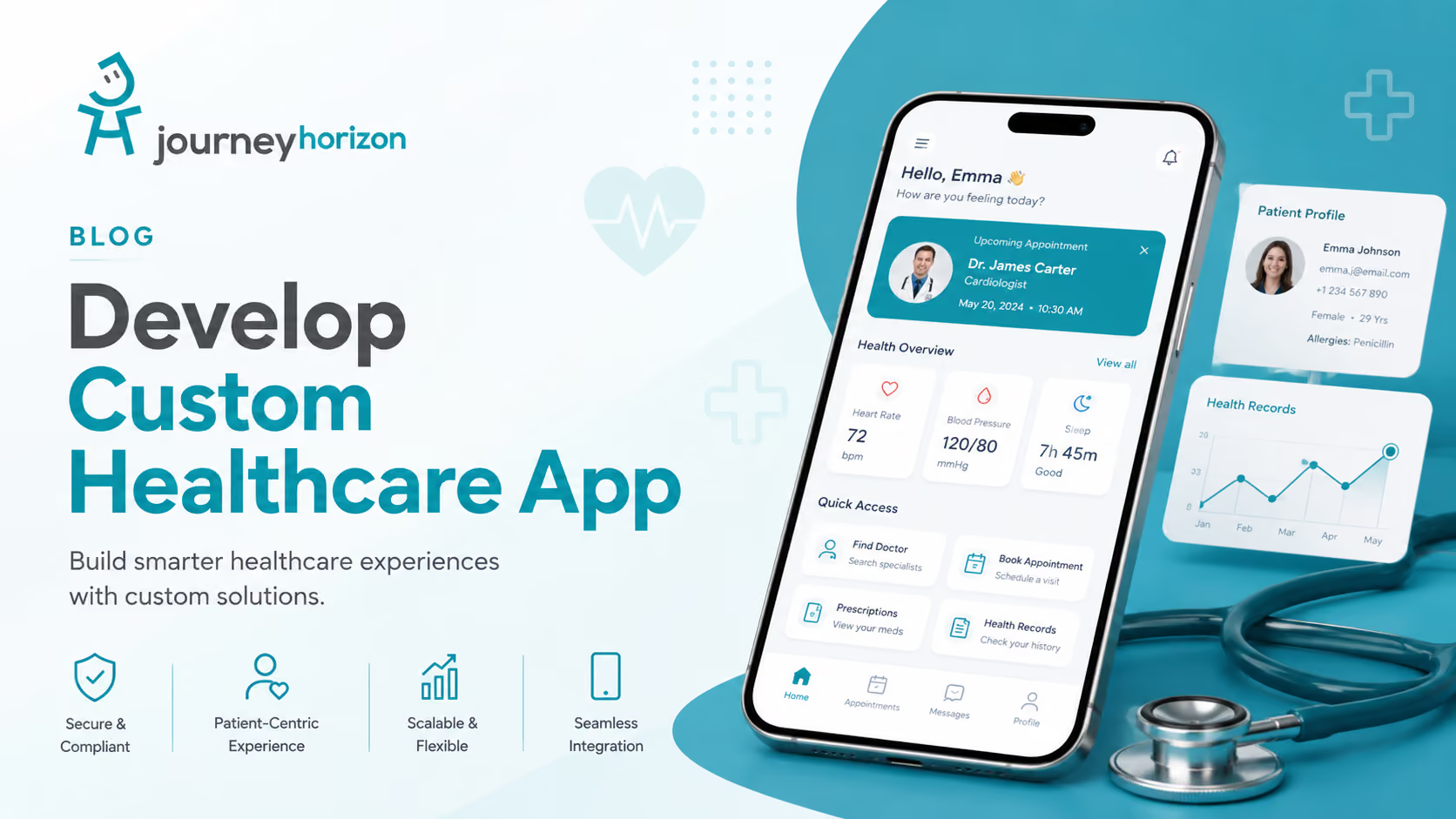
Healthcare organisations face a persistent problem: the software they use was designed for someone else's workflows. Whether you're managing a clinic, coordinating patient care, handling billing, or running a health-focused service business, off-the-shelf platforms often create friction instead of solving it. Patient data fragments across systems. Scheduling logic doesn't match your operational reality. Integration with your specific tools becomes a manual, error-prone workaround. As your organisation grows, these limitations become more costly to tolerate. Many healthcare leaders address this by working with partners like Journeyhorizon to build solutions tailored to their actual operations.
This is why many healthcare leaders decide to develop custom healthcare app solutions that reflect how their business actually works. A custom healthcare application isn't a generic software purchase. It's infrastructure built specifically around your operational reality. When designed thoughtfully, it reduces operational overhead, improves data accuracy, strengthens compliance posture, and ultimately delivers better outcomes for patients and your team.
The business case for custom healthcare app development
The decision to develop a custom healthcare app is fundamentally a business decision, not just a technical one. It sits alongside questions about practice efficiency, patient satisfaction, regulatory compliance, and long-term scalability.
Many healthcare businesses start with generic SaaS platforms. These tools work reasonably well at the beginning. But as the operation grows, the limitations become visible. A telemedicine provider might need appointment workflows that don't exist in standard systems. A managed care organisation might need custom reporting that combines patient, claims, and clinical data in ways no pre-built dashboard offers. A healthcare staffing agency might need a vendor and shift management system that reflects their specific labour model.
The financial story is straightforward. A growing healthcare organisation might pay for appointment software, EHR systems, billing platforms, patient communication tools, analytics dashboards, and internal workflow management tools. That's often five to ten separate subscriptions, each with per-user or per-facility costs. As the team expands, per-seat pricing becomes expensive. Features still don't fully match your workflows. Data fragments across platforms.
A single custom healthcare application that consolidates these functions can reduce subscription sprawl, eliminate manual handoffs between disconnected systems, improve data consistency, and provide the operational visibility that healthcare leaders actually need. The upfront investment is significant, but the long-term operational savings and capability improvements often justify the cost, especially for organisations with complex workflows or substantial team sizes.
When a custom healthcare app becomes necessary
Not every healthcare business needs a custom application. Small practices with simple workflows may do fine with standard tools. But several warning signs suggest that developing a custom healthcare app should be on your roadmap.
Your team is spending significant time on manual workarounds. Clinic coordinators spend hours every week moving data between systems, reconciling schedules, or entering the same information multiple times. This is a sign that your software is fighting your workflow instead of supporting it.
Your regulatory or compliance needs are specific. General-purpose EHR systems handle basic HIPAA requirements, but a specialised healthcare operation, research organisation, or integrated delivery network often has compliance needs that generic platforms don't address. Custom development lets you embed specific compliance logic directly into the application.
You need deep integration with other systems. Many healthcare businesses run alongside existing infrastructure: payment processors, insurance verification systems, referral networks, patient data registries, or operational dashboards. Custom apps can integrate seamlessly with these systems, whereas generic SaaS platforms often require brittle API glue or manual intervention.
You're paying more in subscriptions than in development. If your healthcare organisation is spending over £100,000 per year on overlapping tools, and your workflows remain fragmented, custom development becomes a reasonable alternative. The payback period can be two to four years, after which the custom system becomes pure operational advantage.
You need features that don't exist in commercial products. Some healthcare organisations operate with unique patient populations, delivery models, or operational priorities that standard platforms simply don't support. Custom development lets you build exactly what your operation needs.
Key capabilities for a custom healthcare application
When you decide to develop a custom healthcare app, what should you actually build? The answer depends on your specific operation, but several capabilities appear across most healthcare applications.
Patient management is foundational. This includes patient demographics, medical histories, appointment scheduling, communication preferences, and consent tracking. A custom patient management system reflects your clinic's specific workflow, not a one-size-fits-all template.
Clinical documentation and data capture must be efficient and compliant. Whether you're documenting patient visits, tracking treatment protocols, managing test results, or handling referrals, a custom system can streamline data entry, reduce errors, and ensure that clinical information flows correctly to the right people.
Scheduling and resource management becomes more intelligent. Custom apps can allocate staff, manage room bookings, handle telehealth sessions, and manage wait lists in ways specific to your operation. If you run a clinic with specific constraints, a custom solution adapts to your reality rather than forcing your operation into a predefined model.
Billing and financial management. Whether you bill insurance, manage copays, handle treatment payment plans, or track revenue by provider or clinic, a custom system can embed your specific billing logic, compliance requirements, and reporting needs.
Reporting and analytics. Healthcare leaders need visibility: patient volumes, wait times, clinical outcomes, staff productivity, financial performance, and compliance metrics. A custom app can deliver these insights in real time, tailored to how your leadership actually makes decisions.
Integration with external systems. Your custom app needs to communicate with labs, imaging centres, pharmacies, insurance systems, or government health networks. Custom development lets you build this interoperability directly into the core application.
Cost, timeline, and return on investment
Developing a custom healthcare app is a material investment. A modest system—perhaps a patient management and scheduling platform for a mid-sized clinic—might cost £80,000 to £200,000 to develop. A more comprehensive system with integrated billing, reporting, and clinical documentation could run £250,000 to £600,000 or more.
Timeline typically ranges from three to nine months for a complete custom application, depending on scope. This matters because delay in launching a custom healthcare app extends the period you're paying for existing subscriptions and accepting operational friction.
The ROI conversation is practical. If you're spending £150,000 per year on overlapping subscriptions, and a custom app costs £300,000 to build with three years of modest maintenance costs, you break even in roughly two years. After that, the same capability costs you a fraction of the subscription model. More importantly, you gain features and integrations that generic tools never offered.
Consider also the non-financial benefits: reduced manual work, faster decisions through better data, lower error rates, stronger compliance posture, and the ability to customise workflows as your organisation evolves. These operational improvements often deliver more value than the subscription savings alone.
Integration and interoperability
A custom healthcare app doesn't exist in isolation. It needs to work alongside existing systems: EHR platforms, pharmacy systems, lab information systems, imaging repositories, billing engines, insurance verification tools, or health information exchanges.
Custom development gives you the flexibility to build these integrations thoughtfully. Unlike a commercial platform, where you're limited to whatever APIs or connectors the vendor provides, a custom system can be designed to exchange data with your specific ecosystem.
This matters significantly for healthcare operations. A private practice might need to send referrals to a hospital system via a specific data standard. A telehealth provider might need to ingest clinical records from multiple EHR vendors. A diagnostic centre might need bidirectional integration with hundreds of referring providers. A custom app can handle these requirements directly.
Building these integrations requires careful attention to data security, HIPAA compliance, and operational reliability. This is why many healthcare organisations partner with development teams that understand healthcare infrastructure, not just generic software development.
Building software that fits the wider business model
For many healthcare organisations, a custom healthcare app works best when connected with broader operational and growth systems. Consider a mid-sized telehealth provider. The core custom app handles patient scheduling, clinical documentation, and visit management. But that app doesn't operate alone. It needs to connect with marketing systems that drive patient acquisition, content infrastructure that builds trust, analytics that measure clinical outcomes and patient satisfaction, and operations dashboards that the leadership team actually uses.
This is where Journeyhorizon's broader experience becomes valuable. Custom healthcare app development often works best when paired with related strategic thinking about integration, compliance infrastructure, operational automation, and growth planning. The goal isn't to build software in isolation, but to create a system that supports how the healthcare business actually operates and grows.
For example, a healthcare staffing agency might need a custom vendor matching and scheduling system, but also needs to integrate that system with CRM tools, payment processing, compliance tracking, and reporting dashboards. A diagnostic centre might need custom image analysis workflows, but also requires integration with referring provider networks, quality assurance systems, and clinical communication tools. Custom app development is most valuable when it connects to these wider operational needs.
Journeyhorizon works with healthcare organisations to design systems that do more than just manage individual processes. The approach is holistic: understanding the operational workflows, the integration requirements, the compliance constraints, and the growth goals, then building a custom healthcare application that serves all of these priorities simultaneously. The philosophy is simple: let's create a system that fits your business, not the other way around.
Moving forward
The decision to develop a custom healthcare app requires careful consideration of your operation's size, complexity, budget, and timeline. But for healthcare organisations that have outgrown generic platforms, that face specific workflow requirements, or that are paying too much for disconnected tools, custom development is increasingly the logical choice.
A thoughtfully built custom healthcare application reduces operational friction, improves data quality, strengthens compliance, and gives you the foundation for sustained growth. Whether you're building your first custom system or modernising an existing application, the goal remains the same: software that genuinely serves how your healthcare business works.
If you're exploring options for developing a custom healthcare app, the right partner matters. Journeyhorizon has deep experience building custom applications across healthcare, from patient-facing platforms to internal operational tools to integrated marketplace solutions. The team understands not just software development, but the operational reality of healthcare businesses, the compliance requirements, the integration complexity, and the connection between technology and commercial outcomes.

.avif)
